The decentralized finance (DeFi) and broader cryptocurrency sectors are currently facing an unprecedented wave of highly sophisticated, state-sponsored cyberattacks. Recently, leading blockchain investigation firms TRM Labs and Chainalysis have definitively attributed a massive string of recent cryptocurrency thefts to a specific North Korean hacking collective known as "TraderTraitor"
Background and Context
The Democratic People's Republic of Korea (DPRK) has long utilized state-sponsored cybercrime to bypass heavy international economic sanctions. Unlike traditional cybercriminals who steal data for ransom, DPRK operatives specifically target financial institutions to steal liquid capital. "TraderTraitor" is not a new entity; this specific group was previously highlighted and named in a highly publicized 2022 joint cybersecurity advisory issued by the FBI, CISA (Cybersecurity and Infrastructure Security Agency), and the US Treasury Department
Threat Overview
Key Definitions
- TraderTraitor: A North Korean state-sponsored advanced persistent threat (APT) group focused exclusively on stealing cryptocurrency assets to fund the DPRK regime
- Spear-Phishing: A highly targeted cyberattack in which perpetrators send customized, deceptive communications to specific individuals to install malware or steal credentials.
- Hot Wallet: A cryptocurrency wallet that is connected to the internet, making it highly liquid but inherently vulnerable to network-based attacks.
Fundamental Principles
The core operational principle of TraderTraitor is to bypass a company's external security perimeter entirely by compromising the humans who possess the keys to the internal kingdom. They achieve this by identifying and directly attacking high-value internal personnel
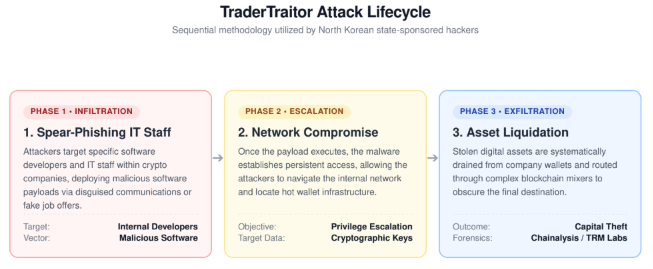
Figure 1. Step-by-step breakdown of the TraderTraitor cryptocurrency theft methodology.
Attack Mechanism and Methodology
Target Selection
TraderTraitor does not cast a wide net; they utilize a highly precise targeting matrix. According to the federal warnings and blockchain analytics, the hackers specifically target internal software developers and IT staff operating within cryptocurrency companies and exchanges
Infiltration Tactics
The group relies heavily on sophisticated social engineering campaigns. They often pose as legitimate recruiters offering lucrative job opportunities or as fellow developers sharing open-source tools. The ultimate goal of these interactions is to trick the targeted IT staff into downloading and executing malicious software payloads
Execution and Exfiltration
Once the malicious software is executed on an employee's machine, the malware establishes persistent access to the corporate network
Impact and Scale
The impact of TraderTraitor's operations is catastrophic for the targeted entities. Successful breaches routinely result in the loss of tens to hundreds of millions of dollars in liquid assets. Because blockchain transactions are immutable, recovering these stolen funds is exceptionally difficult once they have been funneled into DPRK-controlled wallets.
Detection and Mitigation
Defending against TraderTraitor requires a paradigm shift from traditional network security to rigorous identity and endpoint protection, particularly for developers.
- Zero-Trust Architecture: Companies must implement strict least-privilege access controls. Developers should not have default access to production hot wallets or sensitive key management systems.
- Advanced Endpoint Detection and Response (EDR): Because the initial vector is often disguised malicious software executed locally by IT staff
- Security Awareness Training: IT and development staff must undergo rigorous, specialized training regarding targeted recruitment scams and the dangers of executing unverified code from external sources.
Future Outlook
As the cryptocurrency market continues to mature and institutionalize, the volume of capital available for theft will only increase. Consequently, blockchain intelligence firms like TRM Labs and Chainalysis
Conclusion
The attribution of recent massive cryptocurrency heists to the North Korean "TraderTraitor" group by TRM Labs and Chainalysis underscores a critical reality: the greatest vulnerability in a Web3 company is often its own IT staff