How Mistral’s "Le Cheik" enables enterprises and governments to deploy autonomous, state-of-the-art security agents entirely on-premise without vendor lock-in.
Introduction
The global cybersecurity paradigm is currently experiencing a violent friction point: the absolute necessity of integrating large language models (LLMs) to combat automated threats, juxtaposed against the unacceptable risk of transmitting sensitive network telemetry to third-party cloud APIs. On October 30, 2026, French AI company Mistral catalyzed a structural shift in this landscape by releasing the open weights for its trillion-parameter AI model, Mistral Large 4 (ML4)
Background and Context
Historically, achieving top-tier AI reasoning required organizations to rely on closed-lab APIs. While these models are highly capable, routing Security Information and Event Management (SIEM) logs or internal codebases to an external server creates a massive data privacy exposure for highly regulated industries and national defense agencies. Prior open-source models offered local deployment to mitigate this risk, but they severely lacked the massive parameter count necessary for complex, autonomous reasoning in active, high-stress cyber defense scenarios.
Problem Statement
National cyber command centers and enterprise security operations centers (SOCs) require the cognitive bandwidth of trillion-parameter AI to identify and neutralize sophisticated threats in real-time. However, relying on proprietary API models introduces vendor kill-switches, fluctuating token costs, and strict compliance violations. The industry urgently requires an architecture that combines state-of-the-art analytical performance with the absolute privacy of an air-gapped, on-premise deployment.
Understanding the Core Concept
Key Definitions
Open-Weight Model: An AI architecture where the core mathematical parameters (weights) are publicly released, allowing organizations to download, modify, and run the system locally without third-party API dependencies.
Sovereign Cyber Defense: A localized security posture where threat detection, telemetry parsing, and automated remediation occur entirely on-premise, guaranteeing data privacy and operational continuity
ML4 ("Le Cheik"): Mistral's trillion-parameter large language model, uniquely optimized for high-efficiency agentic coding, reasoning, and security tasks
Fundamental Principles
The underlying principle of the ML4 release is structural autonomy. Pierre Stock, Vice President of Science at Mistral, emphasized that this release guarantees access cannot be cut off by a third-party provider, effectively eliminating vendor kill-switches
Supporting Visuals
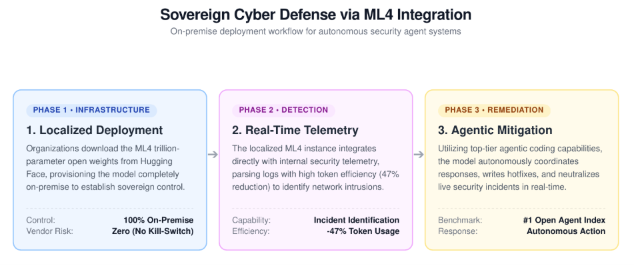
Figure 1. Sequential visualization of an air-gapped ML4 deployment executing autonomous cyber defense operations.
How It Works
Architecture / Components
ML4 operates at a massive trillion-parameter scale, providing reasoning capabilities that rival or exceed the largest closed-lab models on the market. The model weights are accessible directly via Hugging Face and Mistral's own API
Workflow / Process
To establish sovereign defense, organizations pull the ML4 weights from Hugging Face and provision them on their own internal GPU server clusters. Once localized, the model ingests real-time network logs and security telemetry directly from the organization's SIEM tools. Because the data never leaves the local network architecture, strict data sovereignty requirements are immediately satisfied.
Technical Explanation
ML4 distinguishes itself through extreme operational efficiency. According to Mistral, ML4 achieves state-of-the-art performance utilizing a mere fraction of the compute and capital required by closed labs
Practical Applications / Use Cases
Use Case 1: Real-Time Incident Coordination
Because ML4 possesses deep contextual reasoning, it is deployed to actively identify, coordinate, and respond in real-time to major security incidents
Use Case 2: Autonomous Agentic Mitigation
ML4 is heavily optimized for code generation and execution. Mistral claims the model currently outranks all other open models for agentic coding tasks on the Artificial Analysis Coding Agent Index
Benefits and Opportunities
The primary advantage of ML4 is the convergence of elite performance and absolute control. Organizations gain "state-of-the-art sovereign cyber defense capabilities" without the recurring, variable OpEx costs associated with API-based cloud models
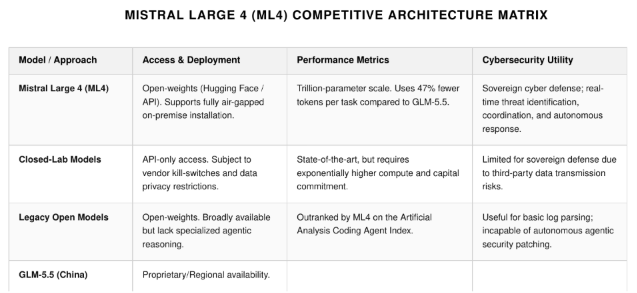
Figure 2. Architectural and performance comparison of ML4 against existing AI defense models.
Challenges and Limitations
Deploying a trillion-parameter model introduces severe hardware constraints; running ML4 on-premise requires massive upfront CapEx in high-end GPU infrastructure. Furthermore, granting an AI model autonomous agentic capabilities to alter network configurations or deploy code introduces significant operational risk. Pierre Stock openly acknowledged the inherent risks associated with "rogue AI agents" misinterpreting telemetry and executing destructive, unintended actions, though he maintains that establishing guardrails for this is a solvable engineering problem
Real-World Examples
While specific government defense deployments remain classified, the immediate availability of ML4 on platforms like Hugging Face allows national cyber command centers to instantly upgrade their air-gapped security operations
Future Outlook
The release of ML4 weights forces a paradigm shift in the enterprise AI industry. As open-weight models achieve strict parity with closed-lab systems in highly specialized tasks like agentic coding
Conclusion
Mistral's release of the ML4 ("Le Cheik") weights represents a definitive turning point in enterprise security architecture. By delivering a highly economical, trillion-parameter model that outranks competitors in agentic coding