When students think about future career opportunities, software development, artificial intelligence, data science and management often dominate the conversation. However, another area is steadily gaining importance: the green economy.
India's transition towards renewable energy, electric mobility, sustainable infrastructure and improved waste management is creating demand for professionals across engineering, manufacturing, research, technology and business. These opportunities are not limited to environmental scientists. Electrical engineers, software developers, data analysts, technicians and project managers can also build careers in this evolving sector.
The development is significant because the energy transition is becoming both an environmental priority and an employment opportunity. A 2026 study by CEEW and NRDC provides a closer look at the workforce already supporting India's clean-energy expansion and the skills that will be required as the sector grows.
Key Highlights
- Renewable energy: Solar and wind projects require engineers, technicians, installation specialists and maintenance professionals.
- Electric mobility: Battery technology, charging infrastructure and electric vehicle systems are creating specialised technical roles.
- Sustainable infrastructure: Green buildings, water management and waste treatment require engineering and operational expertise.
- Technology-driven opportunities: GIS, Python, data analytics and remote sensing are increasingly relevant to environmental monitoring.
- Employment potential: Selected clean-energy sectors added approximately 6.5 lakh workers between FY2023 and FY2026, according to CEEW–NRDC.
- Future skills: Technical knowledge, practical training, problem-solving and adaptability will be important across green industries.
Why Is the Green Economy Growing?
Economic development requires energy, infrastructure, transportation and manufacturing. At the same time, countries are under pressure to reduce emissions, improve energy efficiency and use natural resources more responsibly.
India is investing in renewable electricity, electric mobility, energy storage, green hydrogen and other sustainability-related initiatives. These developments require more than new equipment. They need professionals who can design systems, manufacture components, install infrastructure, analyse performance and maintain operations.
The International Labour Organization (ILO) describes green jobs as decent jobs that contribute to preserving or restoring the environment. Such roles can exist in traditional industries such as manufacturing and construction, as well as emerging sectors such as renewable energy and energy efficiency.
This means a green career is not necessarily defined by an environmental job title. What matters is the work's contribution to sustainability.
Technology Is Advancing Faster Than Workforce Readiness
Installing solar panels, developing electric vehicles and building energy-efficient infrastructure require skilled professionals. Yet having a technical degree does not automatically provide the practical experience needed to work with these systems.
For example, an electrical engineering graduate may understand power systems but still need specialised experience in solar installations, grid connections, battery storage or electrical safety. Similarly, a computer science graduate may understand data analytics but need domain knowledge to work with energy forecasting or environmental datasets.
This creates an important gap between academic learning and industry requirements. The growth of green industries will depend not only on investment in technology but also on training, practical exposure and accessible career pathways.
What Are Green Careers?
Green careers include professional roles that directly or indirectly support environmental sustainability. They can involve reducing emissions, improving energy efficiency, managing waste, protecting natural resources or developing cleaner technologies.
Consider three examples. A solar engineer helps generate renewable electricity, a battery specialist works on energy storage, and a data analyst may develop models to monitor energy consumption. Their responsibilities are different, but each can contribute to a more sustainable economy.
The field can be divided into several major areas:
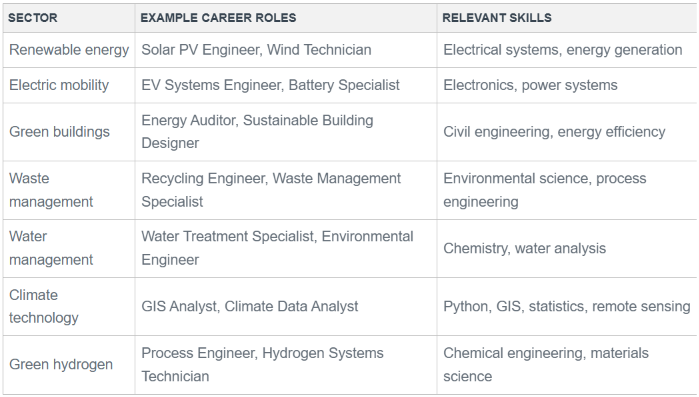
These are examples of possible career pathways, not guaranteed job openings. Actual qualifications and responsibilities depend on the employer and the specific role.
How Green Industries Create Employment
Green employment develops across the entire lifecycle of a project. Consider a solar power installation.
Stage 1 – Research and planning: Specialists evaluate the site, energy requirements, environmental conditions and project feasibility.
Stage 2 – Design and manufacturing: Engineers design systems, while manufacturers produce solar modules, electrical components and supporting equipment.
Stage 3 – Installation: Technicians, electricians and project teams install panels, inverters, wiring and grid connections.
Stage 4 – Operations and maintenance: Professionals monitor system performance, identify faults and carry out repairs.
Stage 5 – Recycling and resource recovery: As equipment reaches the end of its useful life, specialised processes are needed to recover materials and manage waste responsibly.
The same broad employment lifecycle can be seen in electric mobility, energy storage and other sustainable infrastructure projects. This is why opportunities extend beyond research and development into manufacturing, installation, maintenance, logistics and business operations.
Major Career Opportunities Students Should Explore
Renewable Energy and Solar Technology
Solar and wind energy are among India's established clean-energy sectors. Opportunities include solar PV design, electrical installation, system testing, project management and operations and maintenance.
Students from electrical, mechanical and electronics backgrounds can explore these areas, while diploma and vocational candidates may find specialised installation and technician pathways.
Electric Vehicles and Battery Technology
The growth of electric mobility creates demand for professionals working on battery systems, charging infrastructure, power electronics, vehicle components and battery management software.
Electrical, electronics, mechanical and chemical engineering students can explore these roles. Computer science graduates may also work on vehicle software, embedded systems, data platforms and charging-network applications.
Sustainable Buildings and Infrastructure
Buildings consume energy and water throughout their operational life. Sustainable construction focuses on improving energy efficiency, ventilation, lighting, water use and material selection.
Career options include energy auditing, green building design, building-services engineering and sustainability consulting. Civil and mechanical engineering students can find relevant technical foundations in this area.
Climate Data and Environmental Analytics
Environmental challenges increasingly require accurate information. Satellite observations, GIS, sensors and analytical models can help organisations monitor land, water, pollution and climate-related risks.
This creates opportunities for students with backgrounds in computer science, mathematics, statistics, geography and environmental science. Python, data visualisation, GIS and remote sensing are useful skills to explore.
Benefits and Employment Potential in India
The employment potential of the green economy is no longer just a future prediction. India's renewable-energy sector already supports a substantial workforce.
According to IRENA's Renewable Energy and Jobs: Annual Review 2025, published in January 2026, India had an estimated 1.28 million renewable-energy jobs in 2024. Hydropower represented the largest employment segment, followed by solar PV and biofuels.
A separate 2026 CEEW–NRDC study estimated that selected clean-energy sectors added approximately 657,845 workers between FY2023 and FY2026. Rooftop solar contributed around 62% of this workforce addition.
These figures show why green industries are worth exploring. They support employment in engineering, manufacturing, installation, maintenance, operations and technical services, rather than creating opportunities in only one profession.
Challenges and Limitations: What Should Students Know?
Despite the growth potential, green careers come with practical challenges.
- Specialised skill requirements: Several roles involve electrical safety, equipment handling, technical standards and field experience. Students may need additional practical training beyond their academic syllabus.
- Location and project requirements: Renewable-energy installations and manufacturing facilities may be concentrated in particular regions. Some roles also involve site visits, outdoor work or travel.
- Changing technologies: Battery systems, hydrogen technologies, energy storage and renewable-energy equipment continue to evolve. Professionals must keep updating their technical knowledge.
- Workforce inclusion: The transition also needs to create fair opportunities. The CEEW–NRDC study found that women represented only 11% of the surveyed workforce in solar and wind deployment and manufacturing. This highlights the need for better inclusion and career-development opportunities.
Green employment should therefore be evaluated like any other career. Students should examine compensation, working conditions, training, job responsibilities and long-term development instead of choosing a role simply because it carries a sustainability label.
Real-World Example: How Rooftop Solar Is Creating New Jobs
One of the most interesting findings from the 2026 CEEW–NRDC report concerns rooftop solar.
Unlike large solar power plants that operate at a single location, rooftop installations are distributed across homes, shops and commercial buildings. Each project can require customer coordination, site surveys, system design, installation, grid connection and maintenance.
The study estimates that rooftop solar generates approximately 44.68 full-time-equivalent job-years per megawatt, compared with 1 job-year per megawatt for ground-mounted solar. This is an employment-intensity comparison based on the study's methodology, not a statement that every rooftop project creates 44 permanent jobs for each megawatt.
The research also estimates that India's 500 GW non-fossil capacity target, together with the relevant National Green Hydrogen Mission goals, could generate more than 4.4 million full-time-equivalent jobs. This is a modelled estimate, not a guarantee of future vacancies or permanent employment.
The wider lesson is that the design and deployment of infrastructure can influence how many employment opportunities it creates.
How Can Students Start Building Green Skills?
Students do not need to change their entire academic direction to explore this sector. The better approach is to connect their existing skills with an industry that interests them.
- Engineering students: Explore electrical systems, renewable-energy equipment, battery technology, energy storage and sustainable infrastructure.
- Computer science students: Develop skills in Python, GIS, data analytics, embedded systems and environmental monitoring.
- Science students: Explore environmental science, chemistry, materials science, energy research and water management.
- Diploma and ITI candidates: Investigate technical training in solar installation, electrical maintenance and equipment operations.
Students can also explore recognised training institutions. The National Institute of Solar Energy (NISE), under the Ministry of New and Renewable Energy, implements the Suryamitra Skill Development Programme for eligible candidates interested in solar installation, operations and maintenance.
One important eligibility detail: the published Suryamitra programme criteria specify ITI or diploma qualifications in listed disciplines and state that candidates with a degree or higher qualification are not eligible for that particular programme. Students should check the latest official notices before applying rather than assume that every training programme accepts all academic backgrounds.
Official resource: NISE – Suryamitra Skill Development Programme.
Future Outlook: Which Green Technologies Are Worth Watching?
Several areas could expand the range of specialised green careers in the coming years.
- Green hydrogen: Research, production, storage and industrial applications could require chemical engineers, materials specialists and process technicians.
- Energy storage: Battery systems and other storage technologies will be important for balancing renewable electricity supply and demand.
- Electric mobility: Vehicle electrification and charging infrastructure can create opportunities in battery engineering, power electronics, embedded systems and network management.
- Circular economy: Recycling, repair, reuse and material recovery can support new business models and technical services.
- Climate and environmental data: GIS, remote sensing, sensors and AI can help organisations monitor environmental conditions and make better decisions.
The speed of this growth will depend on investment, policy implementation, technology costs and the availability of trained workers. Students should follow actual industry developments and job requirements rather than rely on predictions alone.
Conclusion: Building a Career That Contributes Beyond the Workplace
Green careers are expanding the definition of future employment. They connect engineering, technology, science, manufacturing and business with the need to build more sustainable systems.
India's renewable-energy workforce figures show that this transition is already supporting a significant number of jobs. Emerging areas such as energy storage, electric mobility and green hydrogen may create further opportunities as infrastructure and industrial capabilities develop.
For students, the best starting point is to identify a sector that matches their interests, build relevant technical skills and gain practical experience through projects, training or internships.
The next generation of careers will not only be about building new technologies. It will also be about building them responsibly.