The Structural AI Pivot
In a major structural adjustment to its global workforce, Microsoft has formally offered a Voluntary Exit Offer to roughly 60,000 employees operating in the United States, Canada, India, and the United Kingdom
This strategic move provides eligible personnel with financial and career transition support, allowing the technology giant to adapt its workforce demographics while simultaneously channeling heavy capital investments directly into artificial intelligence (AI) infrastructure
Disconnecting Buyouts from Automation Replacement
Microsoft's Chief People Officer, Amy Coleman, explicitly stated that the buyout offer was designed to provide organizations with the critical flexibility required to adjust their workforces to rapidly evolving needs
Crucially, Microsoft has not directly linked its AI infrastructure spending to the buyout offers, nor has the company indicated that AI is systematically replacing these 60,000 employees
Workforce Adjustment & AI Market Trends Matrix
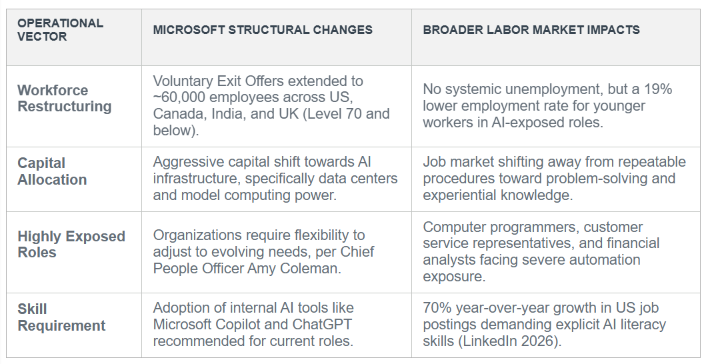
Figure 1. Analytical breakdown of Microsoft's voluntary buyout program versus global AI labor market shifts.
The Stanford and Anthropic Labor Market Research
Despite Microsoft's internal messaging, independent research paints a clear picture of an evolving labor landscape. Recent studies published by Anthropic and Stanford University reveal distinct shifts in the job market, characterized notably by a deceleration in hiring for younger workers occupying occupations highly exposed to AI
According to the data, roles heavily reliant on documented knowledge, repeatable procedures, and routine tasks—such as computer programmers, financial analysts, and customer service representatives—face the most significant exposure to AI automation
Interestingly, the studies found no immediate systemic increase in overall unemployment within these fields
The AI Labor Market Paradigm Shift
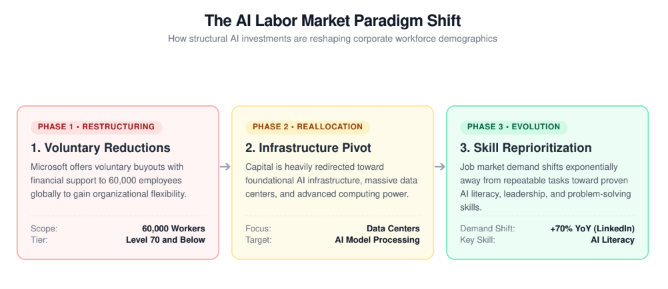
Figure 2. Sequential roadmap detailing the transition from legacy workforce models to AI-augmented requirements.
Adaptation and Skill Protection in 2026
As the market transitions, workers whose entire functional value relies on easily repeatable tasks will face considerably more disruption than those who possess deep expertise derived from nuanced experience and established relationships
To protect their career trajectories, current employees are strongly advised to adapt by proactively integrating AI tools—such as ChatGPT and Microsoft Copilot—into their daily workflows
Ultimately, building skills that extend beyond pure automation—such as complex problem-solving, demonstrable leadership, and proving measurable human value—remains the most effective strategy for long-term career protection in an increasingly AI-driven corporate environment
Expert FAQs
Who is eligible for the Microsoft voluntary buyout? The Voluntary Exit Offer, announced on October 26, is available to eligible employees operating at level 70 and below within participating teams across the United States, Canada, India, and the United Kingdom
Is Microsoft replacing these 60,000 workers with AI? Microsoft has explicitly stated that it is not directly linking its AI spending to these buyout offers, nor has the company indicated that artificial intelligence is directly replacing these specific employees
What roles are most exposed to AI automation? According to research by Anthropic and Stanford, roles heavily reliant on repetitive tasks and documented knowledge—specifically computer programmers, customer service representatives, and financial analysts—have significant AI exposure.
How should professionals protect their careers from AI automation? Professionals are advised to learn how to actively use AI tools like Microsoft Copilot and ChatGPT in their current roles to augment their productivity. Furthermore, developing skills that cannot be easily automated—such as leadership, relationship management, and complex problem-solving—is highly recommended for career protection.
Highlights
Global Restructuring: Microsoft has extended a Voluntary Exit Offer to approximately 60,000 eligible employees across four primary countries
Targeted Demographics: The program, announced on October 26, is specifically available to eligible staff at level 70 and below within participating teams
Infrastructure Capital Allocation: The company is aggressively investing capital into foundational AI infrastructure, including data centers and advanced computing power
Market Research Alignment: Current research indicates a noticeable slowdown in hiring rates for younger workers occupying roles heavily exposed to AI automation