The global deployment of generative artificial intelligence is rapidly fracturing along regional regulatory fault lines. While Western markets operate on a relatively unified AI infrastructure, penetrating the Chinese market requires strict adherence to localized data sovereignty and algorithmic compliance laws. Apple officially acknowledged this geopolitical reality by announcing the launch of "Apple Intelligence" features in China via the upcoming iOS 27.3 update
Background and Context
In July 2026, Apple Intelligence received official regulatory approval to operate within China, signaling the imminent launch of its AI tools
Problem Statement
The central challenge for Apple was delivering the core "Apple Intelligence" user experience—seamless generative text, intelligent image manipulation, and notification summarization—without violating China's strict generative AI regulations. The company needed to sever its reliance on Western AI infrastructure (specifically OpenAI) for this regional rollout, requiring both a bespoke, locally-trained foundation model and strategic partnerships with state-approved domestic AI providers.
Understanding the Core Concept
Key Definitions
Apple Intelligence (China Edition): A localized iteration of Apple's AI suite, running on a custom LLM trained specifically to comply with Chinese data regulations
iOS 27.3: The specific operating system update carrying the localized Apple Intelligence payload to the Chinese market
Alibaba Qwen: A state-approved Chinese generative AI model serving as the regional replacement for OpenAI's ChatGPT within the iOS ecosystem
Fundamental Principles
The underlying principle of this deployment is architectural segregation. Rather than attempting a "one-size-fits-all" global AI model, Apple has embraced regional fragmentation, deploying distinct technological stacks based on local legal frameworks.
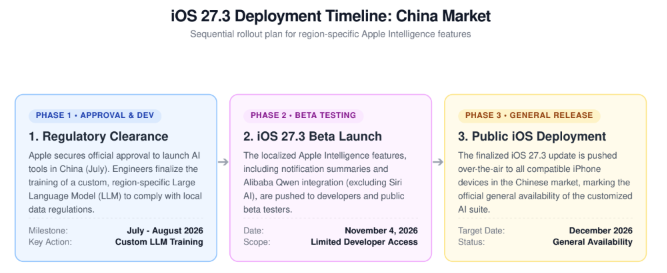
Figure 1. Sequential roadmap detailing the regulatory approval and deployment of Apple Intelligence in China.
How It Works
Architecture / Components
The Chinese implementation of Apple Intelligence relies on two primary components:
The Custom Apple LLM: An in-house model trained specifically for China to handle on-device tasks like summarization and image processing
The Alibaba Integration: For complex, web-connected generative tasks, Apple has integrated support for Alibaba’s Qwen chatbot
Workflow / Process
Apple announced the rollout strategy via its Chinese newsroom website
November 4, 2026: The localized Apple Intelligence features will first become available in an exclusive iOS 27.3 beta release
December 2026: Following beta testing, a full, public iOS 27.3 release is scheduled for general availability across China
Technical Explanation
Crucially, this initial launch explicitly excludes the highly anticipated "new Siri AI"
Practical Applications / Use Cases
Despite the omission of the new Siri AI, the iOS 27.3 update delivers a robust suite of practical AI applications native to the device
Generative Text: Users gain access to intelligent notification summaries, automated rewriting, and advanced proofreading tools
Visual Intelligence: The update includes tools to intelligently identify and remove unwanted objects from photos
Chatbot Queries: Users can route complex queries directly to the integrated Alibaba Qwen chatbot natively through the OS
Benefits and Opportunities
By successfully navigating Chinese AI regulations, Apple secures its competitive positioning in a vital market where domestic smartphone manufacturers (like Huawei and Xiaomi) are already deeply integrating local AI models into their hardware. The integration with Alibaba's Qwen
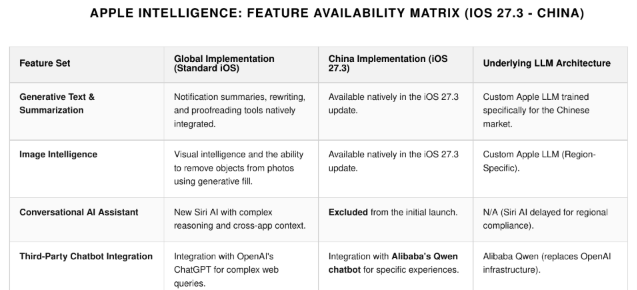
Figure 2. Architectural and feature comparison of Apple Intelligence deployment in China versus global markets.
Challenges and Limitations
The primary limitation of this deployment is feature parity. Chinese consumers purchasing the latest iPhone hardware will not have access to the flagship "new Siri AI" that is heavily marketed globally
Future Outlook
The deployment of iOS 27.3 establishes a precedent for how global technology companies must handle AI deployment in a fractured regulatory environment. Moving forward, it is highly likely that Apple will eventually secure approval for a localized version of the new Siri AI, but this will require further integration with domestic Chinese cloud providers to handle the massive compute required for conversational reasoning.
Conclusion
Apple's localized launch of Apple Intelligence via iOS 27.3