The global cybersecurity landscape recently faced a severe test when attackers successfully exploited two PHP remote code execution (RCE) vulnerabilities—collectively dubbed PHP2Shell—four days before official patches were even released
Background and Context
The PHP2Shell flaws are not new architectural errors; they have existed within PHP's underlying code since 2012
Understanding the Core Concept
Key Definitions
- PHP2Shell: A pair of severe remote code execution (RCE) vulnerabilities embedded in PHP code since 2012, jointly disclosed with OpenAI
- Remediation Gap: The mathematical delta between when a vulnerability is actively exploited in the wild and when enterprise IT teams successfully apply the patch across all exposed endpoints.
Fundamental Principles
The core principle demonstrated by PHP2Shell is that vulnerability severity scores (like CVSS) are only part of the threat equation. Beyond the initial RCE exploitation, the true severity of an incident relies entirely on the access permissions of the compromised service accounts, API keys, cloud roles, and identity tokens
Supporting Visuals
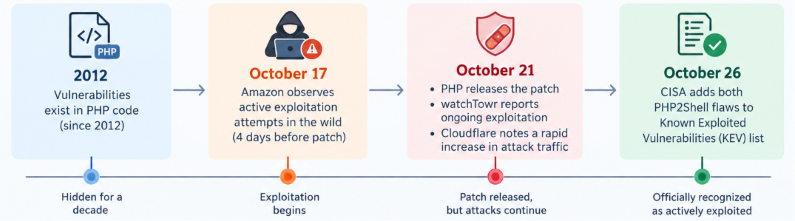
Figure 1. Sequential timeline detailing the rapid escalation of the PHP2Shell threat landscape.
How It Works
Architecture / Components
Attackers utilize the PHP2Shell vulnerability to gain an initial foothold on a target server. However, the architecture of the attack rapidly shifts from exploiting code to exploiting identity. Once inside, threat actors actively hunt for leaked credentials, master keys, or unscoped tokens to subvert workflows
Workflow / Process
The exploitation timeline moved faster than standard enterprise defense cadences:
October 17: Amazon observed active exploitation attempts in the wild, four days prior to public disclosure
October 21: PHP officially released the patch. On the exact same day, watchTowr reported ongoing exploitation attempts, while Cloudflare noted a rapid, massive escalation in attack traffic
October 26: The Cybersecurity and Infrastructure Security Agency (CISA) officially added both PHP2Shell flaws to its Known Exploited Vulnerabilities (KEV) list
Technical Explanation
The challenge with PHP2Shell lies in its deployment architecture. Remediation is severely compounded because PHP frequently ships deeply embedded within third-party appliances and hosting control panels
Practical Applications
Use Case 1: Exploiting Leaked Credentials
Attackers inherently seek the path of least resistance. Rather than chaining multiple complex zero-day vulnerabilities, threat actors use an initial RCE like PHP2Shell to scan environments for leaked credentials and hardcoded API keys, escalating their privileges instantly
Use Case 2: Subverting Release Workflows
Once identity is compromised, attackers can take over core infrastructure. By acquiring unscoped organization-owner tokens, threat actors can actively subvert software release workflows to publish their own credential-stealing artifacts into legitimate supply chains
Benefits and Opportunities
The PHP2Shell crisis presents a distinct opportunity for organizations to pivot their security posture toward Identity and Access Management (IAM). Recognizing that perimeter breaches are inevitable, companies can implement specialized agent security. For example, platforms like Token Security offer AI Agent Security to specifically identify automated agents, link them directly to their human owners, and strictly restrict their capabilities and token scopes
Challenges and Limitations
The primary limitation in combating PHP2Shell is the sheer volume of legacy exposure and the slow speed of enterprise patching.
The Patching Lag: According to Verizon’s 2026 DBIR, the median time to fix a known exploited vulnerability is 43 days
Open Vulnerabilities: Qualys data indicates that 63 percent of critical vulnerabilities remain completely open after a week, featuring a mean remediation time of 21.2 days
Legacy Abandonment: Compounding the issue, PHP versions 8.1 and older did not receive official patch builds
Mass Exposure: As a result of these factors, Censys reported a staggering 32.5 million internet-facing PHP services were still running potentially vulnerable versions as late as October 27
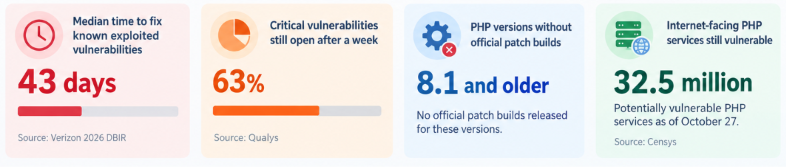
Figure 2. Analytical breakdown of vulnerability exposure metrics versus organizational remediation capabilities.
Real-World Examples
A pristine real-world example of how identity dictates severity is the recent incident at LiteLLM. Attackers did not rely on complex zero-day chaining; instead, they utilized a master key that was inadvertently exposed in a public repository
Future Outlook
The timeline from vulnerability discovery to active exploitation is shrinking to zero. As AI models continue to assist in uncovering legacy flaws embedded deep within ubiquitous codebases (like the 2012 PHP code), the volume of zero-day threats will increase
Conclusion
The PHP2Shell zero-day exploit serves as a critical warning for the modern enterprise. When threat actors can exploit a vulnerability four days before a patch exists, and organizations take an average of 43 days to apply that patch, the traditional perimeter defense model is mathematically obsolete