Robots are no longer limited to science-fiction films or experimental research laboratories. They are increasingly becoming part of modern manufacturing, healthcare, logistics, agriculture and other industries. From assembling automotive components to assisting surgeons and transporting materials inside warehouses, robotic systems are changing how physical work is performed.
India is also becoming an important part of this transformation. According to the International Federation of Robotics (IFR), the country installed approximately 10,500 industrial robots in 2025, recording 15% growth over the previous year. For students, this development raises an interesting question: what does the expansion of robotics mean for future careers, engineering skills and the next generation of technology professionals?
Key Highlights
- India's robotics growth: Approximately 10,500 industrial robots were installed in India during 2025, placing the country sixth worldwide.
- Global expansion: Around five million industrial robots were operating in factories worldwide in 2025.
- Beyond manufacturing: Robotics is expanding into healthcare, logistics, agriculture, inspection and professional services.
- Human-robot collaboration: Collaborative robots, commonly called cobots, are designed for applications involving interaction with human workers.
- Emerging careers: Robotics engineering, automation programming, machine vision, control systems and robot integration offer specialised career pathways.
- Government initiatives: India's Skill India Mission includes future-skills training and robotics-related opportunities through technical education and apprenticeship programmes.
Why Is Robotics Becoming Important?
Traditional manufacturing has relied heavily on human-operated machinery and fixed production processes. Although these methods remain important, industries increasingly require greater precision, consistency, productivity and flexibility.
Robotic systems help address these requirements by performing repetitive, physically demanding or highly controlled operations. Their capabilities have also expanded through improvements in sensors, computing, computer vision and artificial intelligence.
According to the IFR's September 2026 report, factories worldwide installed more than 600,000 new industrial robots during 2025. The global operational stock reached approximately five million units, demonstrating how automation is becoming an established part of industrial infrastructure.
India's increasing installations reflect growing adoption within its manufacturing ecosystem, although the country still has considerable room to expand compared with the world's largest automation markets.
The Problem: Traditional Automation Has Its Limitations
Not every industrial process can be automated using a conventional machine. Some production environments involve changing product designs, irregular objects, complex movements and tasks that require continuous human judgement.
A fixed automation system may perform one operation extremely well but struggle when the production requirements change. Integrating several machines can also require complex programming, additional infrastructure and specialised maintenance.
Modern robotics attempts to address these limitations through programmable systems, improved sensing and more flexible automation. However, introducing robots creates new challenges involving investment, workforce training, safety and system integration.
Understanding the Core Technology: What Are Robotics and Automation?
Robotics and automation are related, but they are not the same thing.
Automation refers to using technology to perform tasks with reduced human intervention. It includes everything from simple conveyor-belt control systems to complex industrial production lines.
Robotics involves machines designed to perform physical tasks through mechanical movement, sensors and control systems. Some robots operate independently within a programmed environment, while others work under continuous human supervision.
Major Types of Robotic Systems
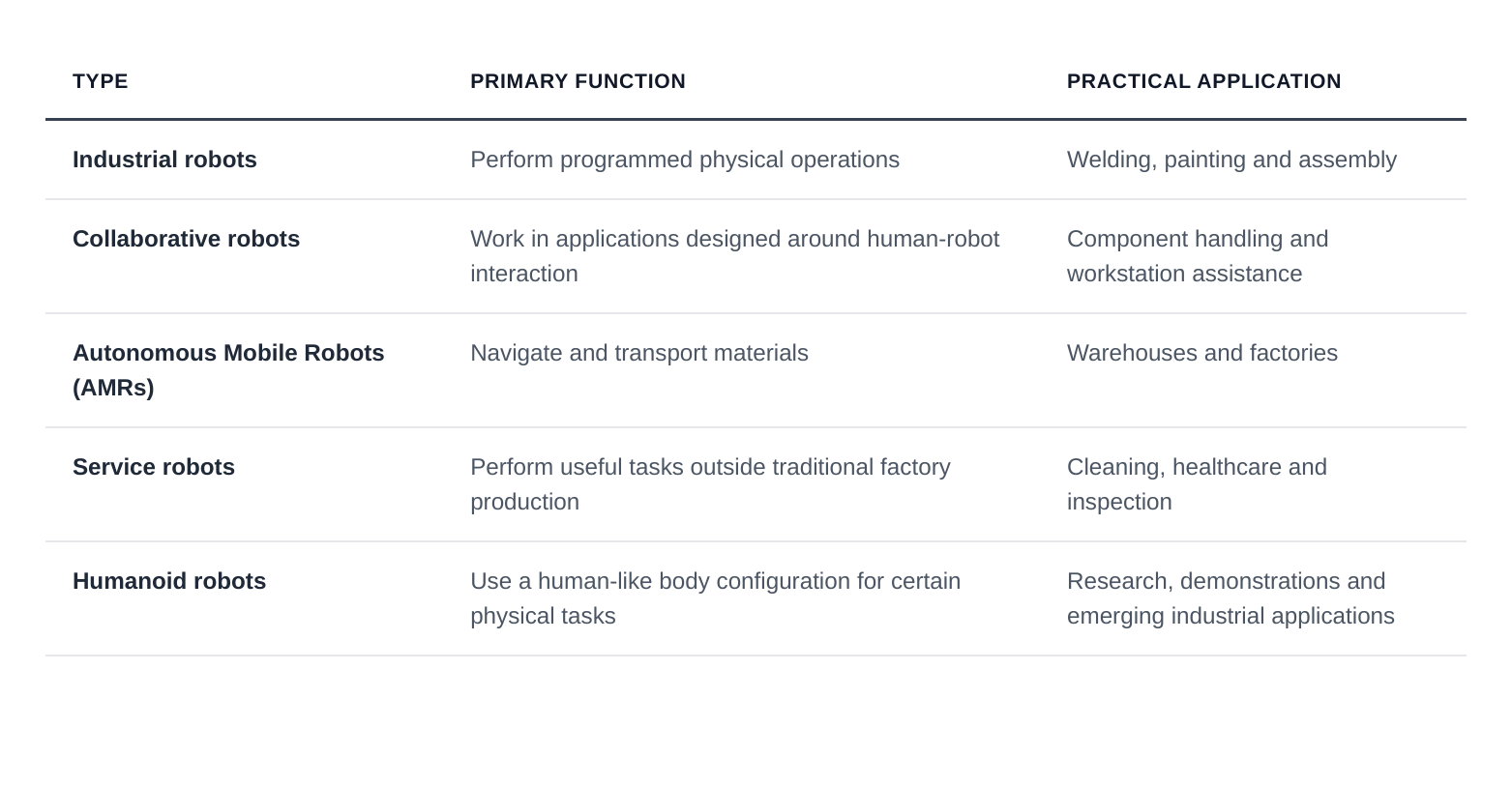
An important distinction is that not every robot requires artificial intelligence. Many industrial robots operate using predefined programmes, sensors and motion controllers. AI becomes relevant when a system needs capabilities such as object recognition, adaptive decision-making or learning from data.
How Does an Industrial Robot Actually Work?
An industrial robotic system is more than a mechanical arm. It combines hardware, software and safety mechanisms to perform a specific operation.
Its major components include:
- Robot arm: Provides the mechanical movement required to perform an operation.
- End effector: The tool attached to the robot, such as a gripper, welding torch or suction mechanism.
- Sensors: Collect information about position, distance, force and surrounding conditions.
- Controller: Processes instructions and coordinates the robot's movements.
- PLC: A Programmable Logic Controller that manages industrial equipment and coordinates different machines.
- Vision system: Cameras and image-processing software that help identify objects or inspect products.
- Safety system: Protective devices, interlocks and monitoring mechanisms designed to reduce operational risks.
A Typical Robotic Workflow
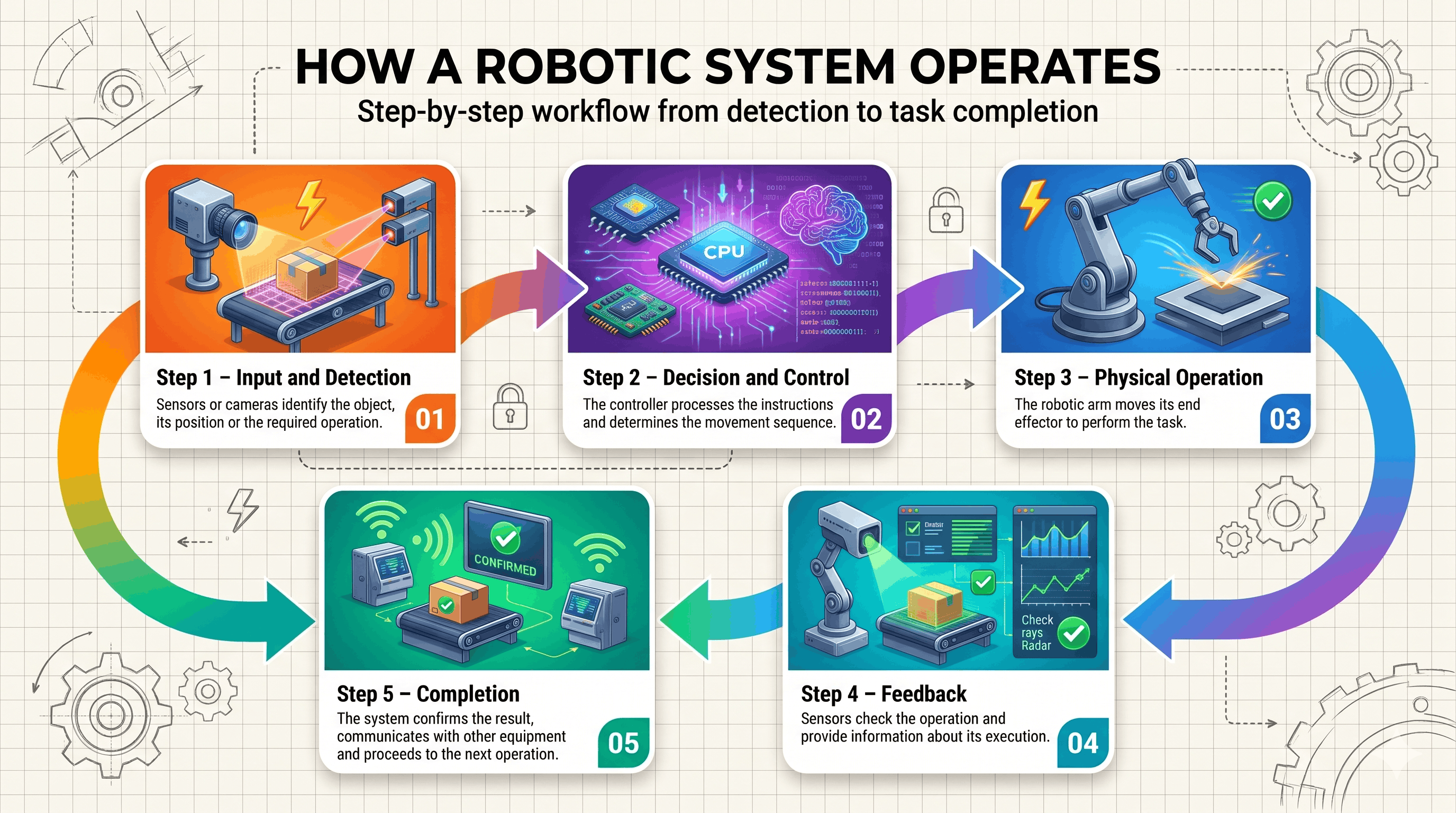
For example, in an automotive assembly line, a robot can identify the required position, pick up a component and place it at a designated location. The controller coordinates the movement while sensors and safety systems help ensure that the operation takes place within defined conditions.
Where Are Robots Being Used?
1. Automotive Manufacturing
Automotive production is one of the major areas of industrial robot adoption. Robots are used for welding, painting, material handling and component assembly, where repeatability and precision are important.
2.Healthcare and Medical Technology
Robotic systems support applications such as minimally invasive surgery, rehabilitation, laboratory automation and hospital logistics. In many cases, specialised robots assist medical professionals rather than independently replacing clinical judgement.
3.Warehousing and Logistics
Autonomous mobile robots help transport materials between storage areas, picking stations and production zones. They can work alongside warehouse-management systems to improve the movement of goods.
4.Agriculture
Agricultural robotics includes automated harvesting equipment, field-monitoring systems, precision spraying and autonomous machinery. These technologies can support operations where labour availability, crop conditions or large-scale monitoring create challenges.
5.Electronics and Semiconductor Manufacturing
Electronics production requires precise handling, component placement and inspection. Industrial robots and automated assembly systems support these operations, particularly where small components and repeatable processes are involved.
Why Industries Are Investing in Robotics
Robotic automation can improve production consistency by executing programmed tasks repeatedly with controlled movements. This is particularly useful for operations involving precision, repetitive handling or demanding working conditions.
It can also help organisations improve operational efficiency, monitor production quality and reduce workers' exposure to certain hazardous tasks. In flexible production environments, programmable robots can be reconfigured for different operations, although this requires suitable equipment and engineering support.
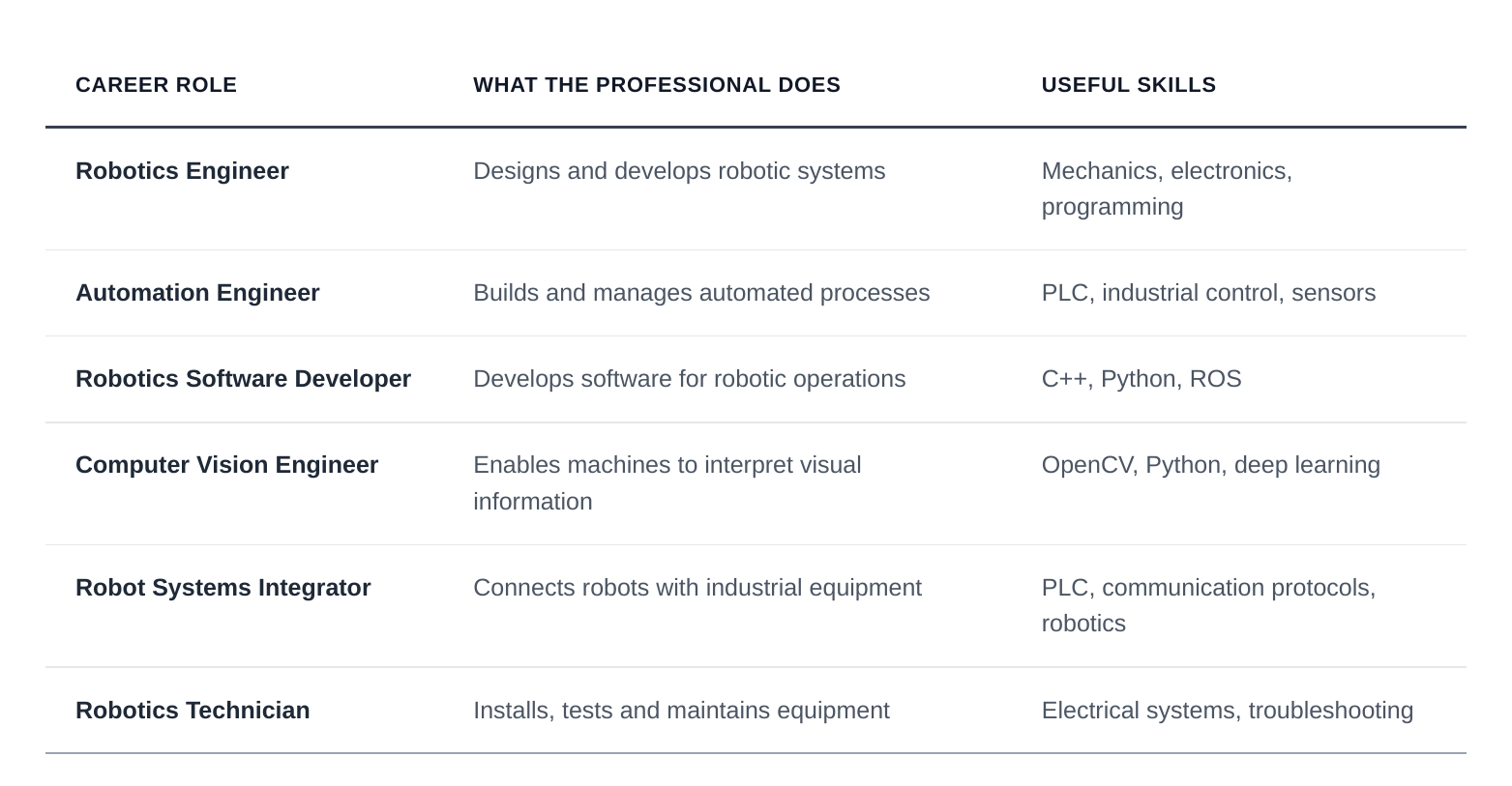
For students, the expansion of robotics creates opportunities beyond designing robots themselves. Companies also need professionals who can integrate automation systems, write control software, maintain equipment, develop sensors and analyse machine data.
Challenges and Limitations
Robotics offers significant advantages, but implementation is not always straightforward.
- High initial investment: Industrial robots require capital expenditure for equipment, installation, integration and supporting infrastructure. Smaller manufacturers may find these costs difficult to justify.
- Technical complexity: A robotic system must work with existing production equipment, software and safety mechanisms. Poor integration can reduce efficiency rather than improve it.
- Maintenance requirements: Mechanical wear, sensor failures, programming errors and component replacement require trained professionals and planned maintenance.
- Workforce transition: Automation changes the nature of certain tasks. Workers may need reskilling to operate, supervise and maintain modern equipment.
- Safety considerations: Robots can create physical hazards if their movement areas, force, speed and interaction with people are not properly controlled. Risk assessments and appropriate safeguards are essential, especially in collaborative applications.
The broader lesson is that successful automation requires people, processes and technology to work together.
India's Robotics Market Is Expanding
India's progress in industrial automation is visible in the latest IFR figures. Its World Robotics 2026 report records approximately 10,500 industrial robot installations during 2025, a 15% increase over 2024. This placed India sixth globally in annual industrial robot installations.
Another development came in May 2026, when Yamaha Motor announced the opening of a Robotics Business Support Division in Gurugram, Haryana. The facility was established to strengthen its robotics sales and service operations in the Indian market.
Its initial focus includes Surface Mount Technology (SMT) assembly systems and industrial robots. Yamaha also introduced a showroom where customers can experience its robotics products and understand how they can address production requirements.
This development is significant because robotics adoption requires more than purchasing machines. Manufacturers also need local technical support, demonstrations, integration expertise and maintenance services.
Career Opportunities: What Should Students Learn?
Robotics is an interdisciplinary field. It combines mechanical engineering, electronics, programming, control systems and computer science. Students can enter the industry through different academic and technical pathways.
A Practical Learning Roadmap
Students can begin with programming fundamentals using Python or C++, followed by electronics, sensors, motors and basic control systems. Once these foundations are clear, they can explore robotics frameworks, simulation environments and computer vision.
A useful progression is:
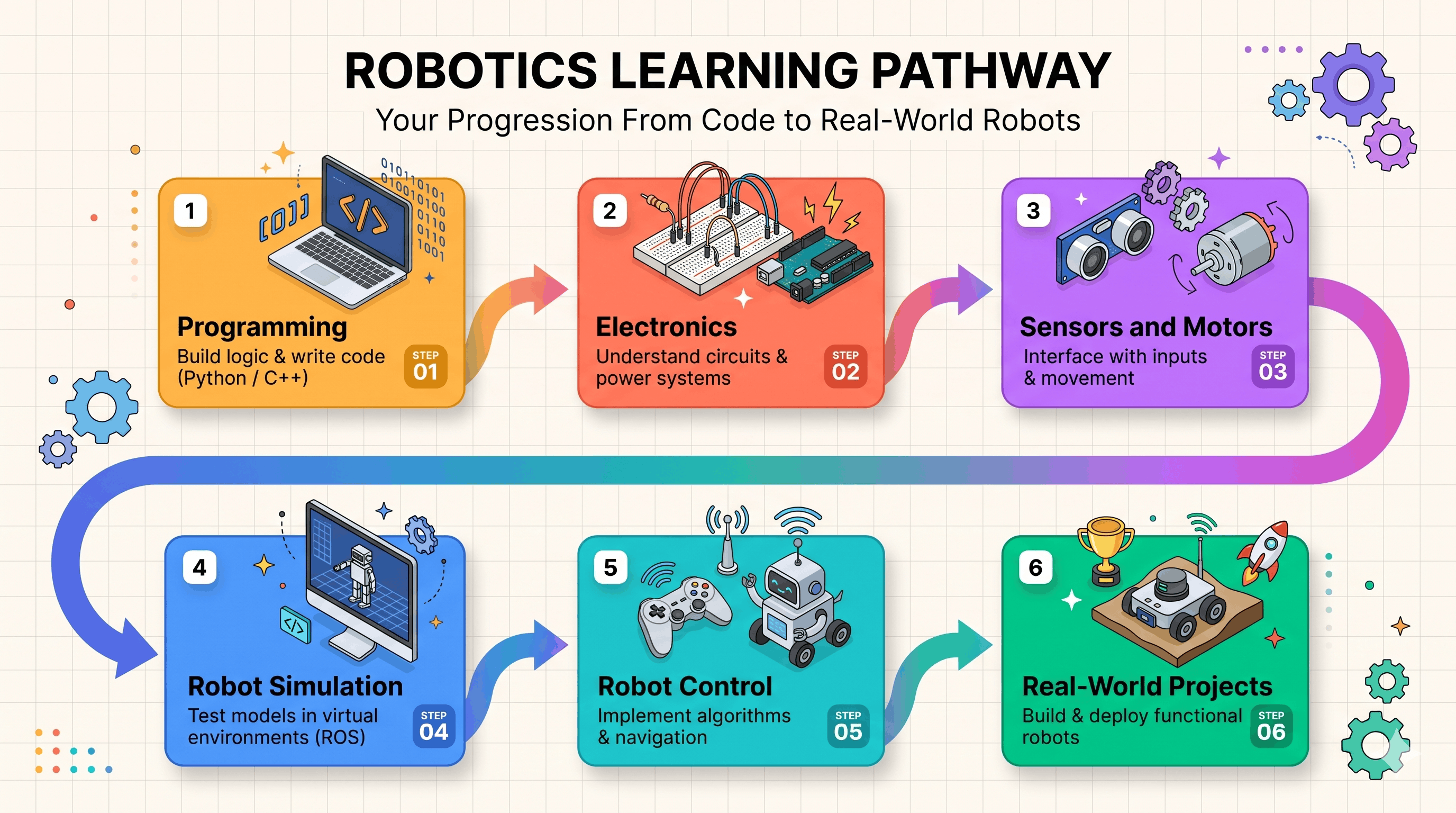
One accessible starting point is to build a small obstacle-avoiding robot or a line-following robot. Students can then move towards robotic-arm simulation, object detection and autonomous navigation.
Government Skill Development and Learning Resources
India has started integrating robotics and other emerging technologies into its skill-development ecosystem.
In a March 2026 parliamentary response, the Ministry of Skill Development and Entrepreneurship outlined several initiatives:
- PMKVY 4.0 includes dedicated job roles under its Future Skills category.
- Apprenticeship training includes robotics-related trades.
- The Directorate General of Training has introduced new-age courses in areas including mechatronics and other emerging technologies.
- The Skill India Digital Hub provides access to industry-relevant learning and skill-development resources.
The Directorate General of Training also lists an Industrial Robotics and Digital Manufacturing Technician trade. The published course information specifies a one-year duration of 1,200 hours and eligibility for candidates who have passed Class 10.
Students should check the latest admission notices, available institutes and course conditions before applying.
Future Outlook: What Comes After Industrial Robots?
The next phase of robotics will involve more flexible machines capable of responding to changing environments.
- AI-powered robotics: Machine learning and computer vision can help robots recognise objects, understand visual information and adapt to certain variations in tasks.
- Collaborative robotics: Cobots may support more flexible workstations by operating in applications designed around human-robot interaction and appropriate safety measures.
- Autonomous mobile systems: AMRs are becoming important for material movement, inspection and logistics operations.
- Humanoid robotics: Human-shaped robots are attracting attention because their form could potentially allow them to operate in environments designed for people. However, widespread deployment still faces challenges involving reliability, cost, safety and practical task performance.
These developments are not guaranteed to transform every industry at the same speed. Adoption will depend on cost, technical maturity, safety requirements and measurable business value.
Conclusion: The Future of Robotics Needs Skilled People
Robotics and automation are changing how industries approach manufacturing, logistics, healthcare and other physical operations. India's growing industrial robot installations and investment in robotics-related skill development show that the field deserves attention from students planning technology-oriented careers.
However, the future is not simply about building machines that replace human effort. It is also about developing professionals who can design, programme, integrate, maintain and improve these systems.
For students, learning programming, electronics, control systems and practical robotics can provide a useful foundation. The opportunity is not limited to creating robots; it also lies in building the technology that makes them useful.