Anthropic’s latest Sonnet 5 model could become a serious talking point for users who currently rely on Claude Opus.
The new model is now the default option for Free and Pro users, and Anthropic is positioning it as its most agentic Sonnet model so far.
In simpler terms, it is designed to work more independently, handle tasks better, and reduce the performance gap with Opus 4.8 across coding, reasoning, and tool-use benchmarks.
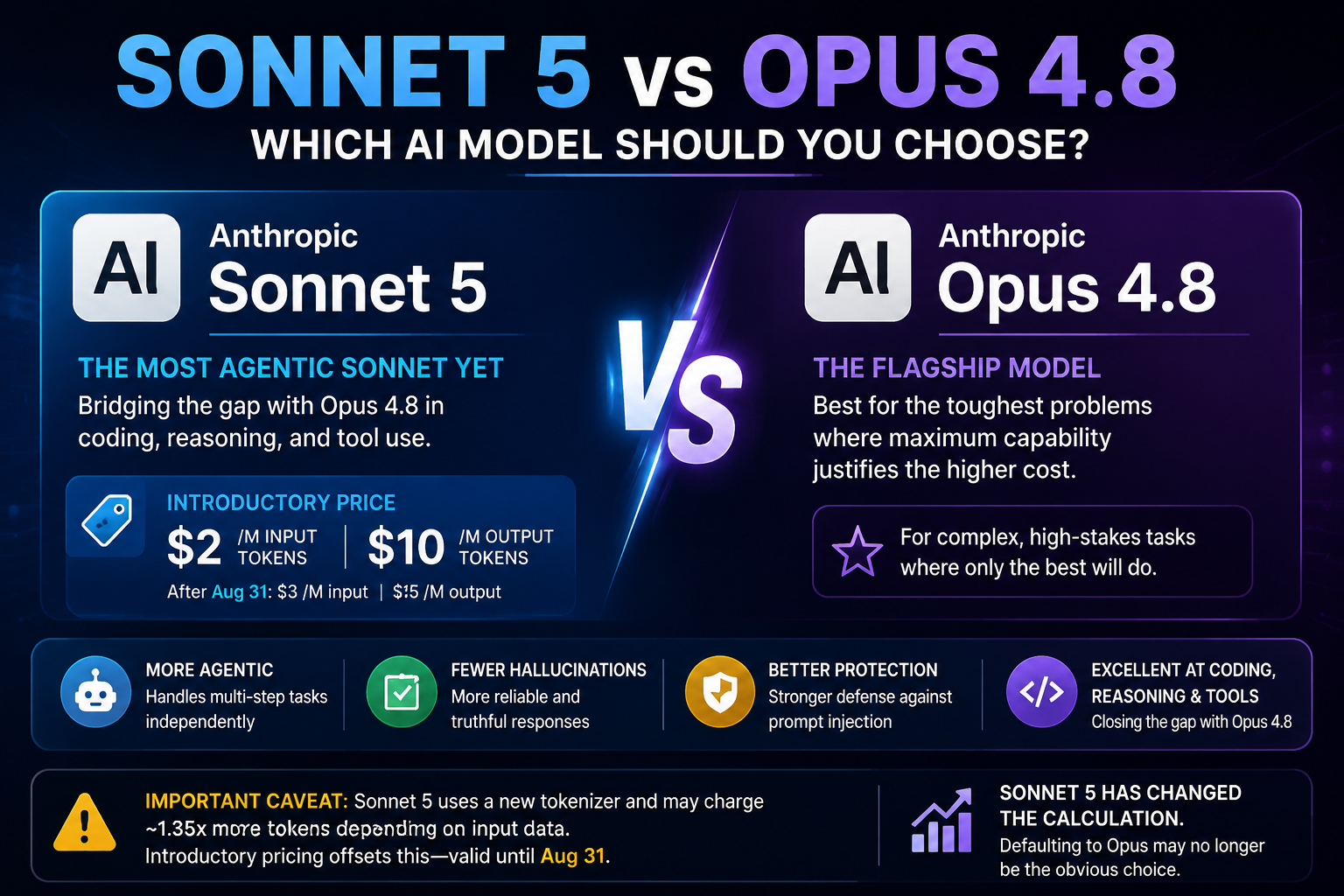
The biggest attraction is the price. Sonnet 5 is being offered at an introductory rate of $2 per million input tokens and $10 per million output tokens.
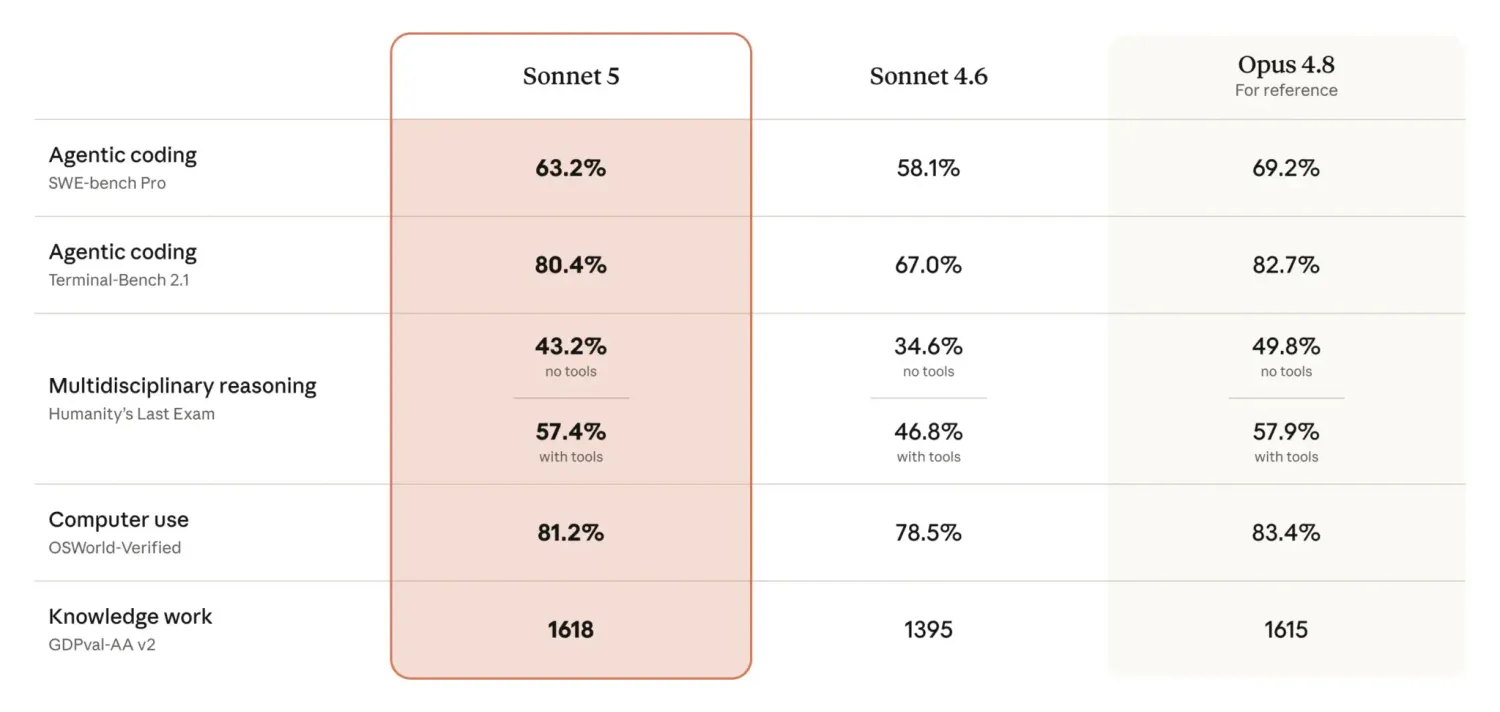
After August 31, this will increase to $3 and $15, respectively. Even then, it remains significantly cheaper than Opus 4.8.
But the real story is not just about benchmark numbers.
According to Anthropic, Sonnet 5 can manage multi-step reasoning tasks with more independence.
It can create its own tests, fix issues, and carry out agent-like work when given a task.
This matters a lot for developers and Claude Code users because there is a major difference between a model that simply responds to prompts and one that can actually be trusted with delegated work.
Anthropic also claims that Sonnet 5 has fewer hallucinations, is less sycophantic, and offers stronger protection against prompt injection.
These improvements could make it more reliable for everyday coding, editing, research, and workflow automation tasks.
That said, Opus 4.8 still has its place.
For the most complex problems, where maximum capability matters more than cost, Opus remains the stronger choice.
It is better suited for tasks where even a small improvement in reasoning or accuracy can justify the higher price.
However, for most routine programming, editing, and agent-based use cases, Sonnet 5 may be hard to ignore.
If it delivers quality close to Opus 4.8 at a much lower cost, many teams may start questioning whether they really need to default to the flagship model every time.
There is one important catch for API users.
Sonnet 5 uses a new tokenizer, which could result in around 1.35 times more tokens depending on the input data.
This may reduce some of the expected savings.
Anthropic appears to have balanced this during the introductory pricing period, but that benefit will end after August 31.
For now, Opus 4.8 has not been replaced.
But Sonnet 5 has clearly changed the value equation.
Unless users have a specific reason to choose the most powerful model, automatically picking Opus may no longer feel like the obvious decision.