Anthropic has officially launched Claude Opus 5, a highly capable new foundation model engineered to serve as an “everyday” assistant for knowledge workers and developers. Designed to bridge the gap between premium performance and operational affordability, Opus 5 delivers capabilities approaching the flagship Claude Fable 5 but at half the cost. By introducing unprecedented autonomy, advanced scientific reasoning, and a unique set of developer tools—including an adjustable “thinking” dial and dynamic fallback protocols— Anthropic is signaling that the next phase of enterprise artificial intelligence will prioritize cost-efficient execution just as much as raw intellectual power.
The Bigger Picture
The battle for artificial intelligence supremacy is no longer just about building the most massive model; it is about building the most practical one. Over the past month, the industry has seen a flurry of releases from the dominant trio: Google, OpenAI, and Anthropic. Rather than simply chasing higher parameter counts, these organizations are aggressively focusing on efficiency, speed, and unit economics. While flagship models remain necessary for bleeding-edge research, everyday enterprise workflows demand a different kind of architecture. Businesses need AI that can write secure code, summarize documents, and execute autonomous tasks without incurring astronomical API costs. With the release of Claude Opus 5, Anthropic aims to provide exactly that: a highly secure, aggressively priced model that does not compromise on the complex reasoning required for serious enterprise integration.
What Is Claude Opus 5?
Claude Opus 5 is Anthropic’s newest entry in its large language model lineup, positioned specifically as a high-performance, everyday assistant. While Claude Fable 5 retains its crown as the company’s most “ambitious” and intellectually expansive creation, Opus 5 is engineered for the trenches of daily knowledge work.
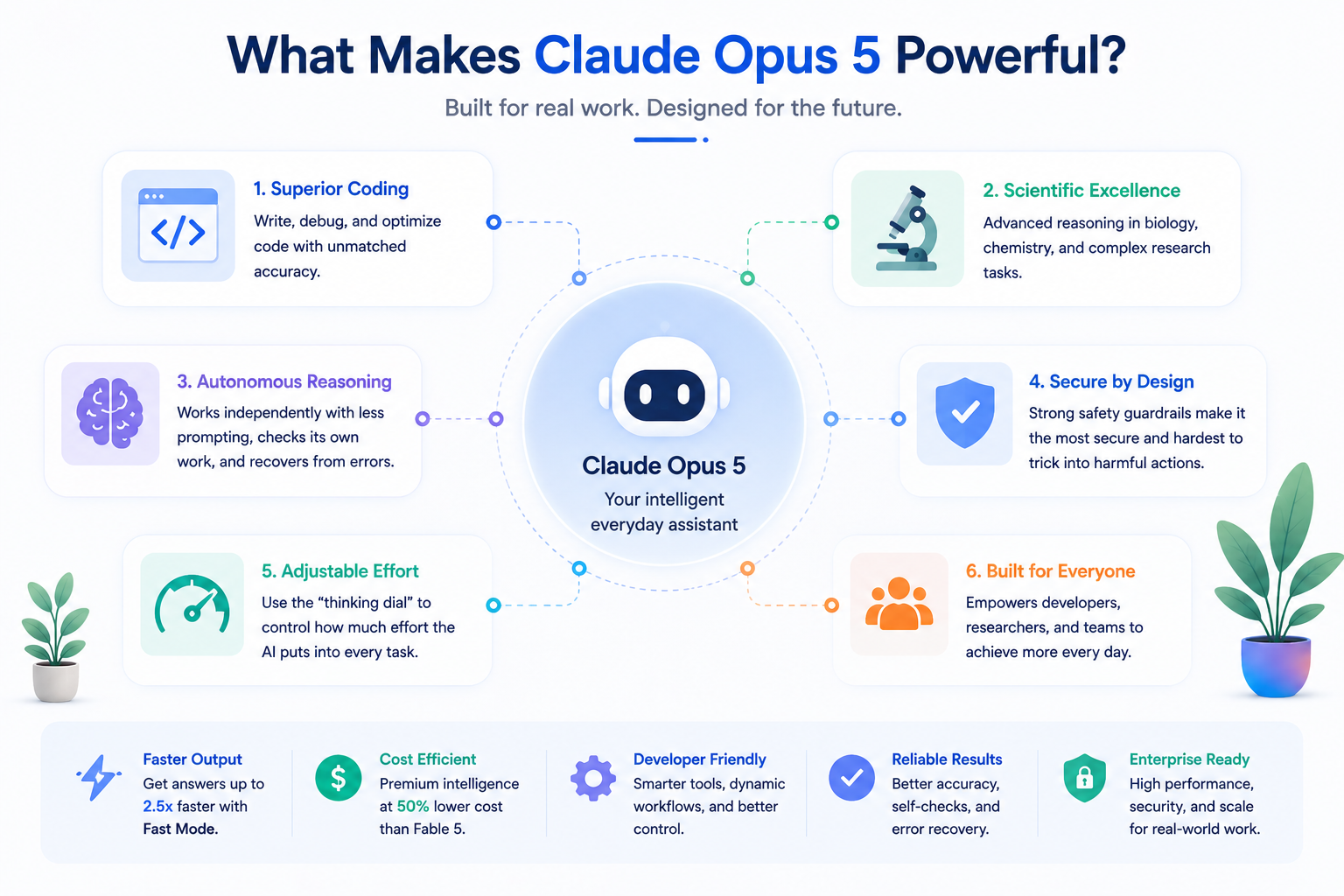
The core value proposition of Opus 5 lies in its pricing and performance ratio. It achieves near-parity with Fable 5 across numerous benchmarks but is offered at a 50 percent discount compared to the flagship tier. This strategic pricing makes it viable for businesses to deploy advanced AI across their entire workforce, shifting highly capable models from specialized research labs into standard enterprise software environments.
Key Improvements in Claude Opus 5
Anthropic has significantly refined the underlying architecture of Opus 5, resulting in several distinct improvements over the previous 4.8 generation:
• Enhanced coding capabilities: Opus 5 demonstrates the strongest work performance Anthropic has ever released, specifically excelling in software development, secure coding, and debugging.
• Greater autonomy with less user guidance: The model is notably more independent. It requires significantly less back-and-forth prompting to complete complex instructions, reducing the friction typically associated with AI task management.
• Self-checking and error recovery: In a major leap for agentic AI, Opus 5 possesses the ability to double-check its own logic mid-task. If it detects an error in its workflow, it can autonomously correct course and recover without requiring human intervention.
• Scientific research improvements: The model has received specialized training in the hard sciences. For example, in organic chemistry, Opus 5 shows a marked improvement in highly complex tasks, such as accurately inferring molecular structures from raw spectroscopy data.
New Features Introduced
Beyond raw performance upgrades, the Opus 5 release includes several novel features designed to give users and developers more granular control over the AI’s behavior.
Adjustable AI Reasoning
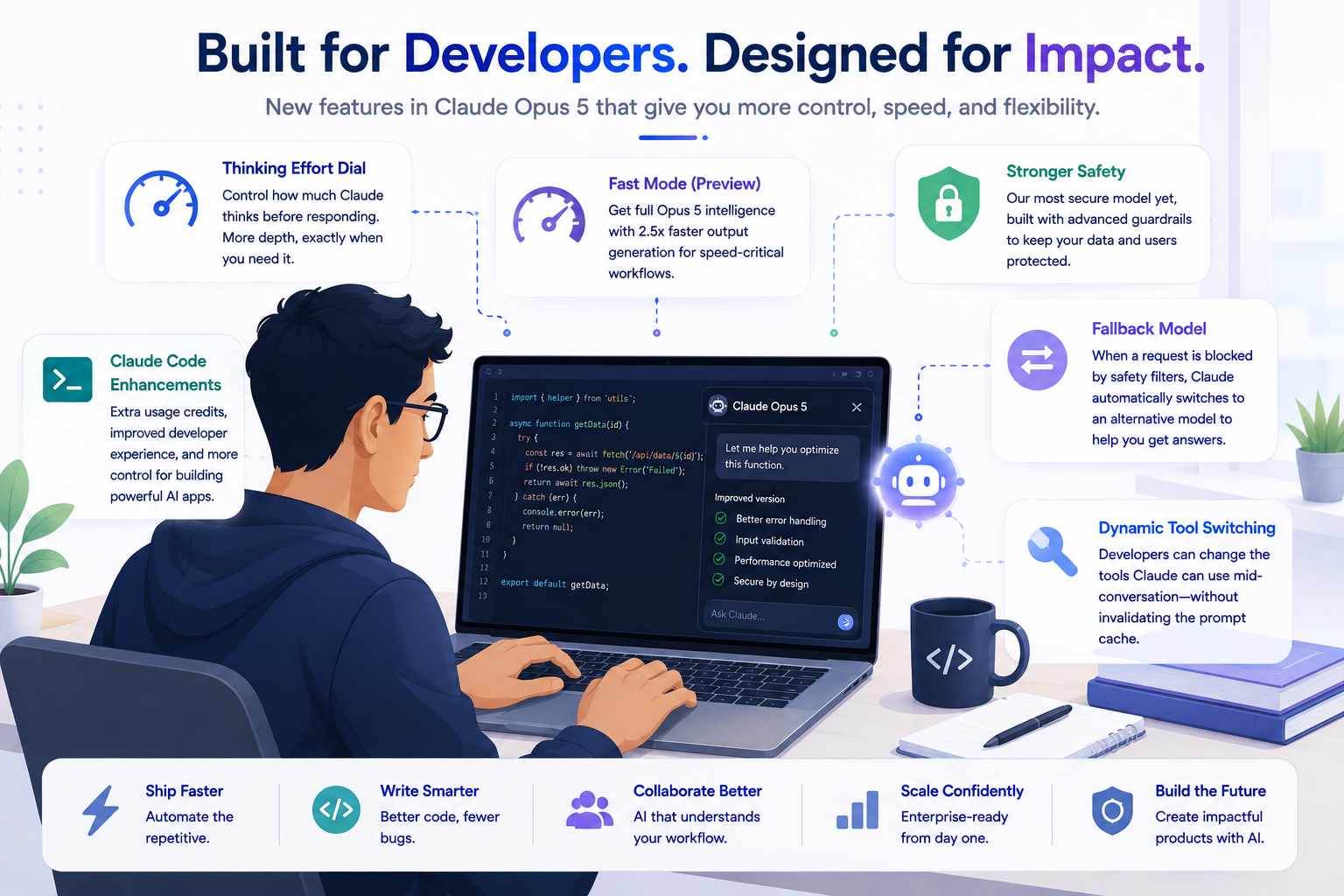
Anthropic has introduced a “thinking effort” dial. This allows users to manually dictate how much computational resources—and therefore time—the model should dedicate to a specific prompt, ensuring simple queries are answered instantly while complex math or logic problems receive deep processing.
Fast Mode (Research Preview)
For environments where speed is critical, Anthropic is previewing a “Fast Mode.” This feature delivers the full intelligence of Opus 5 but generates output tokens 2.5 times faster. However, this velocity comes at a premium, costing twice the standard rate of the older Opus 4 model. It is currently accessible via Claude Code using extra usage credits.
Security and Fallback Models
Touted as Anthropic’s most secure model to date, Opus 5 is highly resistant to jailbreaks and harmful prompts. To improve user experience around these strict safety guardrails, developers can now designate a “fallback model.” If a prompt inadvertently trips Opus 5’s safety filters and blocks the request, the system will automatically reroute the query to a designated alternative model to attempt a safe response.
Mid-Conversation Developer Tools
In a significant upgrade for developers building AI agents, Opus 5 allows for the switching of available tools mid-conversation without invalidating the prompt cache. This ensures that an AI agent is only exposed to the specific tools it needs for the current phase of a multi-step task, improving both security and context efficiency.
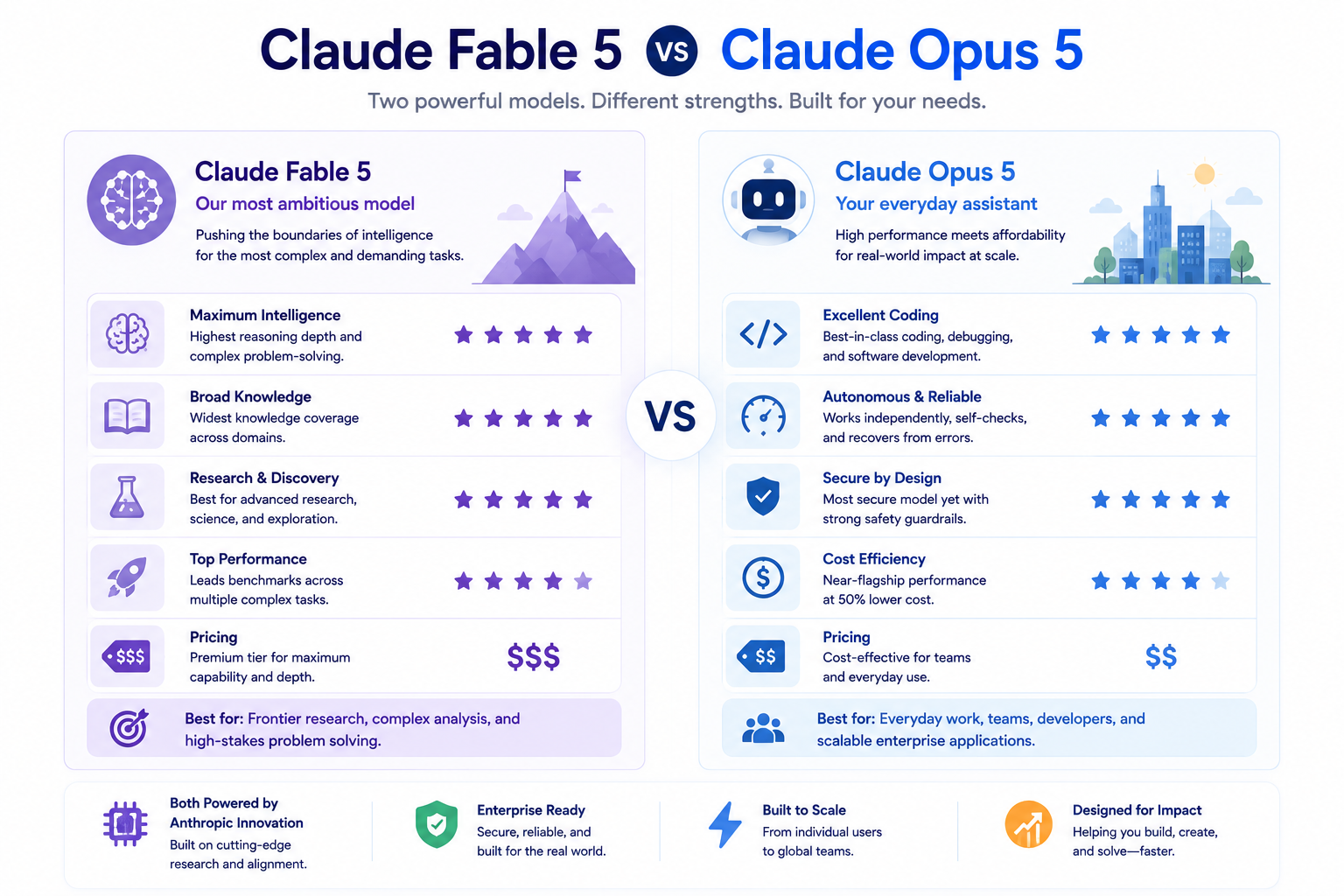
| Feature | Claude Fable 5 | Claude Opus 5 |
| Positioning | Most ambitious, flagship reasoning | Everyday highperformance assistant |
| Relative Cost | Premium pricing | 50% less than Fable 5 |
| Best Use Case | Unprecedented complex reasoning | Enterprise coding, autonomous tasks, daily workflows |
| Autonomy | High | Exceptionally high (features selfcorrection) |
Where It Matters in the Real World
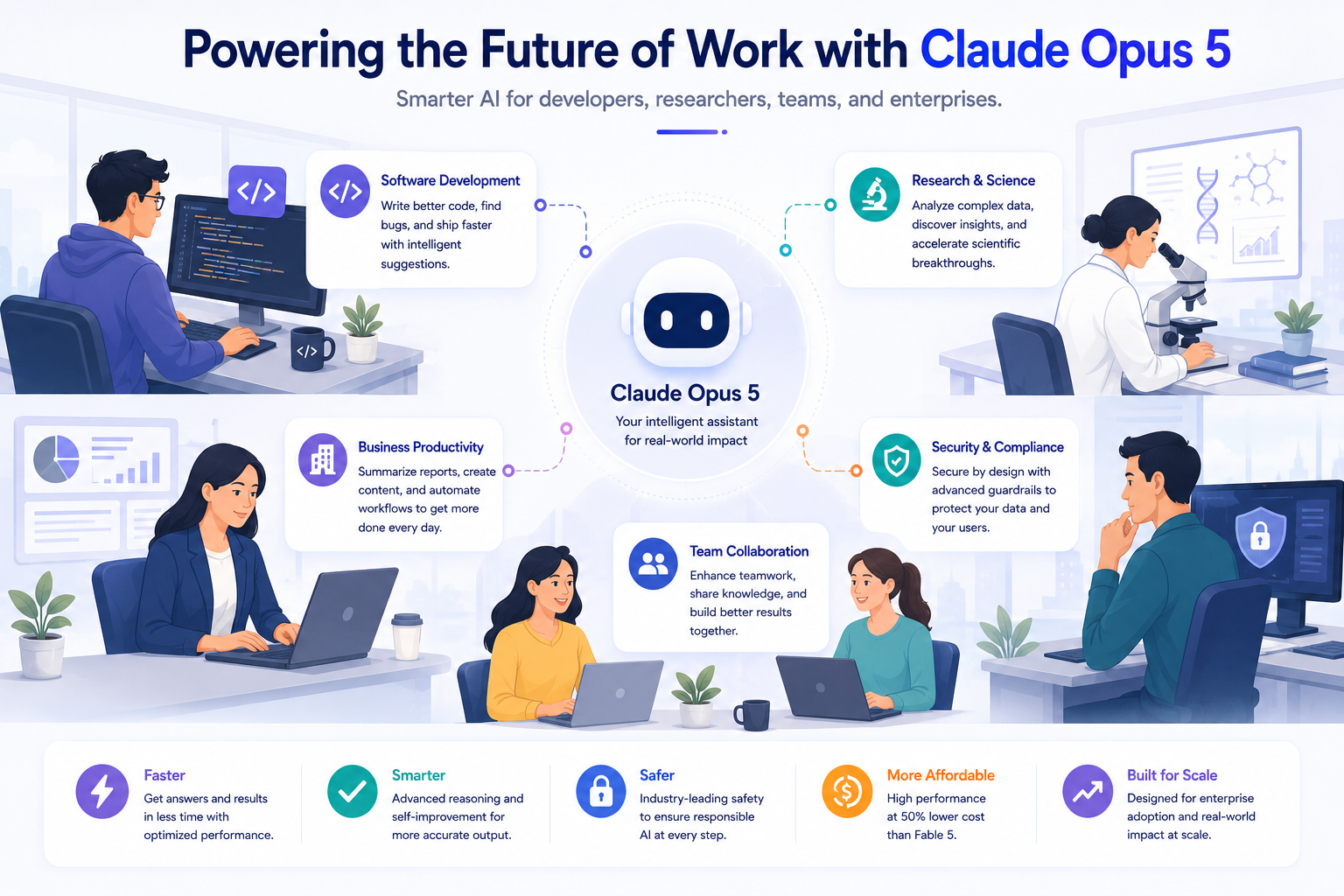
The introduction of Claude Opus 5 alters the landscape for several key demographics. Software developers gain a more autonomous, secure coding partner capable of identifying vulnerabilities without constant hand-holding. For enterprise organizations, the slashed pricing model means advanced AI can be integrated into customer service, data analysis, and internal logistics at scale. Furthermore, the advancements in biology and chemistry provide researchers with a highly capable analytical tool, effectively serving as a tireless research assistant capable of processing dense scientific data.
Where the Industry Is Heading
The release underscores the fierce competition between Anthropic, OpenAI, and Google. The current battleground has decisively moved away from theoretical capabilities toward practical utility. Enterprises are demanding AI that integrates smoothly, operates cheaply, and guarantees security. As AI pricing strategies become more competitive, expect a broader shift where highly efficient, task-specific models like Opus 5 become the standard engine driving daily corporate software, while massive flagship models are reserved for only the most demanding logical puzzles.
Strengths of Claude Opus 5
• Lower operating costs: Delivering near-flagship performance at half the price fundamentally changes enterprise ROI.
• Greater autonomy: The ability to self-correct reduces the need for human micromanagement.
• Stronger security protections: Advanced guardrails make it highly suitable for secure coding environments.
• Faster responses: The introduction of Fast Mode provides critical low-latency options for developers.
• Advanced scientific utility: Deep capabilities in organic chemistry and biology expand its use beyond standard text generation.
What Still Needs to Be Solved
• Safety limitations: While secure, strict safety filters can occasionally block benign prompts, necessitating the new fallback feature.
• Cost-performance trade-offs: Utilizing the 2.5x Fast Mode introduces higher pricing, requiring careful budget management.
• AI hallucinations: Like all large language models, Opus 5 is still susceptible to generating plausible but incorrect information.
• Enterprise adoption hurdles: Integrating highly autonomous agents into legacy corporate systems remains technically complex.
How It Could Shape AI’s Future
The launch of Claude Opus 5 proves that efficiency is now just as critical as intelligence. By engineering a model that can autonomously navigate complex tasks, double-check its own work, and operate at a significantly reduced price point, Anthropic is paving the way for ubiquitous AI. The relationship between affordability and adoption is absolute; as highly secure, capable models become cheaper to run, their deployment will transition from experimental IT projects to foundational corporate infrastructure.
What Comes Next
Looking ahead, the trajectory is clear: AI models will become increasingly autonomous. We can expect future iterations of the Claude family to act less like chatbots and more like embedded digital employees, capable of executing multi-day projects across various software platforms. As the competition among foundation models intensifies, the winners will be those who can offer developers the most flexible, secure, and cost-effective tools to build the next generation of enterprise agents.
The Bottom Line
Anthropic’s Claude Opus 5 is a masterclass in striking the right balance. By recognizing that businesses need affordability and autonomy as much as they need raw intelligence, Anthropic has delivered a highly compelling everyday assistant. While users must navigate the nuances of its strict safety filters and the premium pricing of its Fast Mode, the model’s self-correcting autonomy and robust coding capabilities make it a formidable tool. For developers and enterprises looking to scale their AI workflows reliably and securely, Opus 5 represents a highly attractive proposition.
Questions Worth Asking
What is Claude Opus 5?
Claude Opus 5 is Anthropic’s newly released foundational AI model, designed to be an everyday assistant that balances high-tier reasoning capabilities with significant cost efficiency.
How is Claude Opus 5 different from Claude Fable 5?
While Fable 5 is Anthropic’s most ambitious and capable flagship model, Opus 5 offers performance that approaches Fable 5 but operates at half the cost, making it better suited for daily, high-volume enterprise tasks.
What is the Fast Mode in Claude Opus 5?
Fast Mode is a research preview feature that delivers the full intelligence of Opus 5 but generates output tokens 2.5 times faster. It currently costs twice as much as the standard Opus 4 pricing.
How does Claude Opus 5 improve coding tasks?
The model features the strongest coding capabilities Anthropic has released, augmented by its ability to work independently, double-check its own logic, and recover from errors midtask without user prompting.
What is the purpose of the AI reasoning dial?
The reasoning dial allows users to manually adjust how much computational effort the AI applies to a specific prompt, letting them prioritize either instant speed for simple queries or deep processing for complex problems.
Is Claude Opus 5 safer than previous Claude models?
Yes, Anthropic describes Opus 5 as its most secure model yet, featuring advanced guardrails that make it exceptionally difficult to trick into generating harmful content.