SpaceX is advancing its semiconductor manufacturing ambitions with Terafab, a colossal Texas-based facility designed to produce specialized chips for data centers. However, the energy strategy powering this multi-billion dollar project has drawn significant attention: SpaceX is bypassing terrestrial solar power in favor of building dedicated natural gas power plants. This decision highlights a growing industry trend where the immense, uninterrupted energy demands of AI infrastructure are clashing with the limitations of renewable energy, forcing technology giants to prioritize reliability and speed of deployment over immediate sustainability goals.
Introduction
The artificial intelligence boom is not just a software revolution; it is an infrastructure challenge of unprecedented scale. The physical hardware required to train and run massive language models—tens of thousands of interconnected GPUs—demands an astronomical amount of electricity. As technology companies race to build bigger data centers and the fabs necessary to manufacture those specialized chips, they are encountering a severe bottleneck: the existing power grid cannot keep up.
In this hyper-competitive environment, waiting for utility companies to upgrade transmission lines is no longer an option. Tech leaders are increasingly taking energy production into their own hands. SpaceX’s strategy for its new Terafab facility in Texas perfectly encapsulates this shift, illustrating how the desperate need for immediate, reliable baseload power is reshaping corporate energy policies and challenging prior commitments to green energy
The Terafab Project: Scale and Ambition
SpaceX’s Terafab is a planned semiconductor fabrication plant located in Grimes County, Texas. Fueled by a lucrative incentive package—including a 100% county tax abatement and $30 million in state incentives—SpaceX has committed to investing at least $5 billion by 2030 and creating 1,800 full-time jobs. The primary objective of the facility is to manufacture chips specifically designed for the data centers operated by SpaceX and its sister AI company, xAI. While initial estimates placed the cost of the first phase at a staggering $55 billion, recent projections have adjusted that figure down to $16.8 billion. Regardless of the final price tag, a semiconductor fab of this magnitude requires a continuous, massive supply of electricity to maintain its cleanrooms and complex manufacturing equipment
The "Bring Your Own Power" Strategy
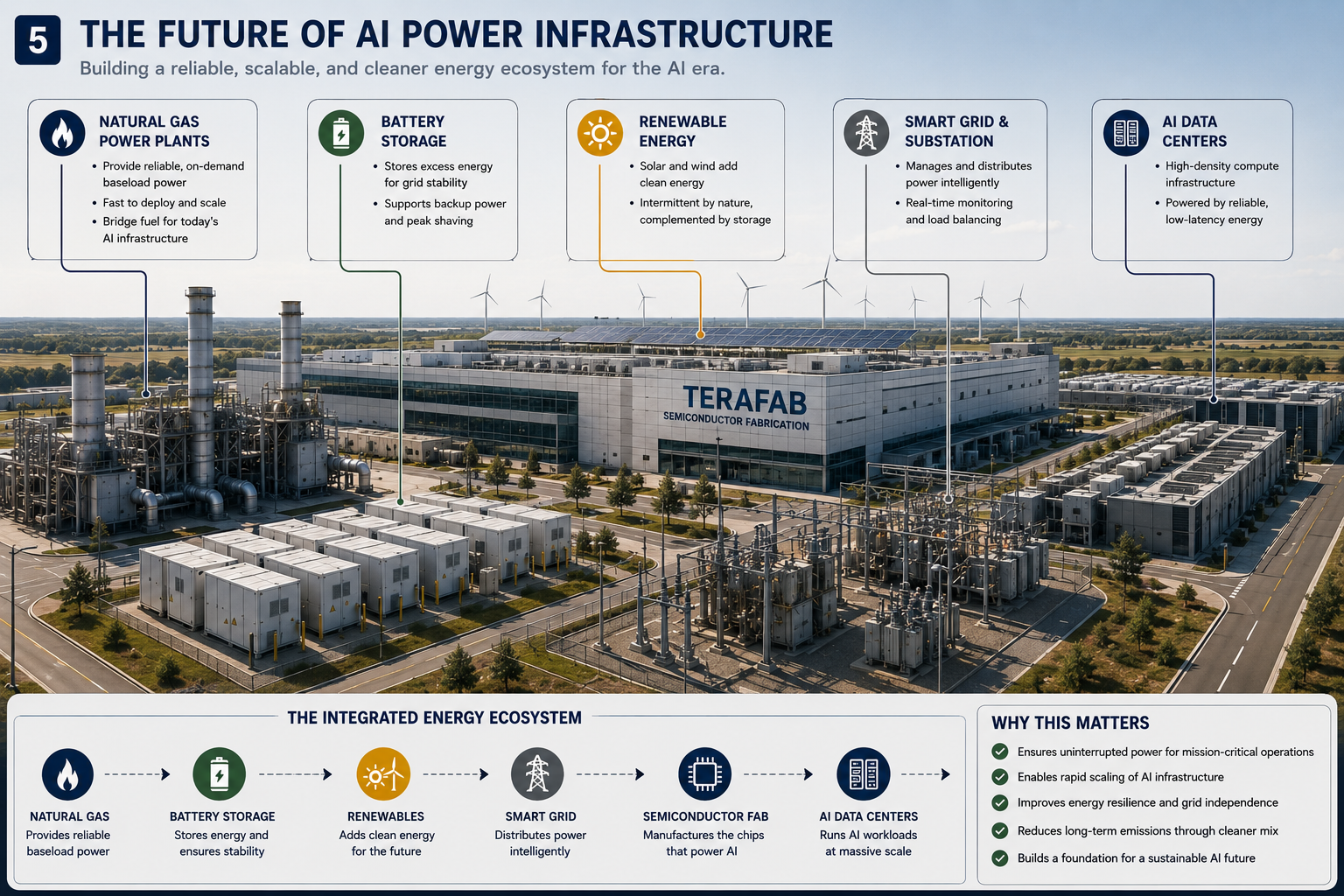
To guarantee this energy supply, SpaceX has adopted a "bring your own power" model. During a recent public meeting, Riley Trettel, head of energy and data center development for SpaceX, confirmed that the company will construct its own power generation infrastructure on-site, supported by "very large battery arrays."
Crucially, the primary source of this power will be natural gas power plants.
This approach bypasses the long interconnection queues that currently plague the U.S. power grid. Texas alone has seen proposals for over 70 gigawatts of capacity from companies looking to build independent power infrastructure. By generating their own electricity, companies like SpaceX insulate themselves from grid instability and volatile consumer electricity prices, allowing them to rapidly scale operations on their own timelines.
Why Natural Gas Over Solar?
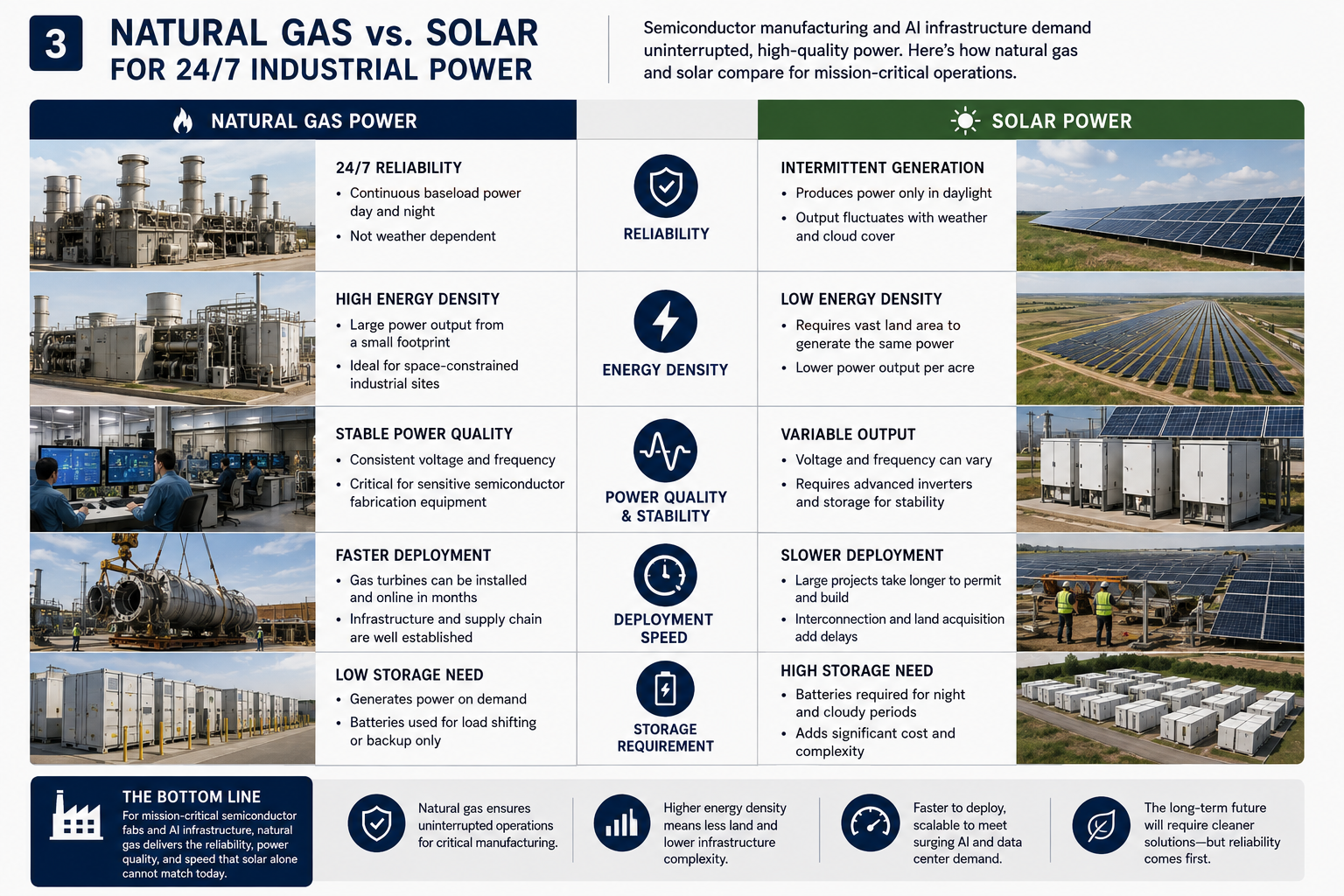
The decision to rely on natural gas instead of solar power is notable, especially considering Elon Musk’s role as CEO of Tesla, a prominent solar developer and partner in the Terafab project. The absence of terrestrial solar in the Terafab plans stems from the fundamental physics of semiconductor manufacturing and AI workloads.
• Baseload Reliability: Semiconductor fabs cannot tolerate power fluctuations. A momentary dip in voltage can ruin millions of dollars worth of silicon wafers. Natural gas provides a steady, uninterrupted flow of electricity (baseload power) 24/7, whereas solar generation fluctuates with weather and daylight.
• Energy Density: The physical footprint required to generate the necessary megawatts via solar panels is vast. Natural gas turbines offer much higher energy density, providing massive power output from a relatively small physical footprint.
• Speed of Deployment: Natural gas turbines can be procured and brought online relatively quickly compared to permitting and building massive utility-scale solar farms.
The Industry Shift Toward Fossil Fuels
SpaceX is not alone in this pivot. The broader technology industry, desperate to fuel the AI data center boom, is increasingly relying on natural gas.
• xAI’s Precedent: Musk’s xAI data centers in Memphis already run almost entirely on natural gas.
• Corporate Investments: Musk recently acquired a company specializing in natural gas power plants, and SpaceX has announced plans to purchase $2.8 billion worth of gas turbines over the next three years.
• Market Impact: The collective rush for immediate power by companies like Google, Meta, Microsoft, and xAI has driven up the costs of natural gas power plants by 66% across the industry.
Strengths of the Natural Gas Strategy
• Uninterrupted Operations: Guarantees the absolute reliability required for sensitive semiconductor manufacturing.
• Grid Independence: Protects the facility from regional blackouts or rolling brownouts common in stressed grids like ERCOT in Texas.
• Rapid Scaling: Allows the company to build and expand the fab without waiting for municipal grid upgrades.
Limitations and Environmental Concerns
• Significant Pollution: Natural gas combustion releases greenhouse gases and local air pollutants, conflicting with broader corporate sustainability goals.
• Regulatory Risks: Relying on unpermitted or hastily deployed turbines carries legal risks. SpaceX’s subsidiary, xAI, is currently facing litigation over its use of unpermitted turbines in heavily polluted areas.
• Fuel Cost Volatility: While generation is internal, the facility remains exposed to global natural gas market pricing.
Why This Matters for the Future of Tech Infrastructure
The Terafab energy strategy illustrates a critical friction point in the AI revolution: the immediate hardware demands of AI are fundamentally incompatible with the current pace of the green energy transition. When forced to choose between delaying a multi-billion dollar AI infrastructure project and burning fossil fuels, the industry is overwhelmingly choosing the latter.
This dynamic suggests that the next decade of technology infrastructure will be heavily industrialized, looking more like traditional heavy manufacturing than the clean, cloudbased aesthetic historically promoted by Silicon Valley.
Future Outlook
Looking forward, the "bring your own power" model will likely become standard operating procedure for gigawatt-scale data centers and fabs. While companies will continue to invest in massive battery arrays (like those planned for Terafab) to smooth out demand, natural gas will remain the crucial bridge fuel. Ultimately, the industry is banking on the eventual maturation of next-generation nuclear power (like Small Modular Reactors) to eventually replace these gas turbines, but until that technology is commercially viable, the AI boom will run on fossil fuels.
Final Verdict
SpaceX’s decision to power its Terafab facility with natural gas rather than Tesla solar panels is a pragmatic, if environmentally controversial, engineering choice. The sheer energy density and absolute reliability required to manufacture advanced AI chips cannot currently be met by terrestrial solar power alone. While this approach guarantees operational independence and rapid deployment, it also underscores the massive environmental cost of the ongoing AI arms race. For the foreseeable future, maintaining a competitive edge in AI hardware means accepting a heavier carbon footprint.
Expert FAQs
Why isn’t SpaceX using Tesla solar panels for Terafab?
Solar power is intermittent and requires vast amounts of land. Semiconductor manufacturing requires absolute 24/7 reliability and massive energy density, which natural gas turbines provide far more effectively than current solar setups.
What is the "bring your own power" model?
It is a strategy where a company builds its own power plants (often natural gas) on-site rather than relying entirely on the public utility grid, avoiding long wait times for grid upgrades.
Are other tech companies using natural gas for AI?
Yes. The surge in AI data centers has led to a massive increase in demand for natural gas power plants across the industry, driving up turbine costs by 66%.
What are the environmental consequences of this strategy?
Natural gas turbines release significant carbon emissions and local pollutants. xAI is currently facing lawsuits for running unpermitted turbines in a highly polluted area in Memphis.
Will Terafab use any renewable energy?
While the primary baseload will be natural gas, SpaceX has indicated they will install "very large battery arrays," which will likely be used to manage peak loads and ensure absolute power stability, though the primary generation source remains fossil-based.