Artificial Intelligence (AI), Machine Learning (ML), Data Science, and Data Analytics have become some of the most talked-about areas in technology. They frequently appear together in job descriptions, university courses, internship requirements, and online learning platforms. Because they use many of the same tools and concepts, it is easy to assume that they are simply different names for the same thing. They are not.
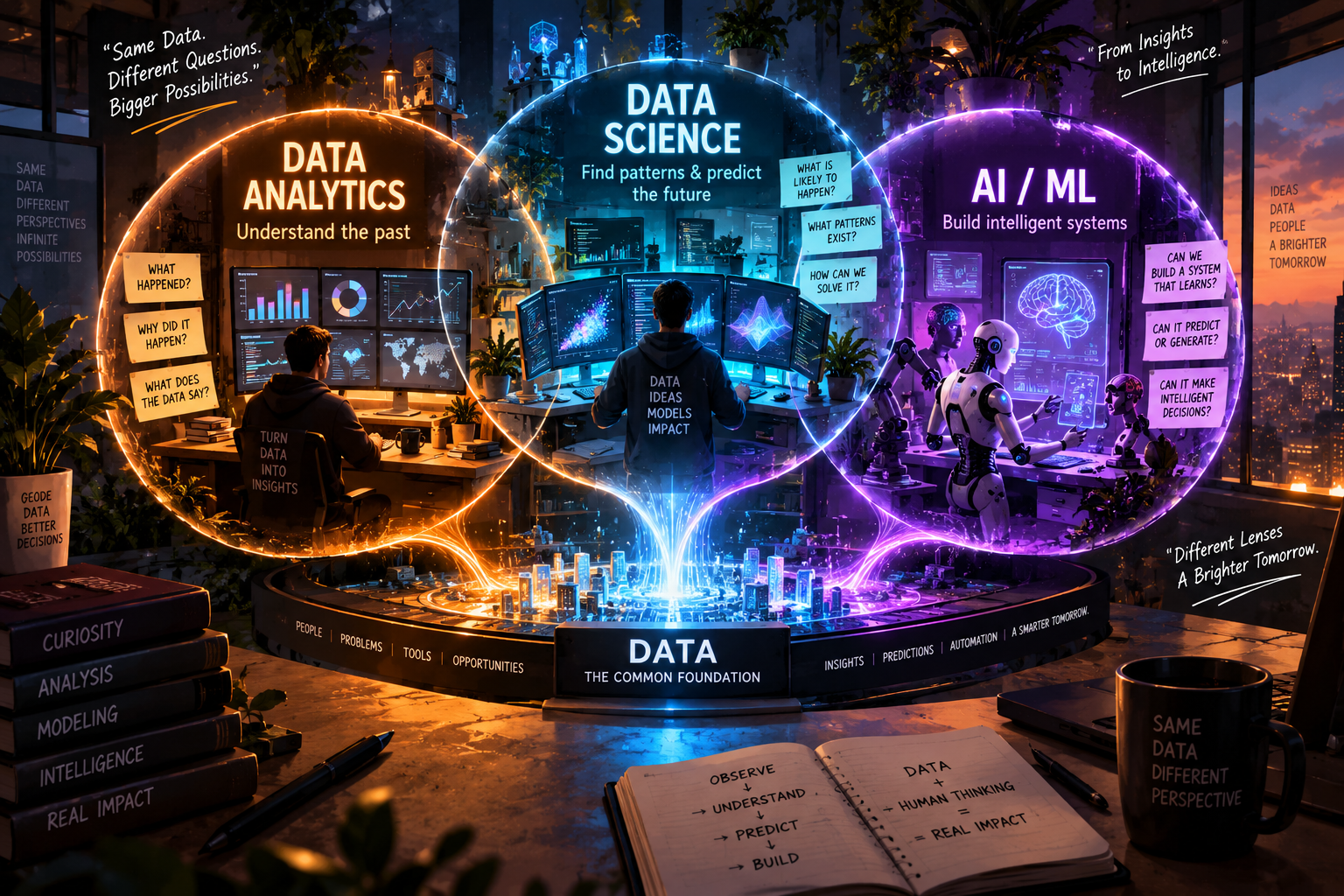
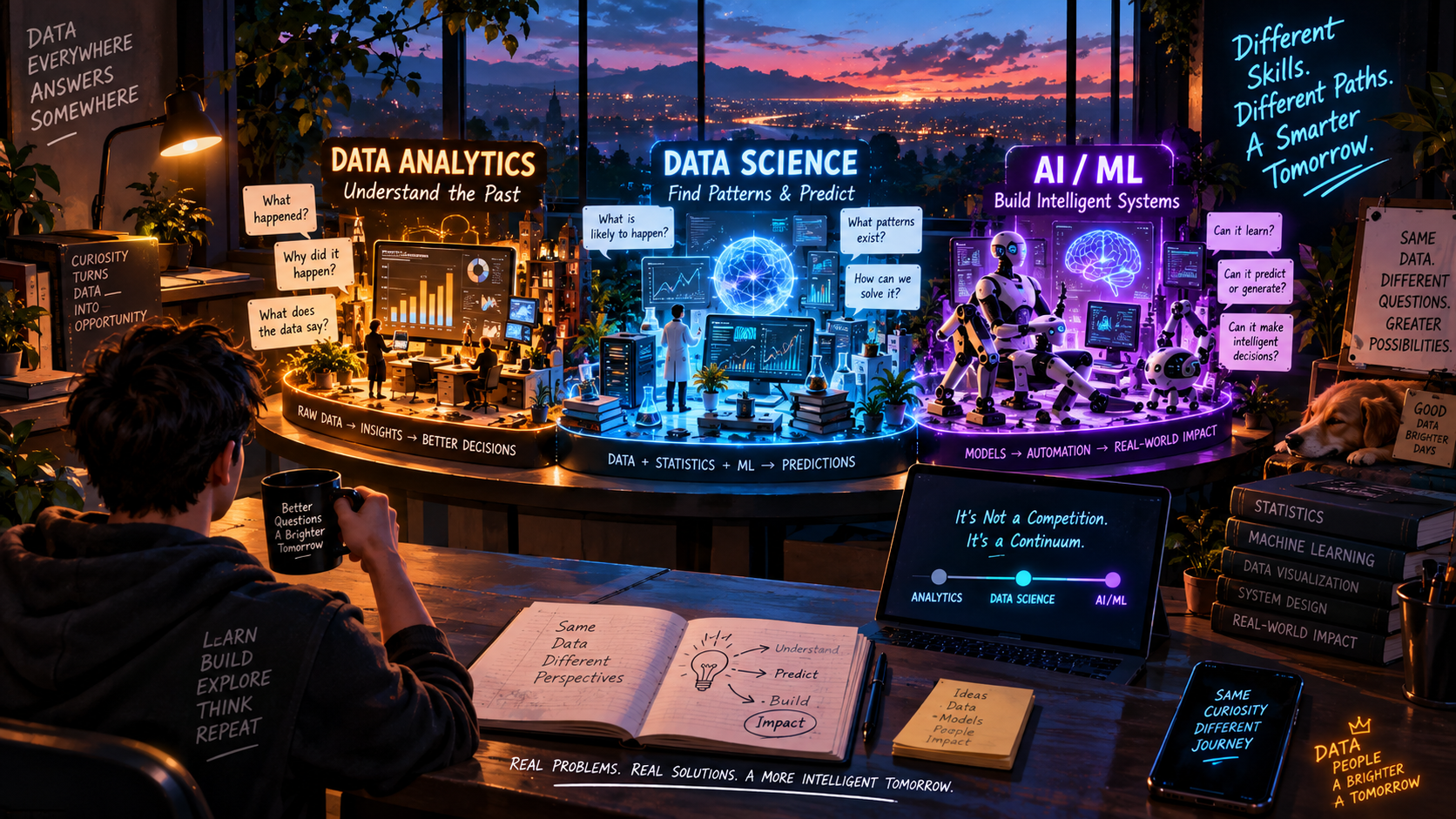
The confusion mainly comes from the fact that these fields overlap. A data scientist may use machine learning, an analyst may use Python, and an AI engineer may spend a significant amount of time working with data. The difference is less about drawing a strict boundary between technologies and more about understanding the purpose of the work, the problems being solved, and the kind of outcome expected. A useful way to think about it is that Data Analytics primarily helps us understand what happened, Data Science helps us discover patterns and predict what may happen, and AI/ML focuses on building systems that can learn, predict, automate, or perform intelligent tasks.
What Is Data Analytics?
Data Analytics is the process of examining existing data to understand trends, answer questions, identify problems, and support better decisions. Instead of looking at raw numbers without context, analysts turn those numbers into information that a business or organization can actually use.
Imagine that an e-commerce company notices that its sales have fallen over the last three months. A data analyst might investigate the sales records and discover that the decline is concentrated in a particular region or product category. They may compare current performance with previous periods, analyze customer behavior, examine conversion rates, and identify where the change occurred. The objective is not necessarily to build a sophisticated prediction model; it is to understand the situation clearly enough for someone to make an informed decision.
This is why data analysts commonly work with SQL, spreadsheets, visualization platforms such as Power BI or Tableau, and sometimes Python or R. Their work may result in a dashboard, report, performance analysis, or set of business insights. The ability to communicate those findings is just as important as the ability to calculate them.
A good analyst therefore does more than create charts. They need to understand what the numbers mean, identify misleading patterns, ask the right questions, and communicate the findings to people who may not have a technical background. In many organizations, this makes analytics an important link between raw data and business decision-making.
What Is Data Science?
Data Science is broader and usually more predictive in nature. It combines programming, statistics, data analysis, experimentation, and machine learning to extract useful insights and build solutions around data.
A data scientist may start with the same sales problem as an analyst, but their questions could be different. Instead of only asking why sales declined, they might investigate which customers are most likely to stop purchasing, which factors are associated with lower sales, or how much demand the company should expect next month.
Getting there usually requires much more than training a model. A data scientist may need to collect data from different sources, clean inconsistent records, handle missing values, explore distributions and relationships, engineer useful features, select an appropriate modeling technique, evaluate the results, and determine whether the model actually solves the original problem. In some cases, the final solution may be a machine learning model. In others, careful statistical analysis may be enough.
This is one of the most important things to understand about Data Science: it is not simply Machine Learning. Machine learning is an important part of the field, but data science also involves understanding the data, defining the problem, designing experiments, interpreting results, and connecting technical findings to a real-world objective.
What Are AI and Machine Learning?
Artificial Intelligence is a broader field focused on building systems capable of performing tasks associated with intelligent behavior. These tasks can include understanding language, recognizing images, making decisions, solving problems, generating content, and interacting with users.
Machine Learning is one of the major approaches used to build such systems. Instead of explicitly programming every possible rule, a machine learning model can learn patterns from examples and use those patterns to make predictions or decisions. A spam filter is a simple example: rather than relying entirely on manually written rules, a machine learning system can learn characteristics of spam messages from historical examples.
Machine learning itself includes different approaches. In supervised learning, the model learns from labeled examples and can be used for tasks such as fraud detection, classification, or prediction. Unsupervised learning attempts to discover structure in data without predefined labels, which can be useful for tasks such as clustering and customer segmentation. Reinforcement learning takes another approach, allowing a system to learn through interaction with an environment and feedback in the form of rewards or penalties. Modern AI also extends into areas such as deep learning, natural language processing, computer vision, generative AI, and large language models.
How Do These Fields Work Together?
The easiest way to understand the relationship between these fields is to look at a single business problem from different perspectives.
Suppose a food-delivery company wants to reduce late deliveries. A data analyst might begin by studying historical delivery data to determine where and when delays happen most frequently. They could discover that certain areas experience significantly more delays during particular hours.
A data scientist could take that analysis further by developing a model that predicts the probability of a delivery being late. The model might use factors such as distance, traffic conditions, restaurant preparation time, weather, and historical delivery patterns.
An ML engineer could then take that model and integrate it into a production system so predictions are automatically generated for new orders. An AI engineer might build an intelligent application around those predictions, allowing the system to recommend actions or communicate with customers automatically.
The important point is that these are not completely separate worlds. They can form different stages of the same broader solution.
The Difference in Skills
The skills required in each field overlap, but the emphasis changes.
Data Analytics generally places strong importance on SQL, spreadsheets, visualization, statistics, business understanding, and communication. A person working in analytics needs to be comfortable asking questions of data and presenting the results in a way that decision-makers can understand.
Data Science usually requires a broader technical foundation. Python or R, statistics, probability, data manipulation, exploratory data analysis, feature engineering, experimentation, and machine learning are all relevant. A data scientist often needs to understand not only how to build a model, but also whether the model is appropriate and how reliable its results are.
AI and ML roles can require deeper specialization. Depending on the position, this may include machine learning, deep learning, neural networks, mathematics, model evaluation, deployment, APIs, and software engineering. Modern AI-focused roles may additionally involve large language models, retrieval-augmented generation, vector databases, AI agents, and other technologies used to build intelligent applications.
This difference in technical requirements is also why software engineering becomes particularly important in AI/ML engineering. Building a model in a notebook is one thing; turning that model into a reliable system that can serve users, handle failures, scale appropriately, and be maintained over time is a different challenge.
What About Mathematics?
Mathematics plays a role across all three areas, but the level of depth depends heavily on the role.
For many analytics positions, practical statistics and basic mathematical reasoning are enough to perform useful work. Data science generally requires a stronger understanding of probability, statistics, regression, experimentation, and related concepts. Advanced machine learning and AI can require deeper knowledge of areas such as linear algebra, optimization, probability, statistics, and calculus.
However, learning mathematics should not become a barrier to building things. The most useful approach is often to learn the concepts alongside practical projects. Understanding why a model behaves the way it does becomes much easier when the mathematics is connected to something you are actually trying to build.
Is Data Analytics Less Technical?
One of the most common misconceptions is that Data Analytics is simply a beginner version of Data Science. That is not necessarily true.
Analytics can involve complex SQL, large datasets, experimentation, statistical reasoning, business intelligence systems, and sophisticated visualization. The key difference is usually the type of problem being solved rather than how “advanced” the field is.
An experienced analyst may answer a business question that saves a company significant time or money without building a single machine learning model. In many situations, understanding the existing data correctly is more valuable than applying machine learning simply because it is available.
Is Data Science Just Machine Learning?
Another common misconception is that Data Science and Machine Learning are interchangeable terms.
They are closely related, but they are not the same. A data science project can include data collection, cleaning, statistical analysis, visualization, experimentation, feature engineering, and business reasoning before machine learning is even considered.
In fact, knowing when not to use machine learning can be an important part of good data science. A model should solve a real problem, not exist simply because the technology is available.
Similarly, AI is broader than Machine Learning. Machine learning is one approach within AI, while AI can also involve methods based on rules, search, reasoning, planning, and knowledge representation. The modern popularity of generative AI and large language models has made AI strongly associated with these technologies, but the field itself is much broader.
Which One Should You Learn?
There is no single path that is correct for everyone. The right direction depends on the kind of problems you enjoy solving.
Someone who enjoys working with business data, SQL, dashboards, trends, and communicating insights may find Data Analytics appealing. Someone interested in statistics, experimentation, programming, predictive modeling, and extracting deeper insights may prefer Data Science. Someone who enjoys building intelligent systems, machine learning models, deep learning applications, LLM-based systems, and production software may be more interested in AI/ML.
These paths are also not permanent choices. Someone can begin with analytics, strengthen their programming and statistical foundations, move into data science, and later specialize in machine learning or AI engineering. The fields are connected enough that skills developed in one can often become useful in another.
For students, a practical learning path is to start with programming fundamentals, SQL, statistics, and data analysis before moving into machine learning and then specialized AI topics. Once the foundation is strong, areas such as deep learning, NLP, computer vision, generative AI, or AI engineering can be explored according to individual interests. Most importantly, learning should be accompanied by real projects. Building systems and working with messy real-world data teaches lessons that courses alone cannot provide.
The Bottom Line
The simplest way to remember the difference is to focus on the question being answered.
Data Analytics is mainly about understanding what happened and what the existing data tells us. Data Science combines data, statistics, programming, and modeling to discover patterns and make predictions. AI and Machine Learning focus more heavily on building systems that can learn, predict, automate, generate, or perform intelligent tasks.
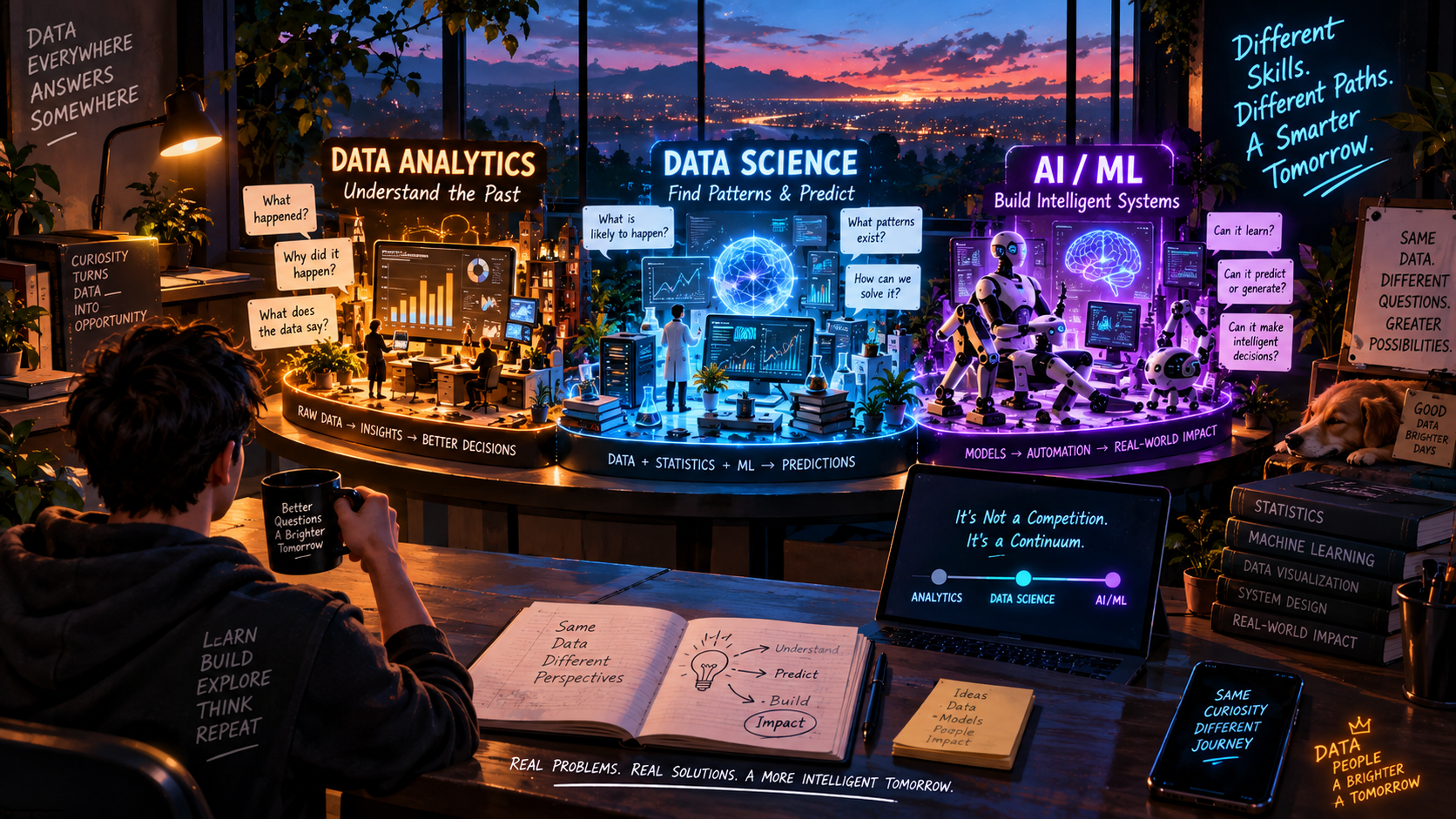
At the same time, these fields should not be viewed as isolated boxes. In real organizations, they often work together. Analytics can reveal a problem, Data Science can investigate and model it, and AI/ML engineering can turn the resulting solution into a product or automated system.
The technologies will continue to change, and new tools will keep appearing. What remains valuable is the ability to understand data, think statistically, write useful software, and solve real problems. That foundation matters far more than simply knowing the latest tool or choosing the most fashionable job title.