The era of impressing recruiters with a simple wrapper around a Large Language Model (LLM) API is officially behind us. In 2026, tech recruiters and engineering managers evaluate student portfolios based on system design, architectural complexity, and deterministic execution. As generative AI models reach high benchmark performance across reasoning tasks, the primary challenge in software engineering has shifted from basic text generation to building reliable autonomous agents capable of performing multi-step domain workflows.
For computer science and technology students preparing for internships and full-time roles, understanding Agentic AI and Multi-Agent Orchestration has quickly emerged as a critical differentiator. Modern developer teams are no longer looking for candidates who can simply send a prompt to an endpoint; they require engineers who understand state management, vector database retrieval, tool execution loops, and asynchronous event streams.
This guide breaks down the core concepts, internal mechanisms, real-world implementations, and architectural trade-offs of autonomous multi-agent systems, providing tech students with a blueprint for building high-impact engineering projects.
2. Background and Context
Over the past three years, student developer portfolios evolved through three distinct phases. In the early stages of generative AI adoption, projects typically consisted of basic frontend forms connected to single completion endpoints. While visually impressive at the time, these applications relied entirely on stateless prompt-in and text-out interactions, leaving little room for complex application logic.
The next evolutionary step introduced Retrieval-Augmented Generation (RAG). By embedding local documentation into vector stores (such as Pinecone, Qdrant, or ChromaDB), student applications could query external knowledge bases before passing context to an LLM. While RAG significantly reduced model hallucinations for factual queries, it remained fundamentally reactive—a user asks a question, the pipeline fetches context, and the model synthesizes a single answer.
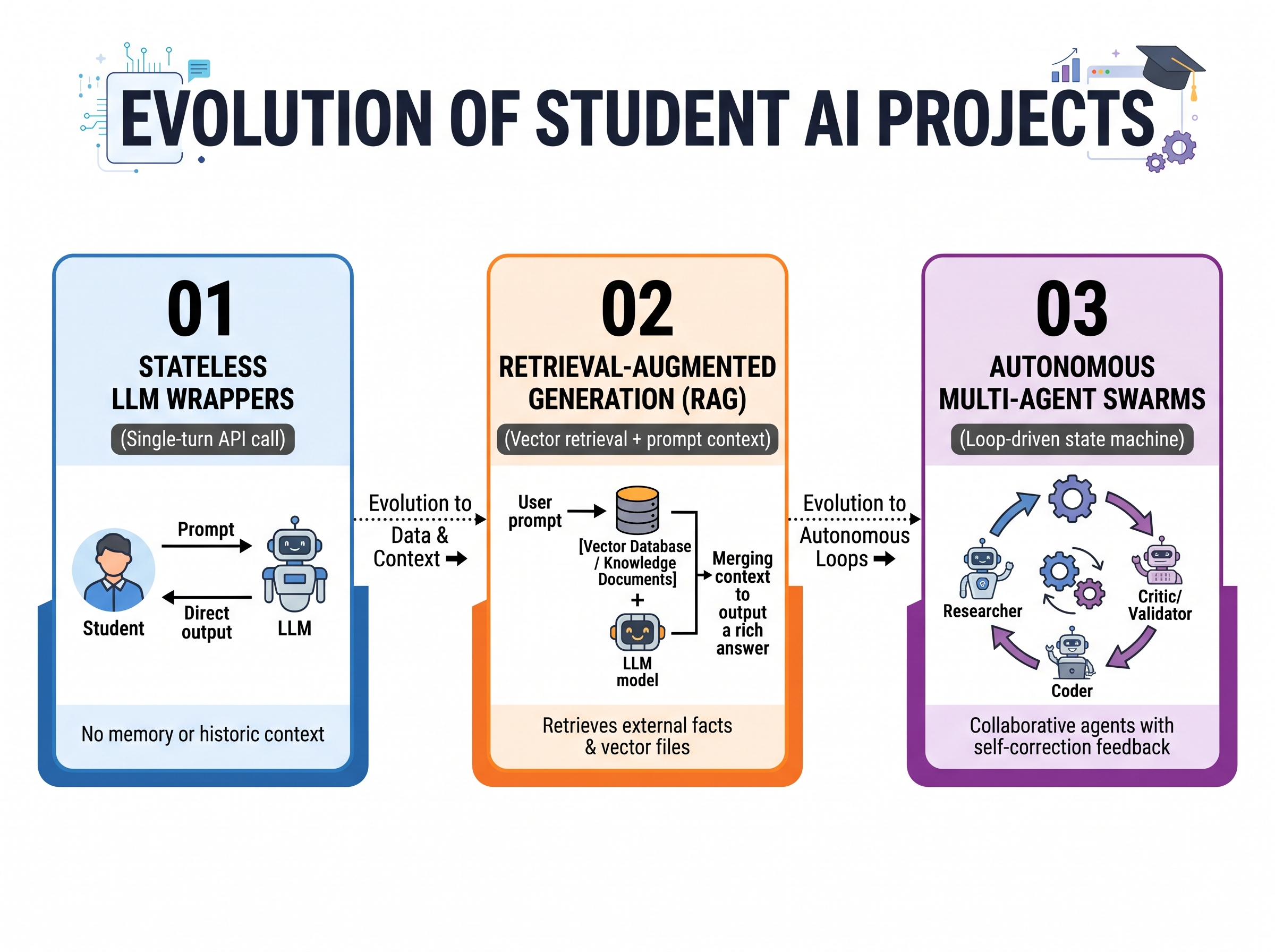
In contrast, production software requires proactive problem-solving. Real-world systems must break down vague goal descriptions, execute code, process API responses, handle rate limits, retry failed operations, and collaborate across specialized domains. This necessity gave rise to Agentic AI—a shift from static text generation to dynamic execution environments powered by autonomous feedback loops.
3. Understanding the Core Concept
To understand agentic architectures, we must clarify what transforms a basic LLM call into an autonomous agent.
Key Definitions & Core Components
- Agent: An autonomous software entity driven by an LLM core that observes an environment, makes decisions, updates state, and takes actions through external tools to achieve a specified goal.
- Tool Calling (Function Calling): The mechanism allowing an LLM to output structured JSON data containing a function name and arguments, which an underlying application executes locally or over HTTP.
- Agent Memory: The short-term state (in-memory execution thread) and long-term state (persisted database context or vector embeddings) that allow agents to retain history and evaluate past outcomes.
- Orchestration Layer: The execution framework (such as LangGraph, CrewAI, AutoGen, or LlamaIndex Workflows) that controls message routing, state updates, and execution sequences between multiple agents.
The ReAct Pattern (Reasoning + Acting)
At the heart of any individual agent is the ReAct paradigm. Unlike traditional linear functions, an agent operates inside an execution loop. Given a user goal, the agent iterates through three continuous phases:
- Thought: The LLM evaluates its current state and determines what information or action is required next.
- Action: The agent selects an external tool from its available registry (e.g., executing a SQL query, running a web search, or parsing a local PDF) and formats the parameters.
- Observation: The execution environment runs the tool, returns the result to the agent, and the agent processes this feedback to plan its next step.
4. How It Works
Multi-agent systems elevate individual ReAct loops by creating a network of specialized agents that collaborate, critique, and delegate tasks to solve high-complexity workflows.
Architecture and Agent Collaboration Models
Instead of burdening a single agent with dozens of tools and prompt instructions, multi-agent architectures follow separation-of-concerns principles. Common topologies include:
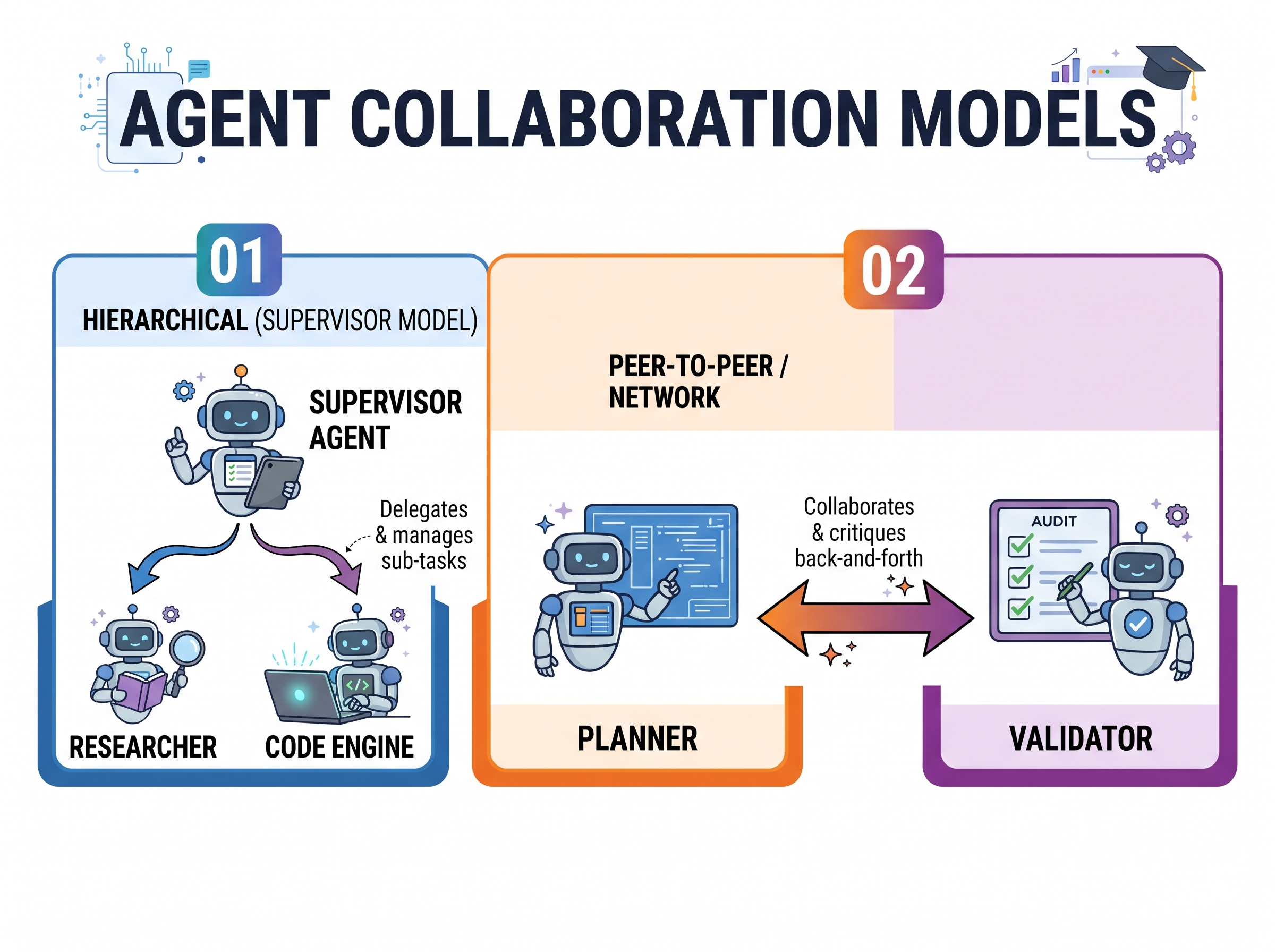
- Hierarchical (Supervisor Pattern): A router/supervisor agent receives user input, decomposes the request into distinct sub-tasks, assigns work to specialized sub-agents (e.g., Researcher, Coder, Reviewer), and aggregates their outputs into a final response.
- Sequential Pipeline: Outputs flow deterministically from one agent to the next in a DAG (Directed Acyclic Graph) fashion, where each agent enriches or transforms data passed down the pipeline.
- Peer-to-Peer Swarms: Autonomous agents pass control directly to one another based on conditional state evaluations, dynamically routing work until a termination condition is reached.
Technical Execution Lifecycle
To implement a multi-agent framework reliably, developers build state graphs using typed schemas. A typical execution flow follows this lifecycle:
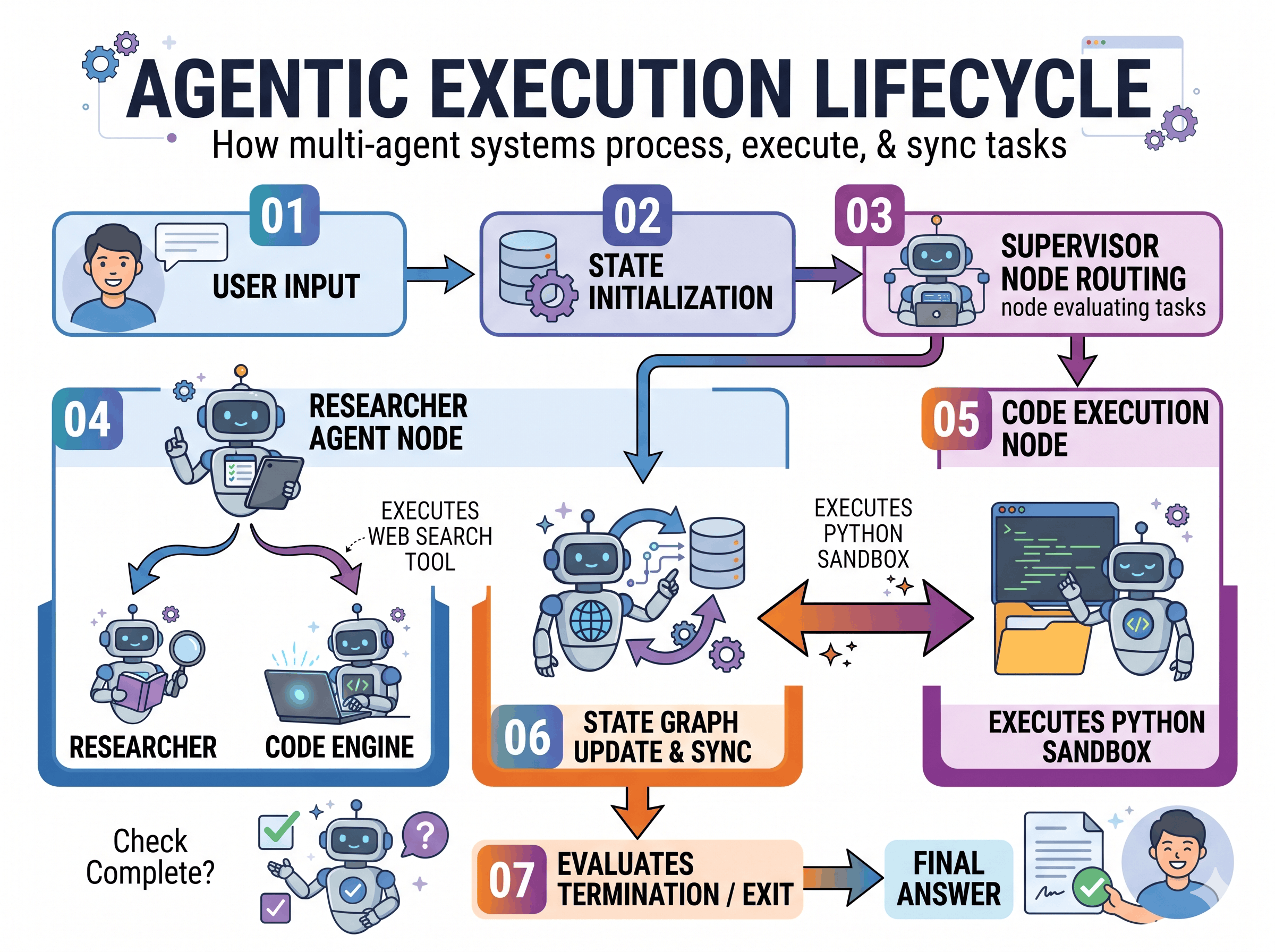
When building this in Python or TypeScript, state transitions must be deterministic. If an agent outputs invalid payload data, the framework catches the validation error, appends it to the state history, and forces the agent to self-correct on its next execution cycle.
5. Practical Applications and Use Cases
Engineering and computer science students can build robust multi-agent projects across several practical domains to showcase advanced software engineering skills.
1. Automated Software Engineering & Code Audit Swarms
A multi-agent team designed to evaluate pull requests. One agent acts as a static analysis reader scanning code changes, a second agent runs unit tests in an isolated sandbox, a third agent checks security vulnerabilities against known CVE databases, and a lead reviewer synthesizes a code review summary with inline suggestions.
2. Autonomous Financial & Market Intelligence Pipelines
A financial analyst swarm that monitors market data. A data fetcher pulls real-time stock ticks or corporate filings; a quantitative agent calculates technical indicators and moving averages; a sentiment analysis agent parses news headlines; and a synthesis agent formats financial risk reports complete with interactive visual charts.
3. Intelligent Incident Triage & Server Monitoring
A system operations agent team that connects to application logs via Server-Sent Events (SSE) or WebSockets. Upon detecting a server error spike, a diagnostics agent analyzes stack traces, a database agent queries system metrics, and an action agent drafts a mitigation patch or opens a detailed issue ticket automatically.
6. Benefits and Opportunities
- Building multi-agent systems equips tech students with skills that map directly to enterprise AI engineering requirements.
- Modularity and Maintainability: Separating complex tasks into single-responsibility agents prevents prompt bloat. Developers can tune, update, or swap out tools for one agent without breaking the prompt context of others.
- Enhanced Accuracy and Self-Correction: By incorporating dedicated evaluator or critique agents into the graph, multi-agent architectures can detect logical errors, validate formatting, and re-run failed execution steps prior to returning a final response.
- State System Design Mastery: Developing agent graphs requires handling asynchronous queues, managing state persistence in databases like PostgreSQL or Redis, and streaming real-time execution tokens over modern APIs.
- Portfolio Differentiation: Demonstrating a working knowledge of deterministic graph execution, state machines, and local agent tool integrations immediately elevates a candidate above traditional front-end CRUD developers.
7. Challenges and Limitations
Despite their power, multi-agent frameworks introduce non-trivial engineering challenges that developers must actively manage.
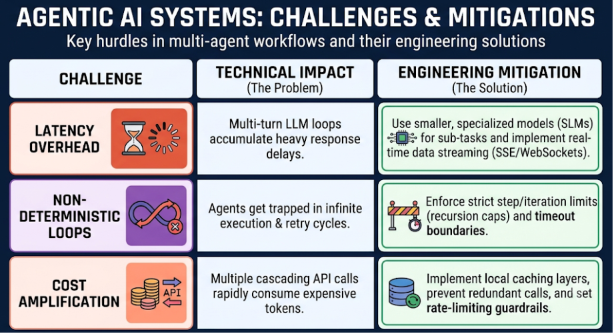
- Latency Accumulation: Because multi-agent workflows involve sequential reasoning steps and external tool calls, end-to-end response times can take several seconds. Students must implement streaming interfaces (like SSE or WebSockets) to maintain a responsive user experience.
- Cascading Errors and Infinite Loops: If an agent encounters unexpected tool output, it may repeatedly retry the same failing action. Setting recursion limits, strict exit conditions, and structured fallback paths is critical.
- Token Cost and Resource Consumption: Running five distinct agents for a single prompt can increase token usage by 5x to 10x. Students can mitigate this by combining local open-weight Small Language Models (SLMs) for basic tool selection with larger frontier models for final synthesis.
8. Real-World Implementation: Building a Multi-Agent Project
To illustrate how accessible these concepts are, let's examine the structure of an open-source, full-stack multi-agent project designed for a student portfolio.
Scenario: Full-Stack Developer Documentation Assistant
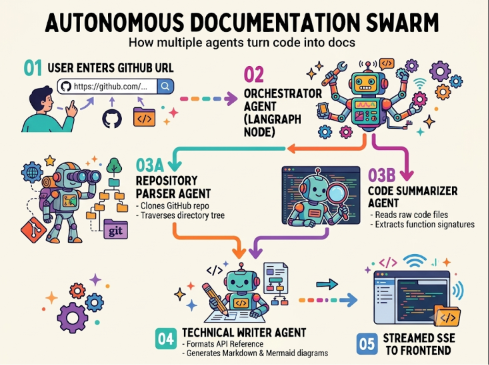
A student team built an autonomous documentation builder for developer repos. The application uses FastAPI on the backend, React with Tailwind CSS on the frontend, and LangGraph for multi-agent state orchestration.
Key Implementation Steps:
- State Graph Initialization: The backend defines a shared state dictionary containing repository metadata, file lists, generated summaries, and error logs.
- Tool Bindings: The Repository Parser agent is bound to shell tool commands for cloning public repos, while the Technical Writer agent uses Markdown validation tools.
- Execution & Self-Correction: If the Technical Writer agent generates broken Mermaid.js diagram syntax, a secondary validation node parses the output. If parsing fails, the error message is appended back to the state, prompting the writer node to correct its syntax automatically.
- Real-Time Streaming: Execution logs—showing exactly which agent is working and what tool is running—are pushed to the React UI using Server-Sent Events, providing full transparency into the system's thought process.
9. Future Outlook
As model capabilities expand throughout 2026 and beyond, several industry trends will shape the future of autonomous agent architecture:
- Local and Small Language Models (SLMs): On-device models optimized for tool calling (such as fine-tuned Llama 3 variants or Phi models) allow developers to run agent nodes locally without relying exclusively on cloud API keys.
- Standardized Agent Protocols: Emerging industry initiatives are defining universal protocols for agent-to-agent communication, enabling software systems from different vendors to negotiate and complete tasks inter-dependently.
- Edge Execution Sandboxes: WebAssembly (WASM) and lightweight containers are making it safer and faster to execute agent-generated code locally in isolated environments, opening up new opportunities for secure automation.
10. Conclusion
Mastering Agentic AI and Multi-Agent Orchestration offers technology and engineering students a direct path to acquiring modern, industry-relevant software skills. Transitioning from basic single-prompt scripts to stateful, loop-driven architectures requires a firm grasp of system design, error handling, state synchronization, and API integration.
By building multi-agent systems—whether a security auditing swarm, an automated research worker, or a real-time debugging assistant—students can create portfolio projects that clearly demonstrate software engineering maturity, technical depth, and practical innovation.