Why stepping outside the lecture hall to audit local supply chains, municipal budgets, judicial records, and ecological habitats builds sharper intellectual credibility than any passive certificate ever could.
The Lecture-Hall Illusion: Why Passive Degrees No Longer Differentiate
Every year across India, hundreds of thousands of bright students graduate with near-identical transcripts in Economics, Commerce, Political Science, Law, Literature, Psychology, and Pure Sciences. In admission interviews for premier postgraduate schools, think tanks, consulting practices, and policy fellowships, selection panels rarely struggle to find candidates who can recite textbook definitions. What they struggle to find are young thinkers who have ever tested an idea against messy reality.
Consider the difference between two final-year undergraduates applying for an economic research role:
- Candidate A lists three online certification courses, a high semester percentage, and an essay summarizing secondary newspaper articles on rural inflation.
- Candidate B spent four Saturdays interviewing twenty wholesale vegetable vendors at a district mandi, cross-checked local price markups against MOSPI Consumer Price Index releases, and wrote a crisp 1,500-word field note explaining cold-storage bottlenecks in their own town.
Candidate B did not need a laboratory grant, an engineering degree, or a line of software code. They used primary observation, public archives, and disciplined synthesis—the three timeless instruments of scholarship that belong equally to a Class 12 Humanities student, a second-year B.Com major, a law undergrad, or a B.Sc botany researcher.
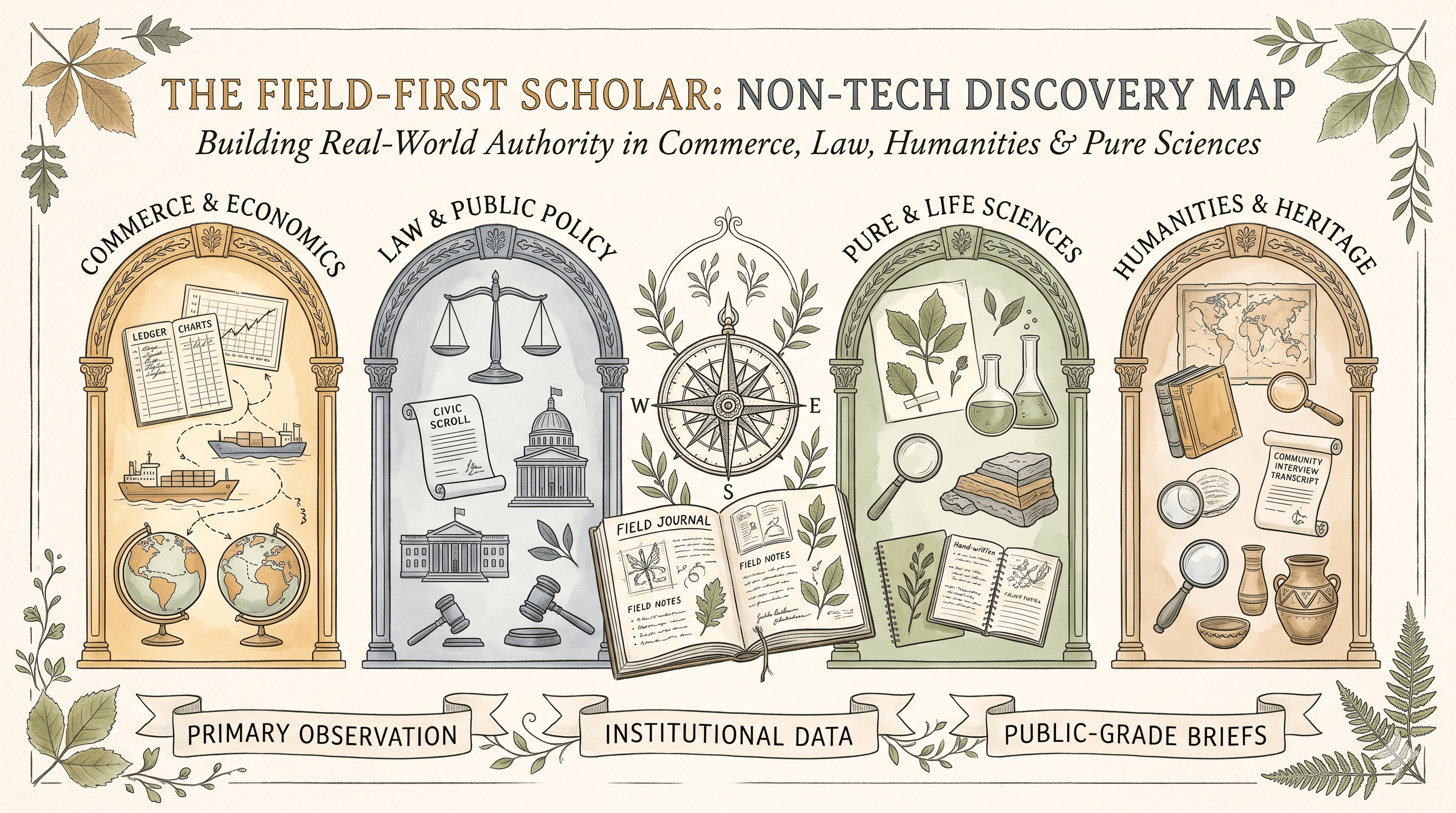
Four Discovery Domains: Mapping Fieldwork to Your Academic Stream
Original inquiry looks different depending on the lens of your discipline. Instead of waiting for a formal internship title, treat your immediate neighborhood, local institutions, and public archives as an open-air research studio:
Domain I: Commerce, Economics & Enterprise Audits
- The Question to Ask: Where do small businesses, local markets, or household budgets experience hidden friction?
- Fieldwork in Action: Conduct structured pricing and working-capital interviews with local pharmacies, kirana distributors, textile weavers, or cooperative banks. Compare what business owners report on the ground against official sectoral data from the Reserve Bank of India’s Database on Indian Economy (DBIE) and annual Economic Survey chapters.
- Signature Deliverable: A 10-page Micro-Market & Supply-Chain Audit complete with cost-structure tables, margin breakdowns, and practical recommendations for credit or inventory efficiency.
Domain II: Law, Public Policy & Civic Governance
- The Question to Ask: How does a statute, municipal rule, or welfare entitlement actually function at the last mile?
- Fieldwork in Action: Visit a local Consumer Disputes Redressal Commission, a municipal ward office, or a legal aid clinic to observe procedural bottlenecks firsthand. Pair on-ground observation with primary statutory texts, Parliamentary Standing Committee reports, and targeted applications filed under the Right to Information (RTI) Act, 2005.
- Signature Deliverable: A 2,000-word Civic Implementation Brief contrasting statutory intent with ground-level administrative reality, backed by verified public records.
Domain III: Pure, Environmental & Life Sciences
- The Question to Ask: What measurable patterns exist in local water quality, urban biodiversity, soil health, or public nutrition?
- Fieldwork in Action: Design repeatable, low-cost observational studies—mapping seasonal pollinator diversity across campus green zones, testing dissolved solids and pH across neighborhood water sources, or analyzing hospital outpatient seasonal trends using standard biostatistics.
- Signature Deliverable: A Reproducible Field & Lab Monograph formatted with clear hypothesis framing, control baselines, error margins, and visual data plots.
Domain IV: Humanities, Heritage & Social Ethnography
- The Question to Ask: Which oral histories, linguistic shifts, craft traditions, or community memory networks are disappearing undocumented?
- Fieldwork in Action: Record structured oral-history interviews with senior artisans, local archivists, or neighborhood educators; examine district gazetteers, vernacular periodicals, and municipal heritage registries to trace how a community’s social or cultural landscape evolved over five decades.
- Signature Deliverable: An Annotated Ethnographic & Archival Essay pairing transcribed primary testimonies with historical maps and photographic documentation.
The 3-Lens Field Investigation Workflow
Great student research rarely fails from a lack of intelligence; it fails because students gather scattered notes without a rigorous verification method. Use this three-lens workflow to move systematically from raw curiosity to a publication-grade document:
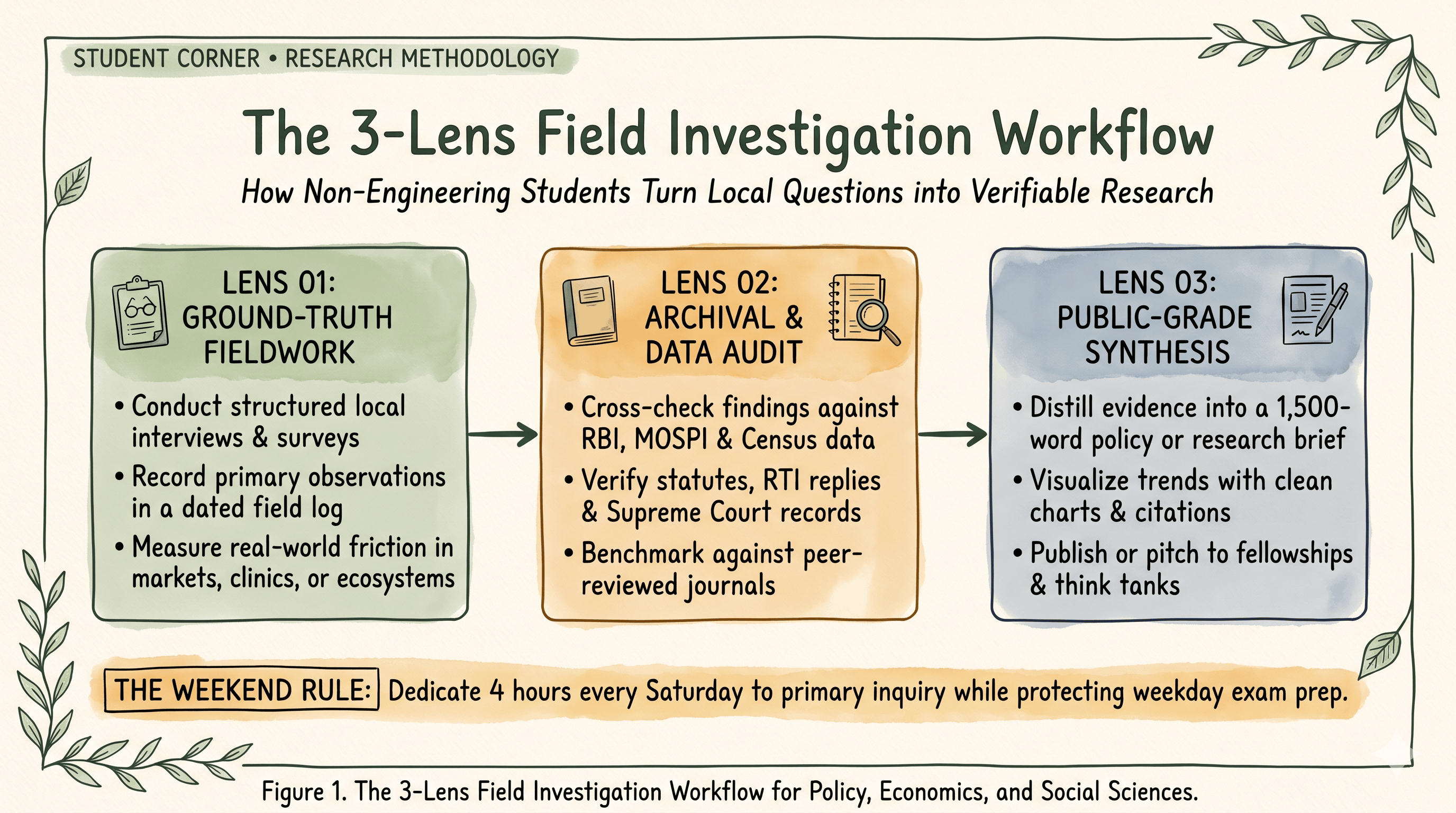
Lens 01: Ground-Truth Fieldwork (Capture Raw Reality First)
Before reading secondary commentary, collect primary observations directly:
- Define a Narrow Boundary: Never study "Indian education" or "urban pollution" in the abstract. Narrow your scope to one municipal ward, one marketplace, one court registry, or one ecosystem over a fixed four-week window.
- Use a Standardized Question Sheet: Whether interviewing fifteen shopkeepers or surveying forty commuters, ask every respondent the exact same five core questions so your answers can be compared quantitatively as well as qualitatively.
- Maintain a Dated Field Journal: Record dates, locations, respondent roles (anonymized where appropriate), and direct verbatim quotes immediately after each visit—never rely on memory days later.
Lens 02: Archival & Institutional Cross-Checking (Test Anecdotes Against Official Data)
Personal interviews reveal why something happens, while official datasets establish how widespread it is. Cross-examine your field notes against authoritative Indian repositories:
- Macro & Household Statistics: Ministry of Statistics and Programme Implementation (MOSPI), Periodic Labour Force Survey (PLFS), and National Family Health Survey (NFHS) state fact sheets.
- Financial & Banking Indicators: RBI DBIE, SEBI annual reports, and NABARD rural financial inclusion surveys.
- Legal & Legislative Texts: India Code, Supreme Court of India judgment archives, Law Commission of India reports, and PRS Legislative Research bill trackers.
- Scientific & Environmental Baselines: CSIR publications, Botanical/Zoological Survey of India records, and Central Pollution Control Board (CPCB) ambient monitoring bulletins.
Lens 03: Public-Grade Synthesis (Write for Decision-Makers, Not Examiners)
Academic exam answers are written to prove you read the syllabus; field briefs are written to help a busy reader make a better decision:
- Lead with the Finding: Open with a 150-word Executive Abstract stating what you investigated, what your primary evidence proved, and what specific change you propose.
- Show Your Method Transparently: Include a brief Methodology & Limitations box explaining your sample size, date range, and potential biases—intellectual honesty immediately signals maturity to faculty and recruiters.
- Publish & Archive Permanently: Host your finished brief on a clean Substack, Medium, SSRN (for economics, law, and policy working papers), or a dedicated Notion portfolio so every application you send includes a live, verifiable link.
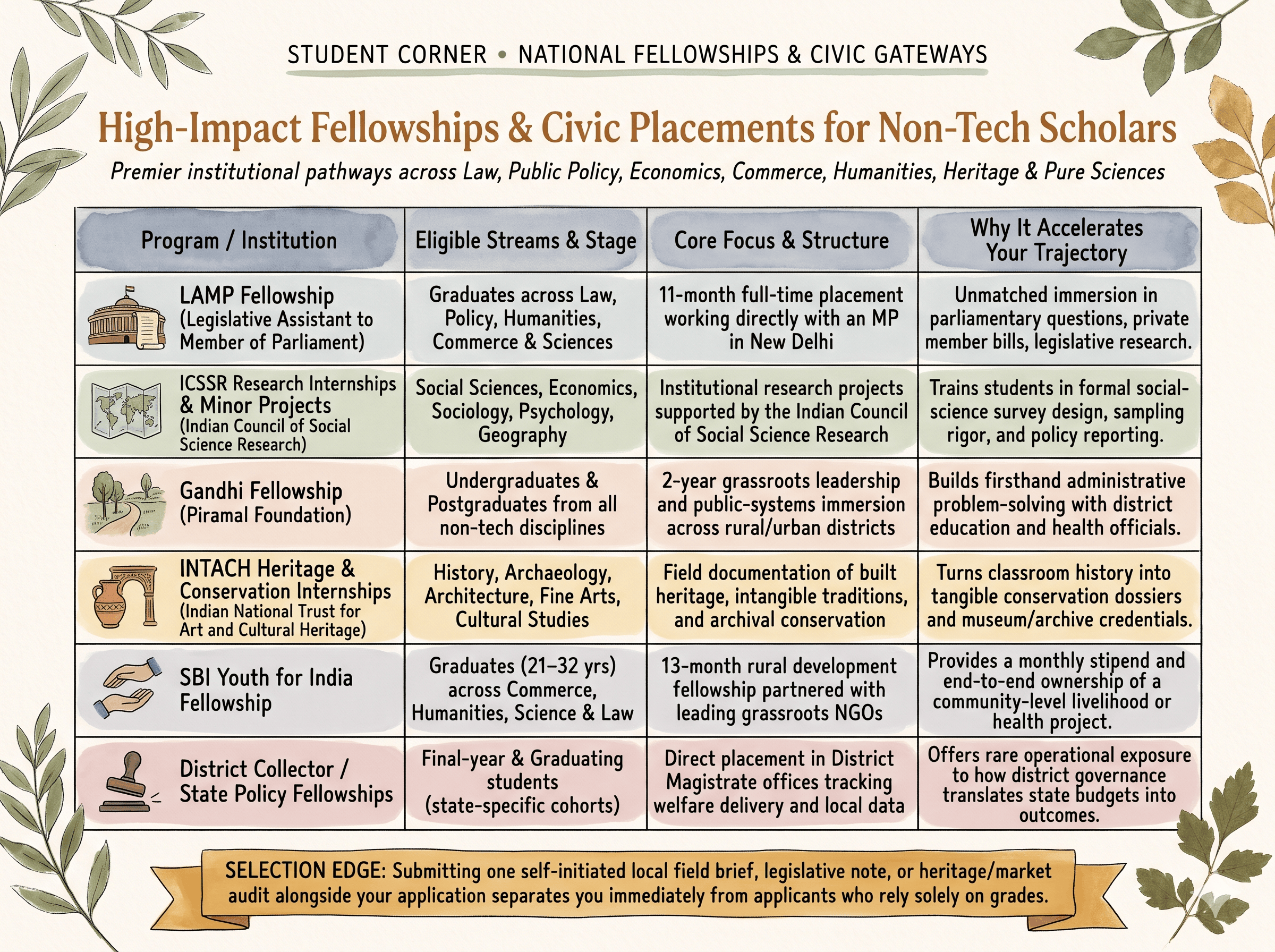
National Fellowships, Civic Labs & Research Gateways (2026–27)
Once you have two or three self-initiated field briefs in your portfolio, you become a standout contender for India’s most competitive non-engineering fellowships and research placements:
The Saturday-Morning Rhythm: Protecting Your Grades While Building Depth
You do not need to skip classes or jeopardize your university CGPA or Class 12 board exams to become a field-first scholar:
- Keep Weekdays Sacred for Core Academics: Dedicate Monday through Friday to lectures, textbook mastery, and exam preparation. A strong academic transcript remains the foundation that unlocks formal fellowships.
- Claim Four Hours Every Saturday Morning: Use 8:00 AM to 12:00 PM on Saturdays exclusively for your field project—visiting a local site, conducting interviews, pulling MOSPI/RBI tables, or drafting 500 words of your brief. Over a 12-week semester, those four weekly hours yield 48 hours of focused primary inquiry, enough to complete two rigorous field reports per term.
- Pair Up Across Disciplines: Collaborate with one peer from a complementary stream—an Economics student paired with a Law student, or a Botany student paired with a Journalism major—so one partner leads quantitative/archival verification while the other sharpens narrative clarity and visual presentation.
Copy-Paste Outreach Template: Pitching a Faculty Mentor or Local Organization
Use this concise, professional note when requesting faculty guidance, institutional access, or a local field internship:
Subject: Undergraduate Field Inquiry Proposal: [Specific Local Topic, e.g., Working-Capital Cycles in Ghaziabad Retail Pharmacies]
Dear Professor / Dr. [Last Name],
I am a [Year, e.g., Second-Year B.Com / BA Political Science / B.Sc Environmental Science] student at [College/University Name] with a strong interest in [specific sub-field]. Over the next six weeks, I am conducting a structured primary study examining [insert 1-sentence specific research question] within [specific local ward/market/institution].
To ensure my methodology is rigorous, I have already compiled baseline data from [mention 1 primary source, e.g., RBI DBIE / MOSPI PLFS / recent Supreme Court rulings] and drafted a 10-question field interview schedule. I have attached a one-page summary of my proposed method alongside a recent analytical brief I wrote on [mention past essay or class paper].
Would you be open to a brief 15-minute conversation next week to critique my sampling approach or advise on institutional permissions?
Warm regards,
[Your Full Name]
[Degree & Semester] • [Phone Number] • [Link to Writing/Portfolio]