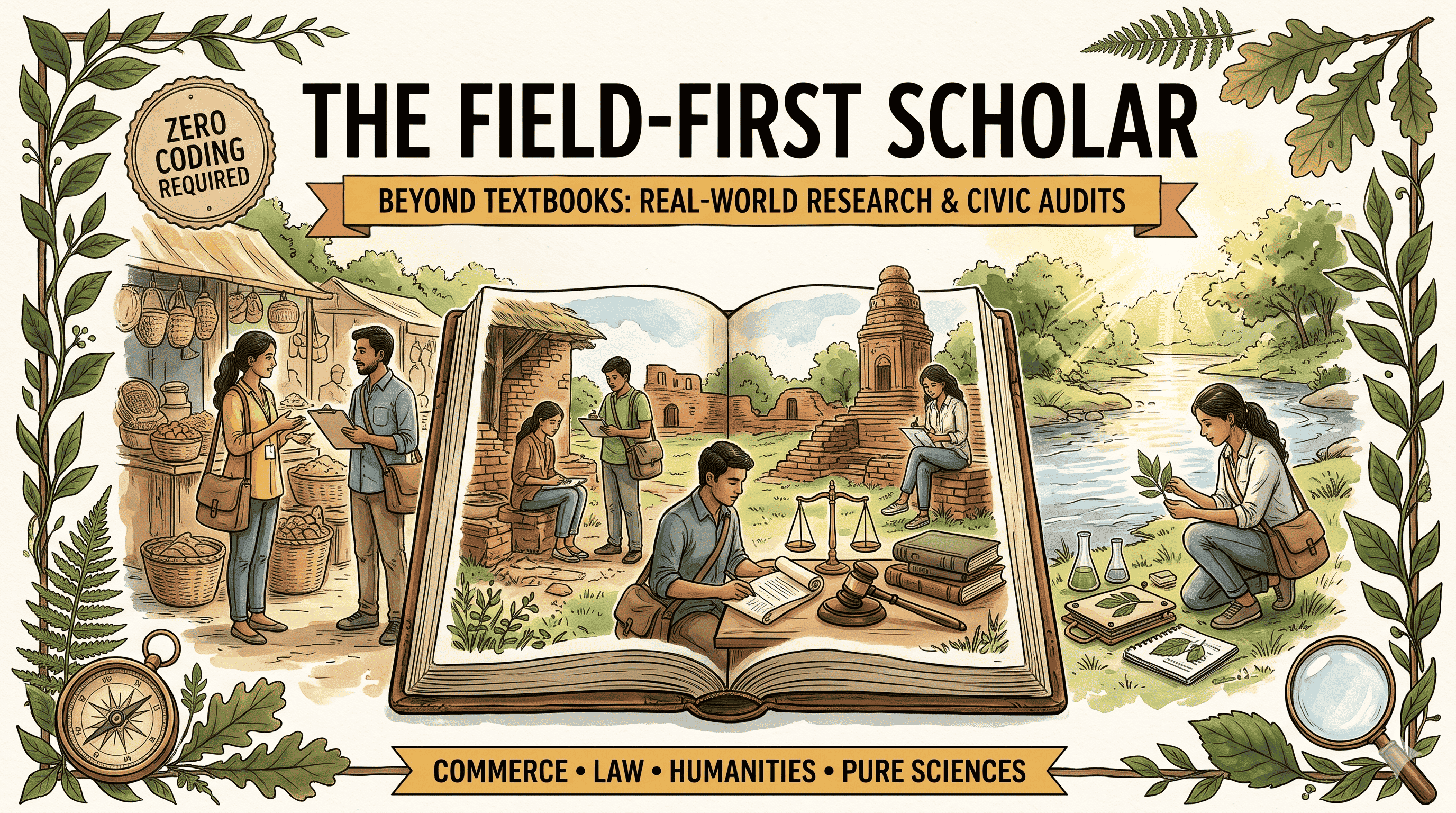
Walk into almost any college career seminar today and you will hear the same repetitive advice: learn programming, build software apps, and upload code repositories to prove your worth. For millions of ambitious students pursuing Commerce (B.Com, BBA, BMS), Economics, Humanities (Political Science, History, Psychology, Sociology), Pure Sciences (B.Sc Physics, Chemistry, Biology, Mathematics), Law (LLB), and Design (B.Des), that narrow narrative creates a false impression that structured "portfolios" belong only to engineers.
In reality, management consulting firms, investment banks, public policy think tanks, corporate strategy teams, media houses, legal chambers, and scientific research institutes evaluate candidates using the exact same principle: verifiable proof of judgment. Whether you are analyzing a company’s unit economics, drafting a legislative policy memo, designing an accessible public service workflow, or conducting an ecological field survey, employers and graduate schools look for tangible artifacts that prove you can think independently under real-world constraints.
Stream-by-Stream Blueprint: What Replaces a "Coding Portfolio" in Your Field?
Every academic discipline has its own high-signal equivalent of an engineering portfolio. Instead of collecting passive participation certificates from webinars, focus on producing two to three deep, defensible artifacts tailored to your stream:
1. Commerce, Finance, Economics & Management (B.Com, BBA, BMS, BA Economics)
- The Core Portfolio Artifact: A 10-to-15-page Equity Research Report, a Sector Deep-Dive Memo, or a 10-slide Consulting Strategy Deck dissecting a real business bottleneck (such as rural supply-chain margin compression or quick-commerce unit economics).
- High-Leverage Skill Stack: Advanced Microsoft Excel (financial modeling, pivot tables, sensitivity analysis), structured slide storytelling, primary consumer survey design, and foundational regulatory credentials such as NISM (National Institute of Securities Markets) certifications.
- Where to Prove It: National business strategy arenas including IIM Ahmedabad’s Red Brick Summit, IIM Bangalore’s Vista, IIM Calcutta’s Intaglio, SRCC Shri Ram CaseCon, SSCBS Finanza/Markhaven, and the CFA Institute Research Challenge.
2. Humanities, Public Policy, Governance & Law (BA, LLB, Political Science, Sociology, Psychology)
- The Core Portfolio Artifact: A 2,000-word Evidence-Backed Policy Brief, a Legislative Impact Tracker, or a Moot Court Memorial evaluating an active Indian welfare scheme, urban governance challenge, or constitutional question.
- High-Leverage Skill Stack: Qualitative and quantitative policy research, RTI (Right to Information) data analysis, structured legal/policy argumentation, ethnographic interviewing, and clear persuasive writing.
- Where to Prove It: Premier governance and think-tank programs such as the NITI Aayog Internship Scheme, PRS Legislative Research, Vidhi Centre for Legal Policy, Centre for Civil Society (CCS), Ministry of External Affairs (MEA) Internships, and national moot court or Youth Parliament circuits.
3. Pure & Natural Sciences (B.Sc Physics, Chemistry, Botany, Zoology, Mathematics, Environmental Science)
- The Core Portfolio Artifact: An Undergraduate Empirical Monograph, a Reproducible Laboratory Notebook, or a Systematic Literature Meta-Analysis documenting original experimental design, error margins, and statistical interpretation.
- High-Leverage Skill Stack: Experimental methodology, scientific literature review (via Google Scholar and PubMed), statistical hypothesis testing, clean scientific graphing, and formal academic poster presentation.
- Where to Prove It: India’s premier funded undergraduate science programs, including the IASc–INSA–NASI Summer Research Fellowship Programme (SRFP), TIFR Visiting Students’ Research Programme (VSRP), IISER Summer Research Fellowships, and JNCASR project internships.
4. Design, Journalism, Mass Communication & Social Impact (B.Des, BA Journalism, Social Work)
- The Core Portfolio Artifact: An end-to-end Human-Centered Usability & Service Design Case Study, an Investigative Photo-Essay, or a Grassroots Community Impact Audit backed by on-ground interviews and measurable before-and-after metrics.
- High-Leverage Skill Stack: Design thinking, field ethnography, visual information hierarchy (Figma, Canva, Adobe Creative Suite), editorial fact-checking, and impact assessment frameworks.
- Where to Prove It: Global and national impact platforms such as the Hult Prize (social entrepreneurship), UNESCO / UNICEF Youth Fellowships, DesignUp student showcases, and national documentary or journalism awards.
The 4-Stage Non-Tech Excellence Pipeline (From Semester 1 to Graduation)
Trying to build a resume in the final two months before placements or postgraduate admissions rarely works. Follow this four-stage progression across your degree so your credentials compound naturally every semester:
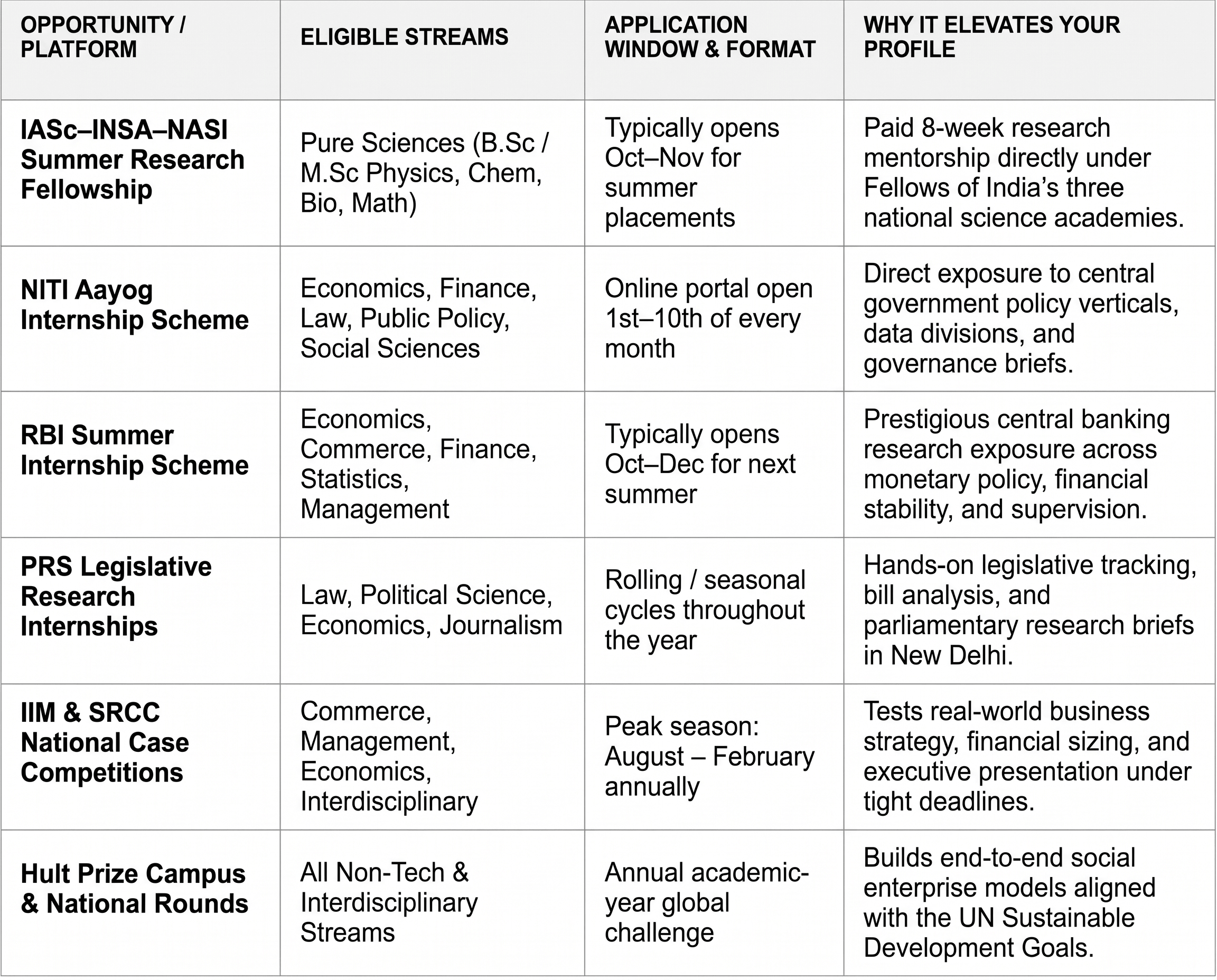
High-Impact National Fellowships & Platforms Worth Bookmarking
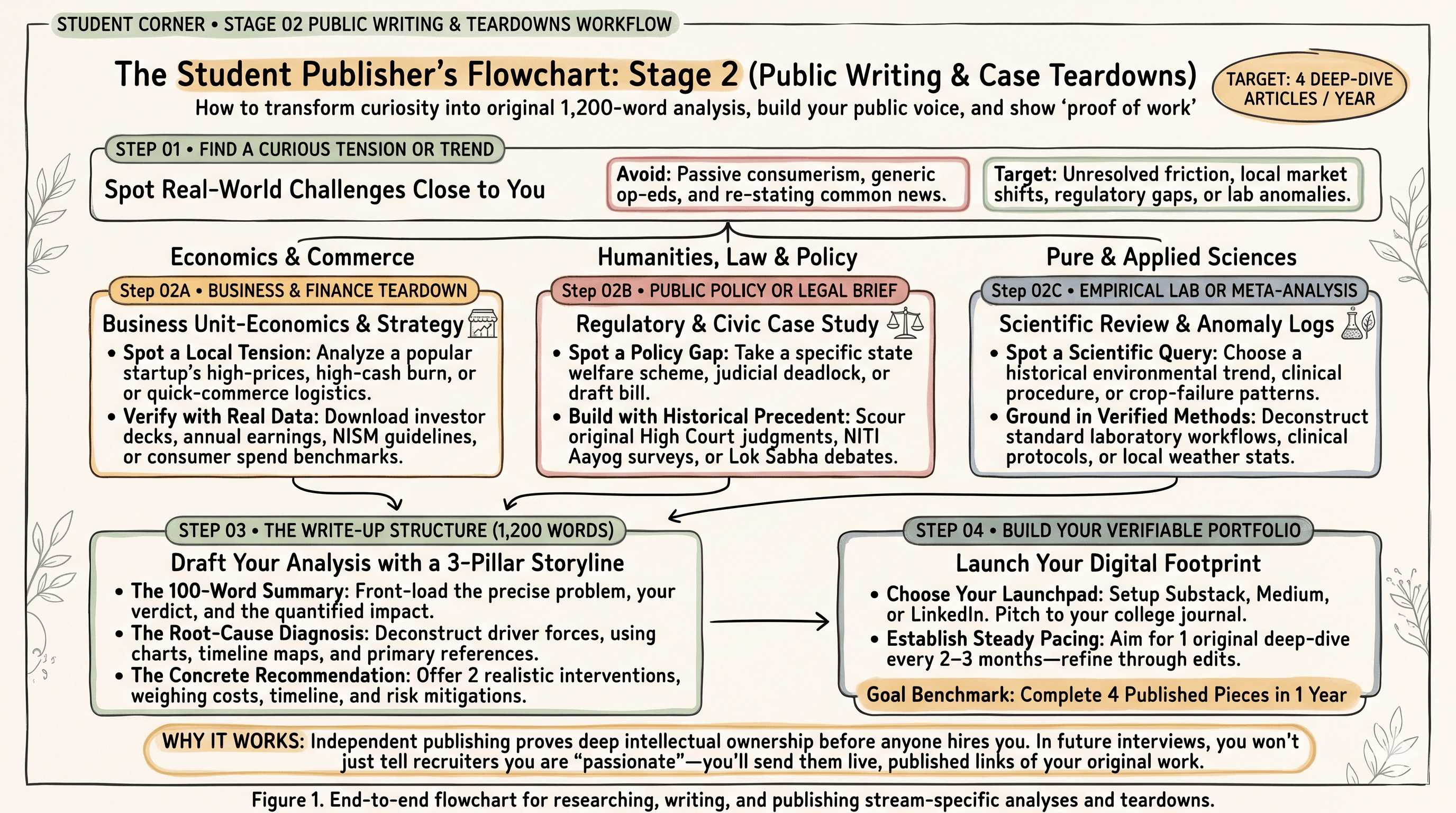
Anatomy of a Winning Non-Tech Case Deck or Policy Brief
Whether you are submitting a strategy deck to an IIM case competition or a policy memo to a think tank, top evaluators look for a crisp four-part logical spine:
- The Executive Thesis (Page 1): State the core problem, your central recommendation, and the quantified impact in the very first three sentences—never bury your conclusion on the final page.
- Root-Cause Diagnosis with Evidence: Break the problem into mutually exclusive drivers supported by primary survey numbers, government datasets (such as MOSPI, NFHS, or RBI bulletins), or financial ratios rather than generic opinions.
- Actionable, Feasible Recommendations: Propose two or three concrete interventions specifying who executes them, how much they cost, and what timeline is required.
- Risk Matrix & Mitigation Plan: Acknowledge the strongest counterargument or implementation bottleneck (regulatory hurdles, adoption friction, or budget trade-offs) and explain how your plan addresses it.
Five Weekly Habits to Balance University Exams with Portfolio Building
- Guard the 80/20 Split: Dedicate 80% of your weekly study hours to university lectures, core readings, and maintaining a strong CGPA, and reserve 20% (4–5 focused hours on weekends) exclusively for writing, case prep, or research.
- Master One Spreadsheet & One Visual Tool: Proficiency in Excel/Google Sheets (for data tables and clean charts) paired with Canva, PowerPoint, or Figma (for clean document layout) instantly separates your work from cluttered student submissions.
- Build a Three-Person Peer Review Circle: Partner with two classmates from complementary streams—for example, pairing an Economics major, a Law student, and a Design student—to critique each other’s arguments and slide clarity every fortnight.
- Keep a Source & Citation Log: Always record where every statistic, quote, or legal citation came from; intellectual honesty and verifiable citations are non-negotiable in research, finance, and policy.
- Pause Extracurriculars Three Weeks Before Semester Finals: Step back from competitions and newsletters ahead of university exams so your academic transcript remains just as strong as your public portfolio.