Most students treat Classes 9 through 12 as a four-year waiting room where real engineering, research, and software building are postponed until the first year of college. In 2026, that mindset puts high school students four years behind peers who start experimenting early.
At the same time, diving into coding or AI tools blindly without structure can backfire—leading to scattered tutorials, copy-pasted homework, and unnecessary stress during Board exam months. The secret is not studying more hours; it is connecting what you already learn in Mathematics, Physics, Economics, and Computer Science directly to hands-on code and disciplined thinking. When you write a 30-line Python script to plot projectile motion or simulate compound interest, you stop memorizing formulas—you understand how the underlying system actually works.
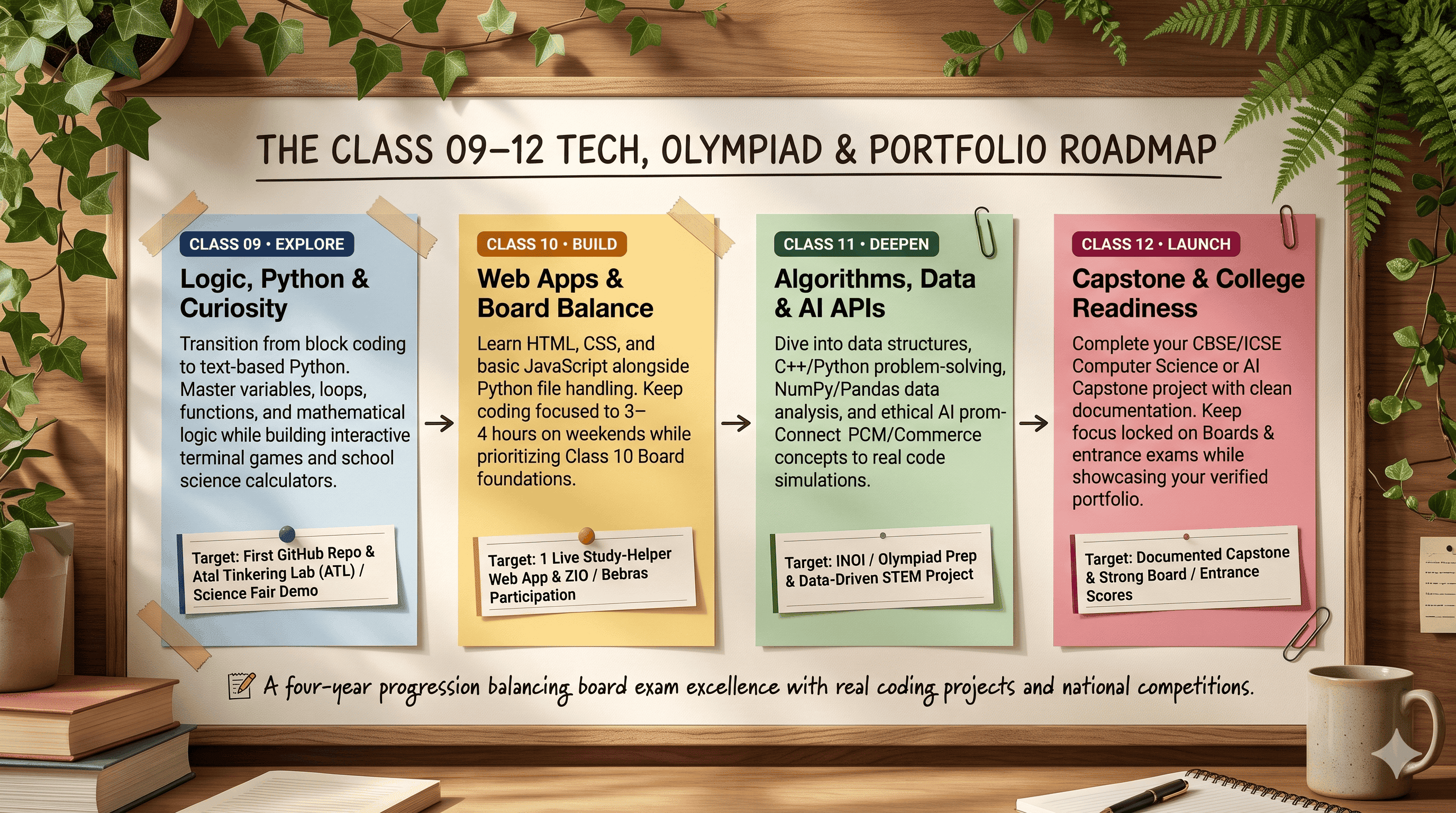

The Four-Year Grade-by-Grade Roadmap (Class 9 to Class 12)
Trying to learn everything at once leads to burnout. Instead, match your technical goals to the academic rhythm of each school year:
Class 9: Logic, Python Foundations & Curiosity
- Core Technical Focus: Transition from visual block tools (like Scratch) to clean, text-based Python. Master variables, conditional statements (
if/elif/else),forandwhileloops, lists, dictionaries, and modular functions. - Academic Synergy: Use Python to verify Class 9 Coordinate Geometry distances, statistics mean/median calculations, and kinematics equations.
- Milestone Deliverable: Create your first GitHub account, push 5 clean mini-programs, and build a working prototype for your school’s Atal Tinkering Lab (ATL) or annual science exhibition.
Class 10: Web Fundamentals, Olympiad Logic & Board Balance
- Core Technical Focus: Pair Python file handling (
CSVandJSONstorage) with core web technologies (HTML5, CSS3, and basic JavaScript) so your projects have visual interfaces rather than black terminal screens. - Academic Synergy: Keep extracurricular coding strictly bounded to 3–4 hours on weekends so Class 10 Board preparation remains your primary priority.
- Milestone Deliverable: Build one lightweight study-utility web app (such as a Pomodoro revision timer or formula flashcard tester) and appear for foundational algorithmic contests like the Bebras Computational Thinking Challenge and Zonal Informatics Olympiad (ZIO).
Class 11: Algorithms, Data Analysis & Ethical AI Workflows
- Core Technical Focus: Class 11 offers the widest runway before Class 12 Board pressure peaks. Learn foundational Data Structures (arrays, strings, stacks, recursion, sorting, binary search) in C++ or Python, alongside introductory data libraries (NumPy, Pandas, Matplotlib) and structured AI prompting.
- Academic Synergy: Whether you choose PCM (Science), Commerce, or Humanities, apply data analysis to your stream—analyzing climate datasets, stock index trends, or census demographics.
- Milestone Deliverable: Qualify for the Indian National Olympiad in Informatics (INOI) or submit a data-backed innovation entry to INSPIRE Awards – MANAK or national high school hackathons.
Class 12: Capstone Execution & Exam-Hall Focus
- Core Technical Focus: Shift from learning brand-new frameworks to polishing and documenting one flagship project—ideally aligned with your CBSE/ICSE Class 12 Computer Science (083) or Artificial Intelligence (843) practical project.
- Academic Synergy: Dedicate 85–90% of your weekly energy to Board exams and entrance tests (JEE, NEET, CUET, IAT, or UGEE). A disciplined, high-scoring Class 12 finish unlocks top universities where your early portfolio will immediately set you apart for research labs and internships.
- Milestone Deliverable: A complete, cleanly documented capstone repository featuring a
README.md, architecture flowchart, sample dataset, and viva-ready explanation.
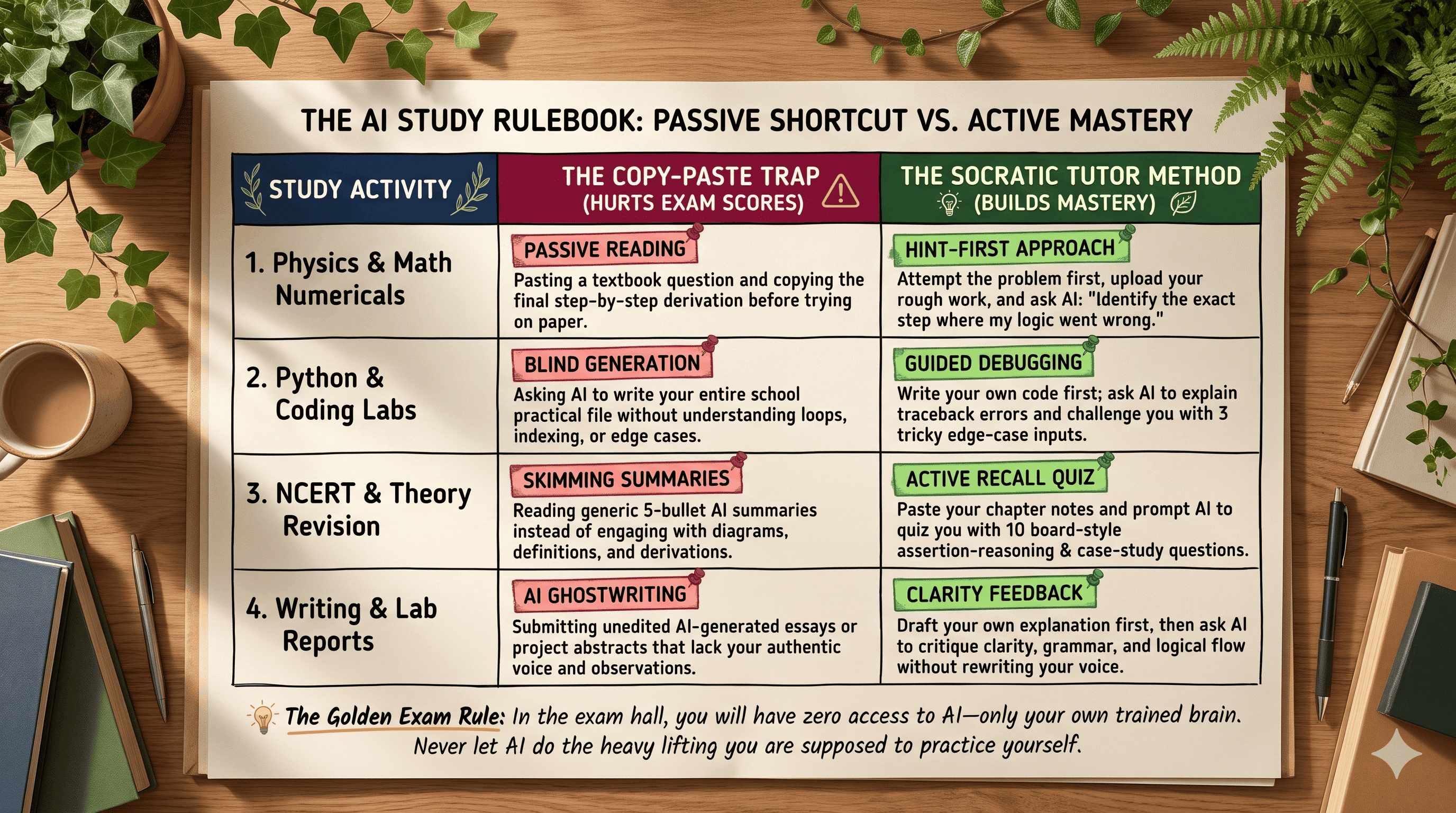
The AI Study Rulebook: Using AI as a Socratic Tutor, Not a Crutch
Generative AI assistants are now accessible to every high school student, creating a sharp divide between two groups: students who use AI to skip thinking (and struggle in closed-book exam halls) and students who use AI as a 24/7 Socratic tutor to uncover conceptual blind spots.
The Copy-Paste Socratic Study Prompt (Save & Reuse)
Whenever you get stuck on an NCERT exercise, Olympiad puzzle, or Python bug, paste this instruction before your question so the AI coaches your brain instead of handing over the answer:
Act as a strict but encouraging Class 11–12 STEM tutor.
Do NOT give me the final answer or full code solution right away.
1. Ask me what I have tried so far or point out the exact step where my reasoning went wrong.
2. Give me ONE small conceptual hint based on NCERT / foundational principles.
3. Wait for my response before moving to the next step.
4. After I solve it, quiz me with one slightly harder variation to test my mastery.Act as a strict but encouraging Class 11–12 STEM tutor.
Do NOT give me the final answer or full code solution right away.
1. Ask me what I have tried so far or point out the exact step where my reasoning went wrong.
2. Give me ONE small conceptual hint based on NCERT / foundational principles.
3. Wait for my response before moving to the next step.
4. After I solve it, quiz me with one slightly harder variation to test my mastery.
Four High-Impact Projects You Can Build Before Finishing School
Skip generic calculator and to-do list tutorials. Build projects that solve real problems in your daily academic life and demonstrate genuine engineering logic during school vivas and college interviews:
- NCERT Physics Kinematics & Projectile Motion Simulator (Class 9–11): Take launch velocity ($u$), angle ($\theta$), and gravity ($g$) as inputs, compute maximum height, range, and time of flight, and plot the parabolic trajectory using
matplotlib. - Spaced-Repetition Exam Revision Tracker (Class 10–12): A Python + SQLite/CSV tracker that logs topics you missed in mock tests and automatically schedules revision reminders at 1-day, 3-day, 7-day, and 21-day intervals.
- Local Air Quality & Weather Anomaly Analyzer (Class 11–12): Download public AQI and temperature CSV records for your city, clean missing rows with
pandas, and identify seasonal pollution spikes and moving averages. - Offline Viva & Assertion-Reasoning Quiz Engine (Class 9–12): A terminal or web app that reads your structured JSON question bank, randomizes assertion-reasoning pairs, tracks accuracy per chapter, and exports a weak-topic report.
Starter Code Blueprint: Interactive Kinematics & Trajectory Analyzer (Python)
Run this self-contained script to see how a few lines of clean Python turn Class 11 Physics equations into an analytical simulation:
import math
def analyze_projectile(velocity_ms: float, angle_deg: float, g: float = 9.81) -> dict:
    """Calculates key projectile motion metrics for a given launch speed and angle."""
    theta = math.radians(angle_deg)
    vx = velocity_ms * math.cos(theta)
    vy = velocity_ms * math.sin(theta)
    time_of_flight = (2 * vy) / g
    max_height = (vy ** 2) / (2 * g)
    horizontal_range = vx * time_of_flight
    return {
        "time_of_flight_s": round(time_of_flight, 2),
        "max_height_m": round(max_height, 2),
        "horizontal_range_m": round(horizontal_range, 2),
    }
if __name__ == "__main__":
    speed = float(input("Enter launch speed (m/s): "))
    print("\n--- Launch Angle Comparison ---")
    for angle in [30, 45, 60, 75]:
        metrics = analyze_projectile(speed, angle)
        print(
            f"Angle {angle}° -> Time: {metrics['time_of_flight_s']}s | "
            f"Max Height: {metrics['max_height_m']}m | "
            f"Range: {metrics['horizontal_range_m']}m"
)import math
def analyze_projectile(velocity_ms: float, angle_deg: float, g: float = 9.81) -> dict:
"""Calculates key projectile motion metrics for a given launch speed and angle."""
theta = math.radians(angle_deg)
vx = velocity_ms * math.cos(theta)
vy = velocity_ms * math.sin(theta)
time_of_flight = (2 * vy) / g
max_height = (vy ** 2) / (2 * g)
horizontal_range = vx * time_of_flight
return {
"time_of_flight_s": round(time_of_flight, 2),
"max_height_m": round(max_height, 2),
"horizontal_range_m": round(horizontal_range, 2),
}
if __name__ == "__main__":
speed = float(input("Enter launch speed (m/s): "))
print("\n--- Launch Angle Comparison ---")
for angle in [30, 45, 60, 75]:
metrics = analyze_projectile(speed, angle)
print(
f"Angle {angle}° -> Time: {metrics['time_of_flight_s']}s | "
f"Max Height: {metrics['max_height_m']}m | "
f"Range: {metrics['horizontal_range_m']}m"
)
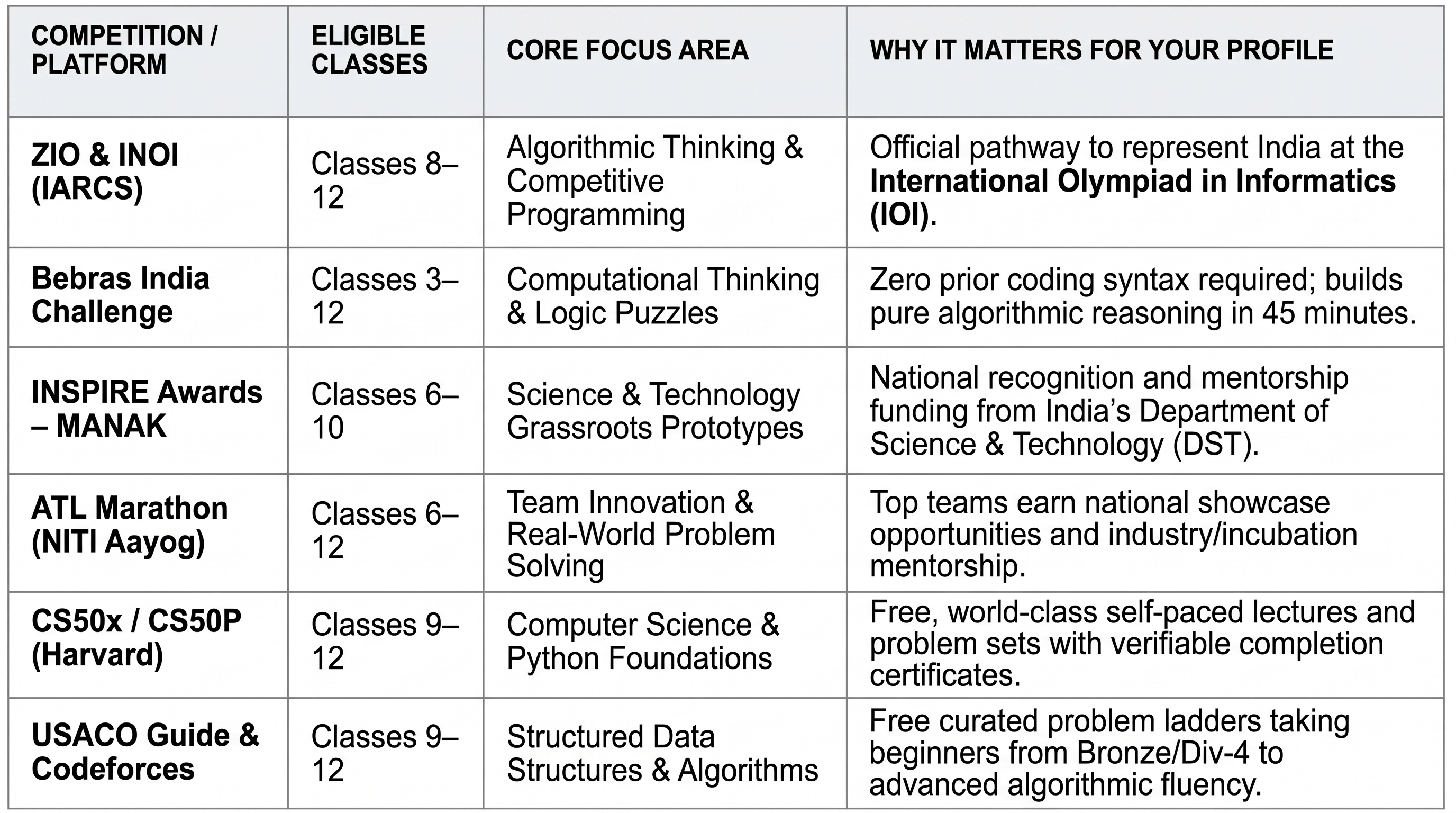
National & Global Competitions, Olympiads & Free Platforms (Classes 9–12)
Competing against peers outside your school classroom is the fastest way to benchmark your problem-solving skills:
The 7-Habit Weekly Balance Checklist (Boards + Coding Without Burnout)
Consistency over four years beats exhausting 12-hour weekend marathons that collapse during exam season:
- Protect Daily Core Study Blocks First: Complete your school homework, NCERT reading, and numerical practice before opening your code editor.
- Adopt the "3 Hours on Weekends" Rule During Exam Terms: During pre-boards or board semesters, cap coding to a focused Saturday or Sunday block so technical curiosity recharges you rather than competing with revision.
- Keep a Handwritten Problem-Solving Notebook: Always sketch flowcharts, dry-run loops, and work out mathematical edge cases on paper before typing code.
- Build in Public with Clean Documentation: Write a 5-sentence explanation of what your project does, what math/science concept it uses, and one bug you fixed in every repository’s
README.md. - Form a 3-Person Peer Study & Code Circle: Review each other’s physics derivations and Python scripts once a week—teaching a concept to a classmate locks it into long-term memory.
- Prioritize Sleep Over Late-Night Screen Time: Memory consolidation for both Board derivations and algorithmic logic happens during deep sleep; aim for 7.5–8 hours nightly.
- Review Your Progress Every Quarter: Every three months, archive half-finished tutorials and polish your single best project so your portfolio stays sharp, focused, and honest.
You do not need an expensive laptop, paid coaching, or a college degree to start thinking like an engineer in Class 9, 10, 11, or 12. By treating AI as a disciplined sparring partner, connecting your school subjects to hands-on Python projects, and pacing your milestones across all four years, you graduate high school with something rare: strong academic fundamentals backed by verifiable proof that you can build.