For decades, lateral specialist hiring in Indian public-sector banking rarely competed directly with private-sector technology or global financial benchmarks. That boundary shifted decisively with State Bank of India’s (SBI) recruitment drive to onboard six senior artificial intelligence specialists, anchored by a newly created Chief AI Officer (CAIO) position carrying an annual compensation package of up to ₹1.6 crore.
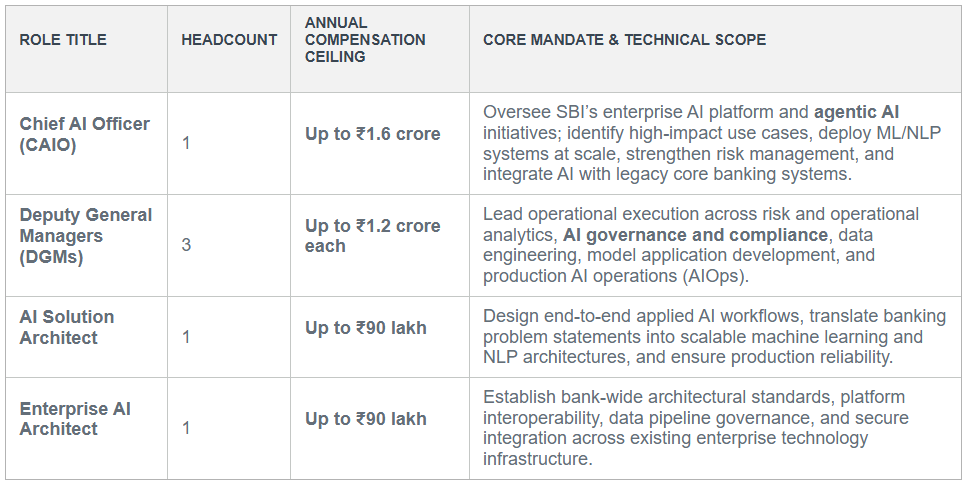
Rather than hiring a single figurehead, SBI structured a multi-tiered leadership cohort spanning strategy, governance, and core architecture: one Chief AI Officer, three Deputy General Managers (DGMs) offered up to ₹1.2 crore each, and two specialized architects—an AI Solution Architect and an Enterprise AI Architect—each carrying packages of up to ₹90 lakh. All six appointments run on an initial three-year contract, extendable by up to two additional years at the bank’s discretion, following an application window that ran from October 19 to November 9, 2026.
Role-by-Role Architecture of SBI’s Six-Member AI Leadership Cohort
Each tier in SBI’s recruitment blueprint targets a distinct layer of the enterprise AI stack—linking executive decision-making with day-to-day model engineering and compliance oversight:
Why "Agentic AI" and Legacy Integration Define the CAIO Mandate
Unlike earlier waves of banking automation that focused narrowly on rule-based chatbots or static credit-scoring models, SBI’s mandate explicitly tasks the Chief AI Officer with steering agentic AI initiatives alongside machine learning and natural language processing (NLP) platforms.
In a financial institution operating at SBI’s scale, deploying autonomous and semi-autonomous AI workflows introduces two interconnected challenges:
- Deep Core-Banking Integration: AI models cannot sit in isolated innovation sandboxes; they must interface cleanly with existing legacy banking infrastructure, transaction ledgers, and customer-facing channels without degrading latency or system stability.
- Operational & Model Risk Oversight: As AI systems take on multi-step operational and analytical tasks, unchecked model drift, hallucination, or biased credit decisions carry direct regulatory and financial consequences—explaining why AI governance, compliance, and model oversight sit at the heart of both the CAIO and DGM charters.
Strict Leadership Pedigree: The Eligibility Bar for the CAIO Seat
To ensure the incoming Chief AI Officer can navigate both complex regulatory frameworks and large-scale technology transformations, SBI set a demanding leadership threshold:
- Age Bracket: Candidates must be between 40 and 55 years old as of September 30, 2026.
- Domain Tenure: Applicants require at least 15 years of professional experience across banking, financial services, insurance (BFSI), or information technology.
- Senior Governance Track Record: Within that 15-year span, candidates must demonstrate at least three years in senior leadership positions directly involving artificial intelligence, analytics, model oversight, governance, or enterprise-wide business transformation.
The Cybersecurity Catalyst: Governance After Data Exposure
The timing of SBI’s executive AI build-out also reflects heightened urgency around digital defense and institutional trust. The recruitment drive follows a reported cyberattack on SBI in which 3,897 customer records were stolen, placing data protection, real-time anomaly detection, and resilient governance squarely in the spotlight.
For systemically important banks, dedicated AI leadership is no longer purely an efficiency play—it is a defensive necessity. Consolidating risk analytics, compliance, data engineering, and model operations under seasoned executive leaders gives the bank centralized accountability over how customer data is ingested, protected, and audited across every automated workflow.
What SBI’s Move Signals for the Broader BFSI Sector
By pricing specialist AI leadership between ₹90 lakh and ₹1.6 crore on renewable multi-year contracts, SBI has established a clear market template for public-sector and mid-sized private banks across India:
- Dedicated C-Suite Ownership: Enterprise AI can no longer be treated as a secondary portfolio under traditional IT administration; banks increasingly require a dedicated CAIO accountable for both business value and regulatory compliance.
- Balanced Leadership Pods: Pairing a strategic CAIO with three execution-focused DGMs and two principal architects prevents the common enterprise trap of hiring a visionary leader without the architectural bench strength needed to ship production systems.
- Governance-First Scaling: As agentic AI moves closer to core financial workflows, institutions that embed model oversight and cybersecurity discipline from day one will scale faster—and safer—than those treating governance as an afterthought.