A major shift is happening in how tech companies hire global talent. IBM has discontinued H-1B visa and green card sponsorship for most roles within its US consulting business. The decision directly affects immigrant employees who rely on the company for work visa sponsorship and permanent residency in the United States. For those affected, the clock is ticking: they must either secure overseas assignments with the company or prepare to leave IBM by the end of the year, according to Bloomberg. An IBM spokesperson confirmed that the company's participation in high-skilled visa programs has been declining for several years. While it marks a significant pivot for IBM, it is a move that has been years in the making as tech companies adjust to a new regulatory landscape.
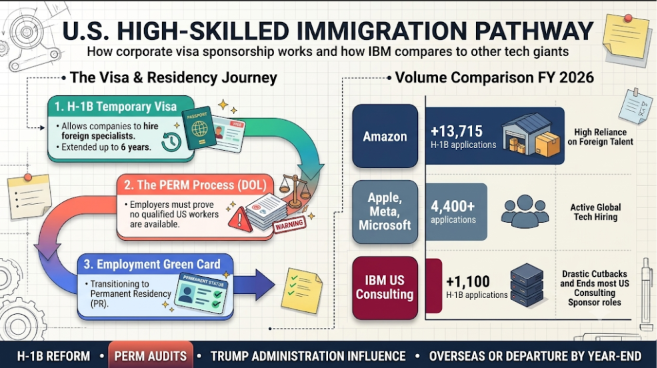
Decoding the Visa & Residency Journey: The Hard Pivot From H-1B to PERM
The H-1B visa is the standard pathway for US companies to hire foreign professionals in specialized occupations. Initially granted for three years, it can generally be extended for another three. However, the H-1B is only a temporary fix. For employers seeking to retain workers permanently, the natural next step is the green card process. This transition starts with the Program Electronic Review Management (PERM) labor certification—the initial step for the most common employment-based green card categories. Under PERM, employers must prove that qualified American workers are unavailable for the offered positions through structured recruitment processes. IBM's new decision completely covers applications under both the H-1B program and the PERM process, effectively cutting off both the temporary stay and the permanent residency path for most of its US consulting hires.
Evaluating Global Talent Dependency: IBM vs. Big Tech
IBM's visa sponsorship scale has historically been much smaller than its peers. In the 2026 fiscal year, which concluded on September 30, IBM applied for just over 1,100 H-1B visas, according to US Department of Labor data. In comparison, Big Tech has a much larger footprint. Amazon, for example, applied for more than 13,715 H-1B visas by the third quarter of fiscal year 2026—about 11 times IBM's figure. Other tech giants like Apple, Meta, and Microsoft each sought approximately four times as many visas as IBM. By stepping back from H-1B and PERM sponsorships in its consulting division, IBM is distancing itself even further from this peer group, opting instead to limit its reliance on foreign high-skilled hires in its client-facing, advisory businesses.
The Pressure From Washington: Trump Administration Scrutiny and Enforcement
This decision does not exist in a vacuum; it is happening during a time of intense government scrutiny. The Trump administration has significantly increased oversight of the H-1B visa program and employment-based green card pathways. While IBM has not been publicly named as facing action, other tech companies have recently faced scrutiny. The Department of Justice recently reached settlements with Instacart and OpenAI over alleged misuse of the PERM system, particularly regarding job advertisements that authorities said appeared to favor foreign workers. This environment of audits, settlements, and rising compliance costs has made visa programs more challenging and expensive to maintain, particularly for consulting roles where foreign worker placement is heavily scrutinized.
Rethinking the Consulting Pipeline: What This Means For Tech Roles
By ending sponsorships for most consulting roles, IBM is sending a clear message about its future workforce. While engineering and AI development teams might still see some sponsorship, client-facing consulting will rely almost entirely on US-based, domestically authorized workers. This creates a massive challenge for immigrant professionals currently on H-1B visas or mid-PERM process in consulting, who now face year-end departures. Ultimately, IBM’s decision reflects a broader trend of companies weighing the high compliance costs, intense government scrutiny, and administrative hurdles of visa sponsorship against the benefits of global talent. As regulatory pressure continues to rise, more companies may follow IBM’s lead, choosing local hiring over the increasingly complex and heavily audited high-skilled immigration system.