Artificial Intelligence is changing the way students learn, create, and prepare for their future careers. For a long time, students were expected to first spend years learning programming languages, software tools, and technical concepts before they could build something meaningful. AI is beginning to change that process. Today, a student can describe an idea in simple language and use an AI tool to help turn that idea into a working application, a research project, a presentation, or a data-analysis solution.
This does not mean that traditional learning is becoming unnecessary. In fact, the opposite is true. The more powerful AI becomes, the more important it is for students to understand what they are asking AI to do, evaluate whether its answer is correct, and make thoughtful decisions about how the technology should be used. The future-ready student will not simply be someone who knows how to ask ChatGPT a question. It will be someone who can understand a problem, communicate it clearly to AI, build a solution with AI, test the result, identify mistakes, and improve it.
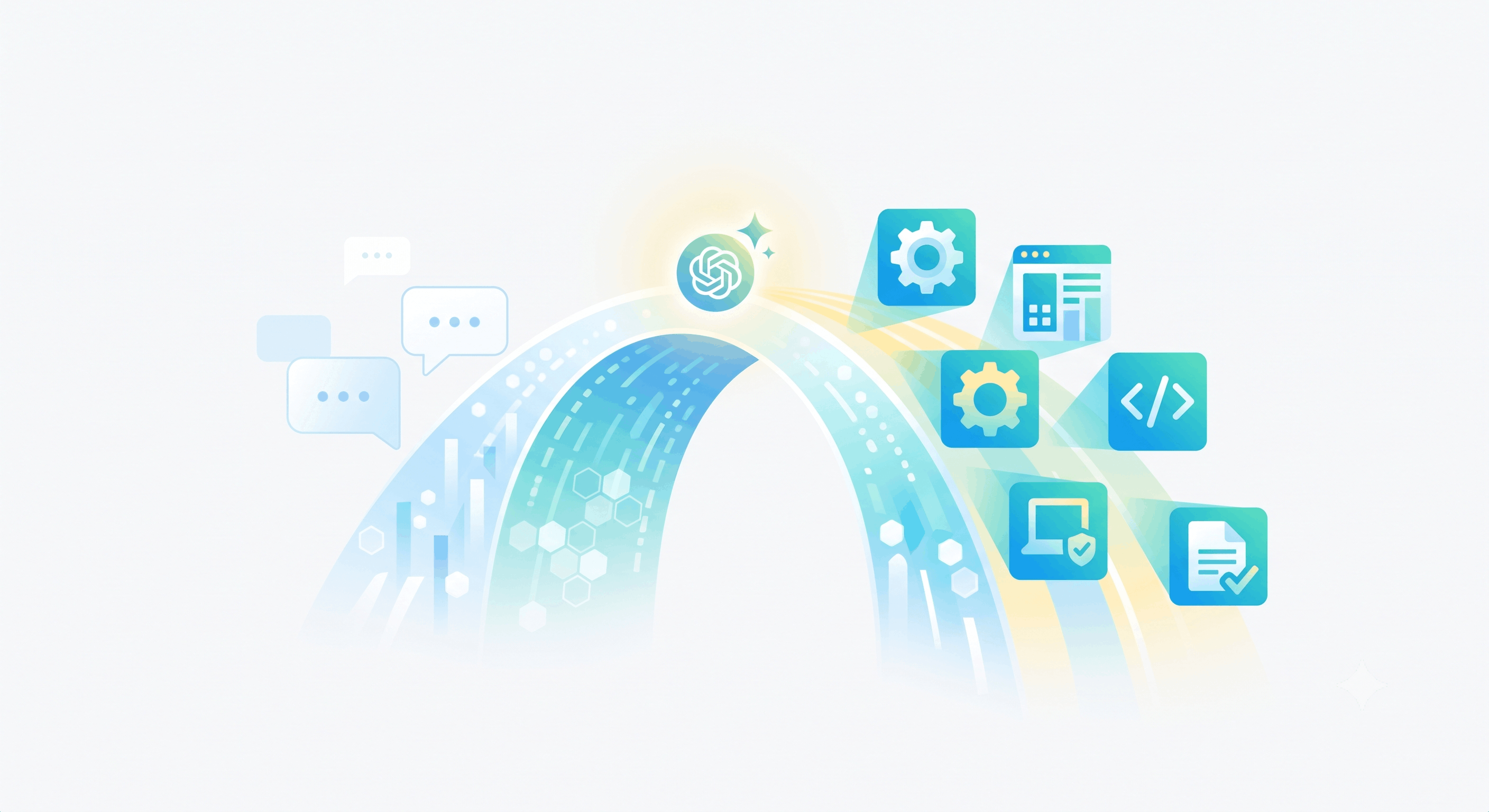
This is creating a new approach to high school education in which students gradually move from being users of AI to builders with AI.
Preparing Students for an AI-Driven Future
The transition from passive AI consumption to active building is becoming an important part of modern education. Students in Classes 9 through 12 now have access to tools that can help them write code, analyze information, generate content, create presentations, build websites, and develop early software prototypes. Used properly, these tools can give students an opportunity to experiment with ideas that previously required much more technical knowledge.
The goal, however, should not be to make students dependent on AI. Students should learn how to use AI to increase their own ability to think and create. AI can help with the difficult or repetitive parts of a task, but students still need to provide the direction, judgment, creativity, and verification. This distinction is important because an AI-generated answer can look impressive while still being incomplete or incorrect.
Technology leaders have also discussed the growing importance of AI-assisted programming, often referred to as “vibe coding.” The basic idea is that a person can describe the software they want in natural language and AI tools can help generate the code needed to create it. This gives students an opportunity to start building much earlier. Instead of waiting until they have mastered every programming rule, they can begin with an idea, ask AI to help implement it, and gradually learn the programming concepts behind the result.
The real advantage comes when students combine this approach with traditional learning. A student who simply copies AI-generated code may be able to produce an application, but a student who understands why the code works, knows how to test it, and can fix it when something goes wrong is developing a much more valuable skill.
Building the Foundation in Classes 9 and 10
For students in Classes 9 and 10, the priority should be to develop AI awareness, digital literacy, communication skills, data awareness, and responsible technology habits. Students do not need to begin with advanced mathematics or complex machine-learning models. At this stage, they should first understand what AI is, what it can do, what its limitations are, and how to work with it effectively.
Understanding Artificial Intelligence and Machine Learning
Students should begin by understanding the basic difference between Artificial Intelligence and Machine Learning. Artificial Intelligence is a broad field concerned with creating systems that can perform tasks that normally require human-like abilities, such as recognizing patterns, understanding language, generating content, making predictions, or solving problems. Machine Learning is one part of AI in which systems learn patterns from data rather than being explicitly programmed with every rule.
This basic understanding is important because students will encounter AI in many different forms. Recommendation systems, voice assistants, chatbots, image-recognition systems, and many modern applications use different approaches to AI. Students should not think of AI as a single technology. Instead, they should understand it as a collection of methods and systems designed to perform particular kinds of tasks.
Along with technical understanding, students should learn about responsible AI use. They should know that AI systems can contain bias, that data quality matters, and that personal information should not be entered carelessly into public tools. They should also begin thinking about questions related to copyright, misinformation, fairness, and the social impact of technology. These topics are not separate from technical education. They are an essential part of becoming a responsible technology user and future developer.
Learning to Communicate with AI
One of the first practical AI skills students can develop is prompt engineering, which means learning how to give clear and useful instructions to an AI system.
A simple question such as “Explain Newton’s Third Law” may produce a general answer. A more carefully designed request could ask the AI to act as a Class 10 physics teacher, explain Newton’s Third Law using a sports example, avoid advanced terminology, and then provide three practice questions with solutions. The second request gives the AI much more context and therefore has a better chance of producing an answer that matches the student’s needs.
Students should therefore learn that effective AI interaction is not about finding a magic sentence. It is about communicating clearly. They should practice giving context, explaining the purpose of the task, specifying the desired format, adding limitations, and asking follow-up questions. They should also learn to refine an answer instead of starting over every time the first response is imperfect.
This skill has value beyond AI. A student who learns to explain a problem clearly is also learning an important communication skill that will be useful in programming, research, teamwork, interviews, and professional life.
Developing Data Literacy
Data is at the heart of modern AI, so students should begin developing basic data literacy at an early age. They do not need advanced statistics, but they should understand how information can be collected, organized, compared, and interpreted.
Simple tools such as Microsoft Excel or Google Sheets can be excellent starting points. Students can analyze test scores, attendance, sports performance, survey responses, reading habits, or other familiar information. They can learn how to sort data, calculate averages, create charts, and identify patterns.
More importantly, students should learn that patterns can be misleading. A graph may show a relationship between two variables without proving that one caused the other. A dataset can also contain missing information, errors, or bias. These lessons help students develop the habits they will need later when working with larger datasets and AI systems.
Moving from Using AI to Building with AI in Classes 11 and 12
By Classes 11 and 12, students can begin moving beyond basic AI literacy and start learning the technical foundations behind modern AI applications. At this stage, programming, data analysis, problem solving, and independent projects should become more important.
Python as a Practical Starting Point
Python is one of the most useful programming languages for students interested in AI, data science, automation, and software development. It has a relatively simple syntax and is widely used for educational and professional applications.
Students should begin with fundamental ideas such as variables, data types, conditions, loops, functions, lists, dictionaries, and basic problem solving. These concepts help students understand how software works and give them enough knowledge to read and evaluate AI-generated code.
At this stage, the purpose is not to memorize programming syntax. Students should instead focus on understanding logic. When AI generates a program, they should be able to ask themselves: What is this part doing? Why is this loop necessary? What happens when the input changes? What could cause this program to fail? This understanding makes AI a much more powerful tool because the student can guide the AI rather than simply accepting whatever it produces.
Once students are comfortable with Python basics, they can begin using tools such as Pandas and NumPy for data processing. This opens the door to real data-analysis projects and introduces them to the kinds of tasks used in modern AI and technology environments.
Exploring Different Areas of AI
Students should also be introduced to the major areas in which AI is used. One important area is Natural Language Processing, which focuses on how computers work with human language. NLP is behind many chatbots, translation systems, summarization tools, and question-answering applications.
Another major area is Computer Vision, which allows computers to work with images and video. Applications include object detection, image classification, medical-image analysis, and visual inspection systems.
Learning about these fields can help students understand that AI is much broader than chatbots. Some students may become interested in language technologies, while others may prefer robotics, computer vision, data science, cybersecurity, or intelligent software systems.
Five Essential AI Skills for High School Students
Although students can explore many different technologies, five skills are especially valuable because they create a strong foundation for further learning.
1. Vibe Coding and Natural-Language Software Development
Vibe coding allows students to describe a software idea in ordinary language and use AI tools to help produce the implementation. Platforms such as Cursor, Replit, and Lovable make this approach accessible to beginners.
A student might say, for example, “Build a website where students enter their subjects, examination dates, and available study hours, and then generate a daily study plan.” An AI coding assistant can help create an initial version of the application.
However, the student should not stop there. They should test the application, look for mistakes, ask AI to explain problems, improve the design, and add features. Through this process, the student begins to understand software development naturally.
The most useful cycle is simple: describe the idea, build a first version, test it, identify problems, fix them, and improve the result. This process is more valuable than simply generating code because it develops problem-solving ability.
2. Context-Driven Prompt Engineering
Strong AI users understand that the quality of the result depends heavily on the quality of the instructions.
A useful prompt often gives the AI a role, explains the context, defines the objective, establishes constraints, and specifies what kind of answer is required. For example, a student could ask an AI system to act as a Class 11 mathematics tutor, explain conditional probability using everyday examples, assume the student already understands percentages, and then provide practice problems from easy to difficult.
Students should also learn to improve prompts through conversation. They can ask the AI to identify weaknesses in its first answer, explain a difficult concept in simpler language, compare two approaches, or challenge an argument. This turns AI into an interactive learning partner rather than a simple answer generator.
3. Data Literacy and Python Fundamentals
Students who understand data will have a stronger foundation for understanding how AI systems work. They should become comfortable with simple statistical ideas such as averages, probability, distributions, and correlation. They should also understand the difference between identifying a pattern and proving a cause.
They can then use Python to work with real datasets. For example, a student might investigate the relationship between study hours and examination performance. The student can collect the data, clean it, create visualizations, and draw conclusions. Such a project combines mathematics, programming, critical thinking, and communication.
4. Critical Evaluation and Hallucination Auditing
One of the biggest risks of generative AI is that it can produce answers that sound correct even when they are not. Students therefore need to develop the habit of checking important information.
They should verify important facts, check citations, examine mathematical calculations, test computer programs, and compare research claims with reliable sources. When AI produces a piece of code, students should run it instead of assuming that it is correct. When AI explains a scientific concept, students should compare it with their textbook or trusted educational sources.
This habit of verification is often more important than the ability to generate an answer quickly. In the future, knowing when not to trust a machine may be just as valuable as knowing how to use one.
5. Ethical AI and Data Privacy
Students should also understand the responsibility that comes with using powerful technology. AI systems can reflect biases in their training data, which can lead to unfair results. Students should learn why privacy matters and why confidential or sensitive information should not be entered into public AI systems without understanding the risks.
They should also become aware of copyright and attribution when using AI-generated text, images, video, or code. The objective is not to discourage experimentation but to encourage responsible behavior. A strong technology user understands not only what can be done but also what should be done.
Practical AI Projects for Students
The best way to learn AI is often through projects. Students should not feel that they need to begin with complicated research projects. Small, useful applications can teach enormous amounts when students build them carefully.
Students in Classes 9 and 10 can start with projects such as a study planner, habit tracker, flashcard generator, quiz application, GPA calculator, or interactive educational presentation. These projects introduce basic programming logic, interfaces, prompts, and automation while keeping the technical difficulty manageable.
Students in Classes 11 and 12 can move toward larger projects such as a college information chatbot, a document question-answering system, a personalized study assistant, a data-visualization dashboard, or a basic RAG-based application. The purpose should always be to solve a genuine problem rather than simply add the word “AI” to a project.
For example, instead of building a generic chatbot, a student could create a chatbot that answers questions about their school, explains admission requirements, provides information about departments, or helps students find academic resources. A project becomes much more meaningful when it addresses a real need.
A Practical 30-Day AI Learning Plan
A structured 30-day plan can help students move from curiosity to actual creation. During the first week, students should focus on using AI as a learning partner. They can practice asking detailed questions, requesting examples, asking for counterarguments, comparing different explanations, and improving AI responses through multiple rounds of conversation. The objective is to learn how to communicate effectively with AI without becoming dependent on it.
During the second week, students can create a simple no-code or low-code project using a tool such as Lovable or Replit. A habit tracker, flashcard generator, study planner, or GPA calculator would be enough. The goal is to complete something functional rather than create something extremely complicated.
During the third week, students should begin learning Python. They can focus on variables, conditions, loops, functions, and basic data structures. They do not need to become advanced programmers in a few days. The purpose is simply to understand the logic behind software well enough to work intelligently with AI-generated code.
During the final week, students should combine these skills into a small portfolio project. They might build a personalized study assistant that creates learning schedules, generates practice questions, and tracks progress, or they could create a data-visualization dashboard using a real dataset. Completing a project teaches students how to move from an idea to a working product, which is much more valuable than simply completing another tutorial.
Building a Strong AI Portfolio
Students should also begin thinking about how their work can be presented. A strong high school AI portfolio does not have to contain dozens of certificates. In many cases, two to four well-developed projects can be more impressive than a long list of short courses.
Each project should clearly explain the problem, the student's approach, the tools used, the role AI played, the challenges encountered, and the final result. Students should also explain what they personally learned rather than presenting AI-generated work as their own understanding.
A good project portfolio can therefore demonstrate much more than programming ability. It can show curiosity, communication, creativity, problem solving, technical understanding, and the ability to complete a project from beginning to end.
Students should ideally be able to answer simple questions about every project they build: Why did you choose this problem? How does your solution work? What did AI help you with? What problems did you face? How did you test the result? What would you change if you had more time? Being able to answer these questions demonstrates genuine learning.
The New Meaning of AI Readiness
The biggest change brought by AI is not that students now have access to better tools. It is that the definition of useful technical skills is changing.
A student who only uses AI to complete homework is learning one kind of skill. A student who uses AI to research a topic, question the results, build a software prototype, test it, analyze data, and explain the final solution is developing a much broader set of abilities.
The ideal progression is therefore simple: understand AI, communicate with AI, build with AI, verify AI, and use AI responsibly. Students in Classes 9 and 10 should focus mainly on AI literacy, communication, prompting, digital skills, and data awareness. Students in Classes 11 and 12 should gradually move toward Python, SQL, statistics, data analysis, AI applications, and independent software projects.
Most importantly, students should never allow AI to replace their own thinking. The purpose of AI education is not to make students dependent on machines. It is to help them become better thinkers, creators, researchers, and problem solvers by combining human judgment and creativity with the power of modern technology.
The real advantage in the AI era will belong to students who know not only how to use artificial intelligence, but also how to think independently while using it.
The AI Revolution in High School Education
Artificial Intelligence is rapidly reshaping how students prepare for the workforce. Alexandr Wang, Meta's Chief AI Officer, recently advised that teenagers should dedicate their time to "vibe-coding"—the practice of generating code through plain English instructions using AI tools. With AI already writing up to 30% of the code at tech giants like Google and Microsoft, learning these skills early provides a massive professional advantage.
Foundational Skills for Classes 9 and 10
In early high school, the focus should be on building core digital literacy and communication skills.
AI Literacy and Ethics: Students must understand the difference between Artificial Intelligence (machines mimicking human intelligence) and Machine Learning (systems that learn directly from data). Furthermore, recognizing the importance of responsible data use and understanding AI bias are essential skills for trustworthy innovation.
Prompt Engineering: The quality of an AI tool's output depends heavily on how well the instructions are structured. Students need to practice providing clear context, refining requests, and effectively structuring questions for assistants like ChatGPT or Microsoft Copilot.
Data Literacy: Because AI relies entirely on data, students must learn how information is organized to recognize trends and avoid misleading conclusions.
Advanced Concepts for Classes 11 and 12
As students progress, they should transition from merely using AI to understanding its underlying mechanics.
Python Programming: Python is a highly practical language for collecting data, cleaning datasets, and deploying basic AI applications.
Exploring AI Domains: Students should study Natural Language Processing, which helps machines understand human text, and Computer Vision, which allows systems to interpret images and video.
Critical Thinking: Since AI models can occasionally produce inaccurate information or miss context, the human ability to verify sources and question assumptions remains irreplaceable.
A Practical Action Plan
To build a strong portfolio, high schoolers should follow a structured, hands-on approach rather than relying solely on theory.
Master Core Languages: Start by learning Python, SQL, and basic data structures.
Practice Vibe-Coding: Use natural language tools like Cursor and Replit to build apps simply by describing what you want.
Build Real Projects: Cement your knowledge by developing interactive projects, such as a document question-answering system or a college information chatbot.
Which specific AI domain or project idea sounds the most exciting for you to start exploring first?