For years, campus placement preparation followed a predictable script: memorize dynamic programming transitions, grind graph traversals on LeetCode, and build a single-server CRUD project the week before resume verification. In 2026, AI coding assistants can generate standard tree and array solutions in seconds—shifting what engineering interviewers actually value.
Hiring panels across product startups, fintech unicorns, and global GCCs increasingly use practical System Design and Low-Level Architecture as their primary tie-breaker for SDE-1 and full-stack internships. They want to know what happens when your college project leaves localhost:3000 and faces real-world traffic spikes, network timeouts, and database bottlenecks.
Five Architectural Upgrades That Transform a College Project into a Production System
You do not need ten years of industry experience to speak the language of distributed systems. Every web or AI application you build in college can demonstrate high-scale engineering across five core layers:
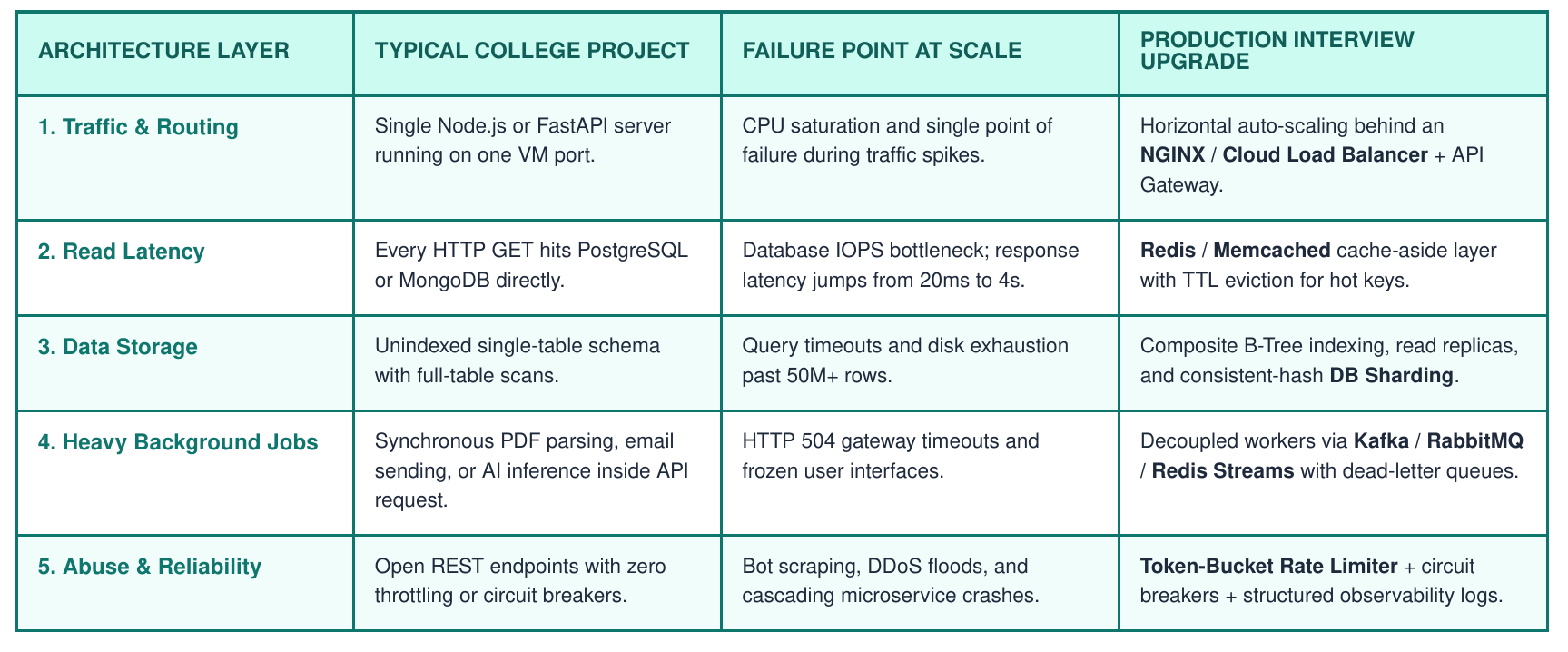
Figure 3. Practical architectural upgrades across traffic routing, caching, storage, background workers, and API reliability.
- Horizontal Scaling & Load Balancing: Running a single Node.js or FastAPI process creates an immediate single point of failure. Placing an NGINX reverse proxy or cloud load balancer in front of multiple stateless container instances lets you distribute incoming HTTP requests evenly and survive individual server crashes without downtime.
- In-Memory Caching with Redis: Database disk reads are orders of magnitude slower than RAM lookups. Implementing a cache-aside pattern with Redis for frequently accessed endpoints (such as user profiles, leaderboards, or trending feeds) drops response latency from hundreds of milliseconds to sub-10ms while slashing database CPU load.
- Database Indexing, Read Replicas & Sharding: Unindexed queries that run smoothly on 500 test rows stall completely at 50 million rows. Learning when to add composite B-Tree indexes, separate heavy analytics reads onto read replicas, and partition massive tables via consistent-hash sharding shows interviewers you think about data growth before outages happen.
- Asynchronous Message Queues: Never block an HTTP request while generating a PDF report, sending emails, or running an AI inference pipeline. Pushing heavy tasks into Kafka, RabbitMQ, or Redis Streams lets your API respond immediately with a
202 Acceptedstatus while background workers process jobs reliably with automatic retries. - Rate Limiting & Circuit Breakers: A single misconfigured client loop or bot scraper can overwhelm an unprotected API. Adding a Token-Bucket rate limiter at the gateway level protects downstream microservices and keeps latency predictable for legitimate users.
How to Practice System Design Without Overwhelming Yourself
Instead of passively reading abstract whitepapers, reverse-engineer systems you already use and upgrade your own repositories:
- Benchmark Your Own APIs: Use open-source load-testing tools like k6 or Locust on your existing full-stack project, record the exact requests-per-second threshold where latency spikes, and document how adding Redis caching or connection pooling improved throughput in your GitHub
README.md. - Master Four Classic Blueprints: Practice sketching end-to-end data flows—covering API contracts, database schemas, caching strategies, and failure modes—for a URL Shortener, a Real-Time Chat System, a Rate Limiter, and a Notification Engine.
- Lead With Trade-Offs in Interviews: Strong engineers never claim a single database or architecture is universally best; explain why you chose SQL over NoSQL for ACID transactions, or why eventual consistency is acceptable for view counters but fatal for payment ledgers.