For many students, Class 10 ends with a question that sounds simple but can feel surprisingly heavy: “Science, Commerce or Humanities — which stream should I take?”
The problem is that students are often asked to make this decision using bad criteria. “Science has more scope,” “Commerce is for students who like money,” or “Humanities is only for UPSC” are not career guidance. They are stereotypes.
A better way to look at the decision is this: your stream is a subject-choice decision, not a ranking of your intelligence or future success.
And there is an important policy-level reason for thinking this way. The National Education Policy (NEP) 2020 explicitly calls for greater flexibility in subject choices and says there should be no hard separation among arts, humanities and sciences, or between vocational and academic education.
Even CBSE makes the distinction very clearly: CBSE does not officially have the concept of “streams.” Students can choose 5–6 subjects from the subjects available under its scheme of studies and offered by their school.
So before asking “Which stream is best?”, ask a better question:
“Which combination of subjects fits the way I learn, the careers I am considering, and the entrance requirements I may need later?”
That question can save you two years of unnecessary struggle.
First, Understand What “Science, Commerce and Humanities” Actually Mean
In everyday school language, students talk about three streams. In practice, however, schools create different subject combinations, and the exact options depend on the board and school.
CBSE's senior-secondary curriculum itself groups subjects across areas including sciences, humanities and social sciences, business and commerce, visual and performing arts, languages and skill electives. Science-related subjects include Physics, Chemistry, Biology, Computer Science and Informatics Practices, while business and commerce subjects include Accountancy, Business Studies and Economics. Humanities and social-science subjects include areas such as History, Geography, Political Science, Sociology and Fine Arts.
That means two students who both say “I took Commerce” may not actually have identical subject combinations.
Likewise, “Science” could mean PCM, PCB, or another combination depending on the school.
This is why you should not choose a stream based only on its label. Look at the actual subjects you will study for the next two years.
Science: Who Should Actually Choose It?
Science makes sense when you genuinely enjoy understanding how things work, especially through mathematics, physical sciences, life sciences or technology.
If you enjoy solving quantitative problems, experimenting, understanding systems, analysing cause and effect, or studying how the physical or biological world works, Science may fit you naturally.
But there is a major difference between liking Science and being told that Science is prestigious.
If you are choosing PCM only because relatives say it “keeps every option open”, you are making a weak decision.
PCM: Physics, Chemistry and Mathematics
PCM is particularly relevant for students considering areas such as:
- Engineering
- Computer science and technology
- Architecture and planning-related routes
- Physical sciences
- Mathematics and statistics
- Some economics and quantitative programmes
- Defence and other technical pathways, depending on the specific eligibility rules
For example, the 2026 JEE Main rules for NIT+ admissions specify subject requirements in the qualifying examination that include Physics and Mathematics, along with a language and one of Chemistry, Biotechnology, Biology or a Technical Vocational subject, plus another subject.
So if engineering is a serious possibility for you, your Class 11 subject selection matters. You should check the latest eligibility rules rather than assuming you can take any subjects now and fix the combination later.
PCB: Physics, Chemistry and Biology
PCB is more aligned with students interested in medicine and biological sciences.
NEET-UG is the common and uniform entrance examination for undergraduate medical education in India and also applies to several Indian-system medicine courses and BHMS under the relevant laws.
That makes PCB an important subject combination for students seriously considering medical pathways.
But again, PCB should not be selected simply because you scored well in Biology in Class 10.
Medicine involves years of intensive study, competitive entrance preparation and a long professional pathway. You should first ask yourself whether you actually enjoy biology enough to study it deeply and whether you are comfortable with the nature of the profession.
Knowledge Corner: What does “eligibility” mean?
Eligibility means the minimum academic or subject requirements you must satisfy before you can apply for a course or entrance examination.
A high entrance-exam score cannot compensate for missing a mandatory subject requirement.
That is why career planning should happen before subject selection, not after it.
Commerce: Much More Than Accounts and Business
Commerce is often misunderstood as the “middle option” between Science and Humanities.
Commerce is a strong choice for students who are interested in business, economics, finance, accounting, markets, entrepreneurship, management and how organisations work.
Typical subjects may include:
- Accountancy
- Business Studies
- Economics
- Mathematics or Applied Mathematics, depending on the school
- Entrepreneurship
- Informatics Practices or Computer Science in some combinations
CBSE describes its business and commerce-based electives as helping students understand core business disciplines and concepts related to the exchange of money, products, services and information.
A student interested in CA, finance, economics, management, entrepreneurship, banking, investment analysis, business analytics or corporate careers may find Commerce particularly relevant.
But there is one decision within Commerce that deserves more attention than students usually give it:
Should you take Mathematics with Commerce?
If you are interested in economics, quantitative finance, analytics or courses with stronger mathematical requirements, keeping Mathematics can be valuable.
But do not blindly take Mathematics because someone says “Commerce with Maths has more scope.”
Ask instead:
Does the additional option value justify the workload for the career paths I am actually considering?
If yes, take it.
If not, there is no prize for making Class 11 unnecessarily miserable.
Humanities: It Is Not a “Backup Stream”
Humanities is probably the stream surrounded by the most outdated stereotypes.
Students hear things like:
“Arts is easy.”
“There are no jobs.”
“Only students preparing for UPSC take Humanities.”
None of these statements is a sensible way to evaluate the field.
Humanities and social sciences cover areas such as History, Geography, Economics, Political Science, Sociology, Psychology, Fine Arts and related disciplines. CBSE says these subjects help students understand history and culture, geographical environments, institutions, constitutional values, politics, economics and social interactions.
That makes Humanities particularly useful for students who enjoy:
- Writing and communication
- Society and human behaviour
- History and culture
- Politics and public policy
- Economics
- Law
- Psychology
- Media and communication
- International relations
- Design and creative fields
- Social research
- Education
- Public administration
And there is another important point.
Humanities does not mean you stop learning analytical skills.
A good student of Economics, Political Science, Geography or Psychology may spend substantial time interpreting data, building arguments, evaluating evidence and understanding complex systems.
The skill is not “memorising answers”.
The real skill is learning how to understand people, institutions, evidence and ideas.
The Biggest Myth: “Science Keeps All Options Open”
This statement contains a small amount of truth and a huge amount of oversimplification.
Science can preserve access to certain science-heavy courses that require Physics, Chemistry, Mathematics or Biology. That is useful.
But having more theoretical eligibility is not the same as having more useful options.
Suppose a student takes PCM but hates Physics, dislikes Mathematics and has no interest in engineering.
Technically, that student may have preserved certain options.
Practically, they may have spent two years studying subjects they strongly dislike and damaging their academic performance and confidence.
Now consider another student who takes Humanities, develops excellent writing and analytical skills, explores law, economics and public policy, and eventually gets into a strong university.
Which student made the “better” decision?
There is no universal answer.
The better decision is the one that creates a strong match between the student's abilities, interests and future requirements.
The Decision Should Start With Careers, Not Streams
Instead of beginning with:
“Should I take Science?”
Start with:
“What kinds of problems do I want to spend my time solving?”
Consider these examples.
Scenario 1: Aarav
Aarav enjoys mathematics, coding and building small software projects. He spends weekends experimenting with programming and genuinely enjoys solving difficult numerical problems.
Possible direction: PCM, with careful checking of engineering/computing eligibility requirements.
The important signal here isn't that Aarav scored 95 in Mathematics.
It is that he repeatedly chooses mathematical and technical problems voluntarily.
Scenario 2: Meera
Meera enjoys understanding businesses. She follows company news, likes Economics, enjoys calculating profits and is curious about how companies make decisions.
Possible direction: Commerce, potentially with Mathematics depending on her target courses.
Her decision should be based on her interest in business and economics—not on whether Science is considered more prestigious.
Scenario 3: Kabir
Kabir spends hours reading about elections, history, international affairs and psychology. He enjoys writing arguments and discussing why people and institutions behave differently.
Possible direction: Humanities.
That does not mean Kabir has selected one career. It means he has selected an academic environment that matches his current interests while leaving multiple higher-education routes open.
A Better Way to Choose: The 5-Factor Test
Before choosing your subjects, score yourself honestly from 1 to 5 on these five factors.
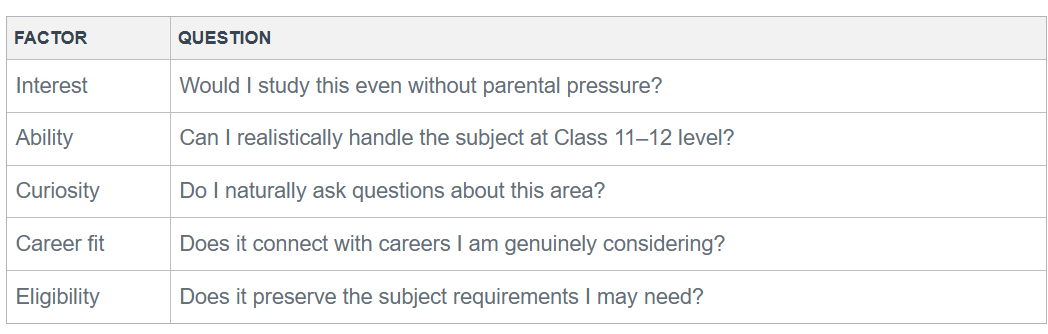
Do not give yourself 5/5 for everything.
Be brutally honest.
A subject that gets 5 for prestige but 1 for interest is not a good choice.
A subject that gets 4 for interest, 4 for ability and 4 for career fit deserves serious consideration even if nobody around you calls it “the best stream.”
Class 9–10: You Do Not Need to Have Your Life Figured Out
If you are in Class 9 or 10, your job is exploration, not making a perfect 40-year career prediction.
The NCF and NEP framework increasingly emphasise flexibility, multidisciplinary learning and broader exposure rather than forcing students into rigid academic compartments.
Use Classes 9–10 to test yourself.
Try coding, Read about businesses, Participate in debates, Study psychology, Build something, Write, Analyse data, Join competitions, Explore design, Talk to professionals, Try small projects.
The goal is to collect evidence about yourself.
Do not simply ask:
“What am I good at?”
Also ask:
“What do I keep coming back to even when nobody forces me?”
That question is often more revealing.
Class 11–12: Now the Decision Becomes More Strategic
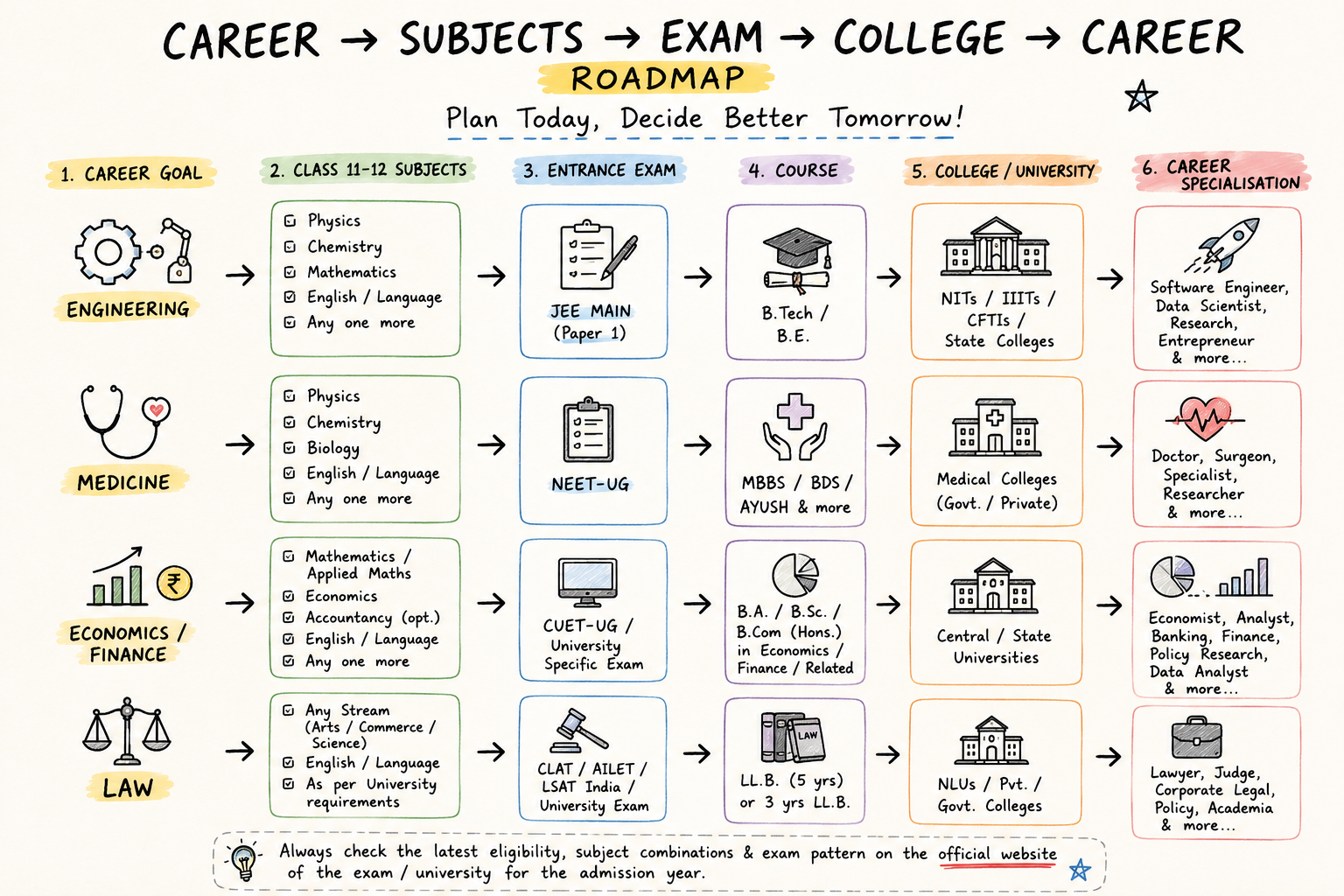
Once you enter Class 11, your subject combination starts interacting more directly with university admissions and entrance examinations.
This is where students need to move from general exploration to eligibility mapping.
For example:
Engineering target → check JEE/college subject requirements.
Medical target → check NEET and relevant course requirements.
Central-university undergraduate programme → check CUET and the specific university/course subject combination.
CUET-UG 2026 is particularly interesting because NTA says candidates can choose up to five subjects, and the 2026 candidate pool produced 12,906 distinct subject combinations, demonstrating how varied subject choices can be.
But don't misread that flexibility.
CUET flexibility does not mean every university course accepts every subject combination.
For example, university-specific eligibility and subject combinations are published for programmes participating through CUET. Delhi University's CUET information includes specific subject combinations for different undergraduate programmes.
So the correct process is:
Course → University → Eligibility → Required Class 12 subjects → Entrance exam → Subject combination
Not: Stream → hope everything works out later.
Knowledge Corner: “Keep Options Open” Has a Limit
Keeping options open sounds smart, but trying to keep every possible option open can create an overloaded subject combination.
Imagine you want: Engineering + Medicine + Economics + Law + Design.
Trying to prepare equally for all of them during Classes 11–12 is not flexibility.
It is lack of prioritisation.
Instead, create:
1 primary pathway + 2 realistic alternatives.
For example:
Primary: Engineering
Alternative 1: Economics/Data
Alternative 2: Mathematics/Statistics
Now your subject choice has a purpose.
What About Entrance Exams?
Your stream decision should be made with entrance examinations in mind, but entrance exams should not completely control your education.
For students targeting engineering, JEE Main remains a major national examination administered by NTA. The official 2026 information includes Paper 1 for B.E./B.Tech and Paper 2 for B.Arch/B.Planning.
For medical education, NEET-UG 2026 is the common national entrance examination for undergraduate medical education and several associated systems of medicine.
For many undergraduate programmes across participating universities, CUET-UG provides a common entrance route, with individual universities determining their programme-specific eligibility and selection requirements.
The lesson is simple:
Do not choose a stream because of an entrance exam's popularity. Choose subjects because they are required for your target pathway and because you can perform well in them.
What About College Selection?
Your stream is only the first filter.
Once you reach Class 12, college selection should involve much more than:
“This college is famous.”
Check:
- Course curriculum
- Admission eligibility
- Entrance requirements
- Accreditation and recognition where relevant
- Faculty and academic environment
- Internship opportunities
- Placement information
- Fees and total cost
- Scholarships
- Location
- Student support
- Higher-study opportunities
- Actual outcomes for the specific course
A famous college with the wrong course for you can be a worse choice than a less famous institution with a stronger fit.
Scholarships: Don't Wait Until College to Think About Money
Financial planning should be part of career planning.
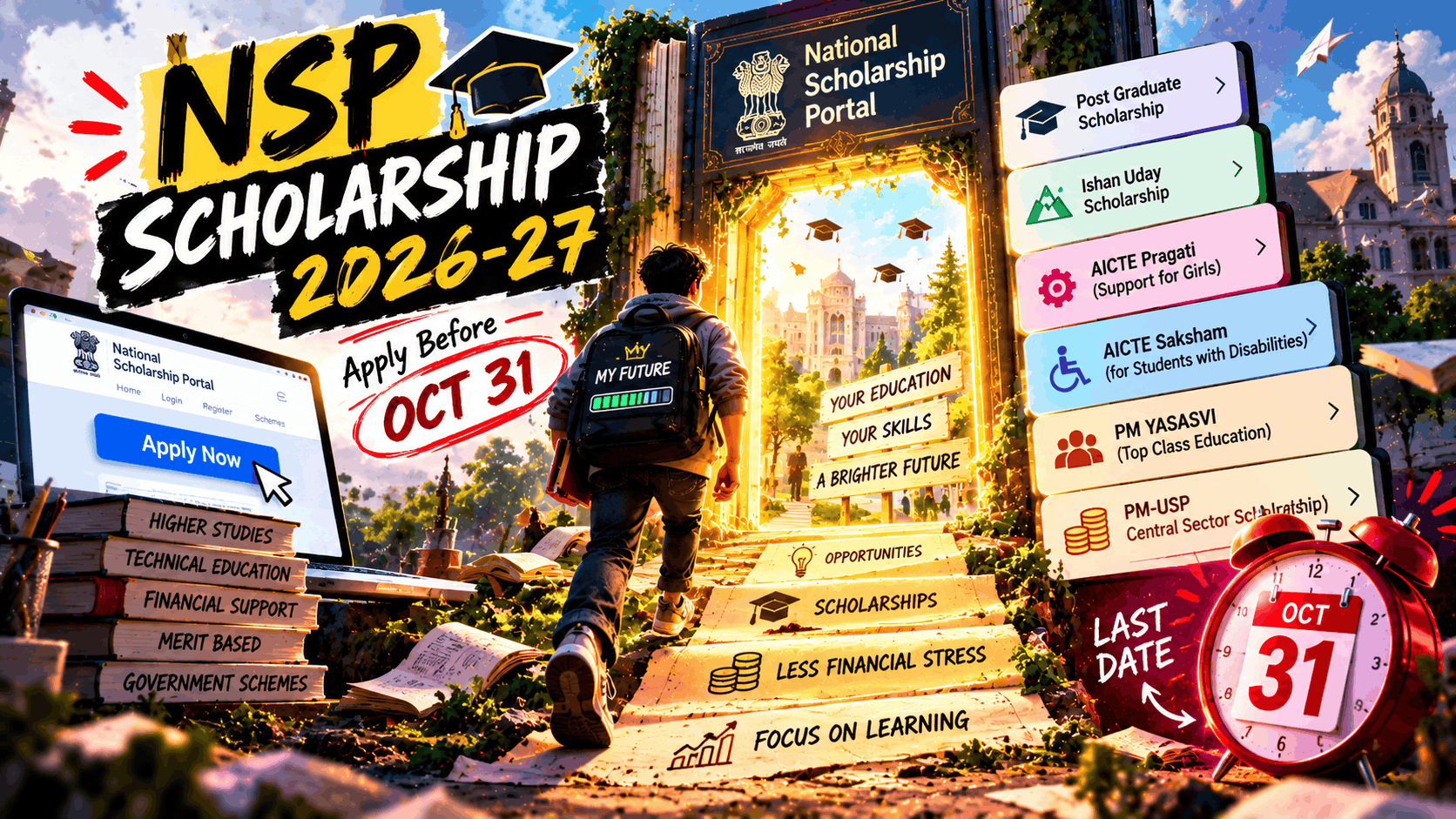
The National Scholarship Portal (NSP) is currently open for the 2026–27 academic year, and students can apply for eligible merit-based and welfare-based schemes according to the requirements of each scheme. The portal also states that One-Time Registration (OTR) is required for scholarship applications.
So when you shortlist a course or college, create a simple financial checklist:
Total tuition + hostel/living costs + entrance preparation + books/equipment + travel − scholarships/financial aid
Do not choose an expensive course first and ask “How will I pay for this?” later.
The Role of Parents: Guidance, Not Career Substitution
Parents often have more experience than students, but experience does not automatically mean they know which career fits their child.
A useful conversation is not:
“Science is better. Take Science.”
Instead, ask:
What subjects do you enjoy?
Which subjects drain you?
What careers have you explored?
What have you actually tried?
Which entrance exams are you considering?
What does each option require?
What happens if Plan A doesn't work?
The CBSE itself has used aptitude, interest and personality assessment as tools to support academic choices. Its Student Global Aptitude Index was designed for Class X students and aimed to indicate academic orientations at the +2 level.
That does not mean an aptitude test should decide your life. It means your decision should consider more than marks alone.
Don't Choose a Stream Based on These 7 Reasons
“My friends are taking it.”
Your friend's strengths are irrelevant to your subject combination.
“My parents said Science has more scope.”
“Scope” without a specific career, course and eligibility requirement is meaningless.
“I scored highest in this subject.”
Scoring well is useful evidence, but it doesn't automatically mean you want to study the subject deeply for two more years.
“Humanities is easy.”
A subject can be easier for one student and difficult for another.
“Commerce is only for CA.”
Commerce connects to far more areas, including business, finance, economics, management and entrepreneurship.
“Science means guaranteed high salary.”
No stream guarantees income.
“I need to decide my entire life now.”
You don't.
You need to make the best informed next decision.
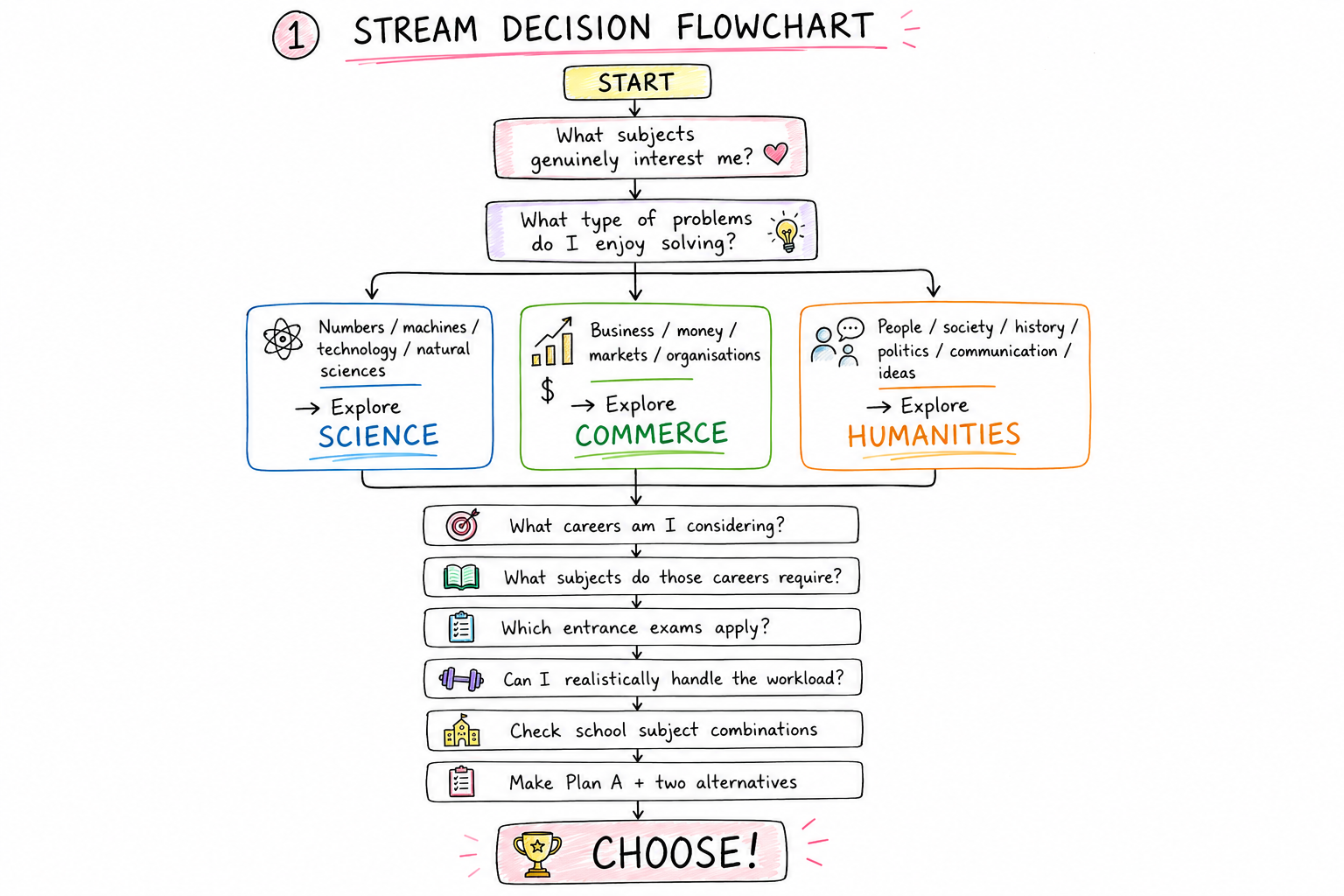
A Simple Flow to Decide Your Stream
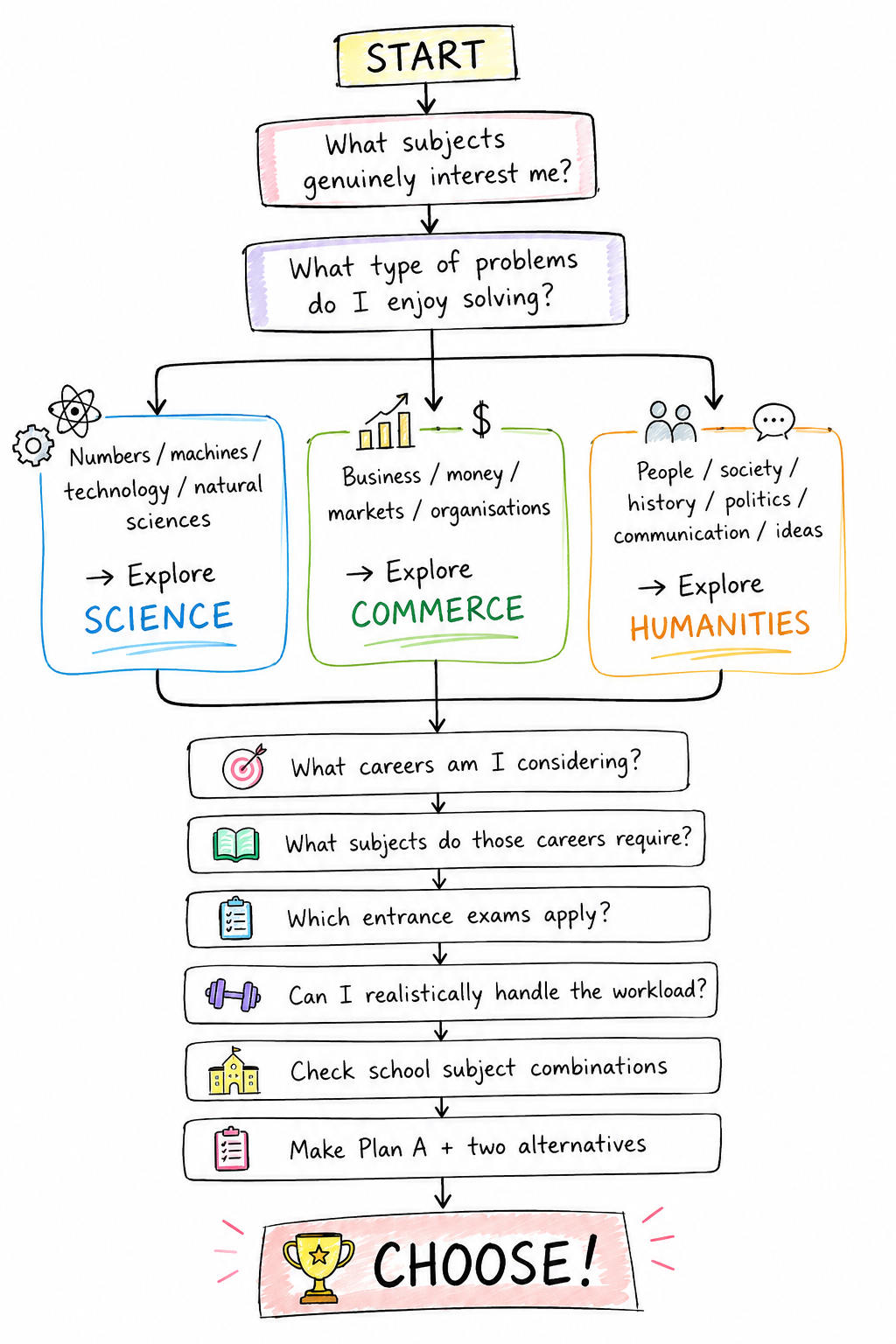
What Should I Do Now?
If you are currently in Class 9 or 10, don't rush into choosing a stream tomorrow.
Spend the next few weeks collecting evidence.
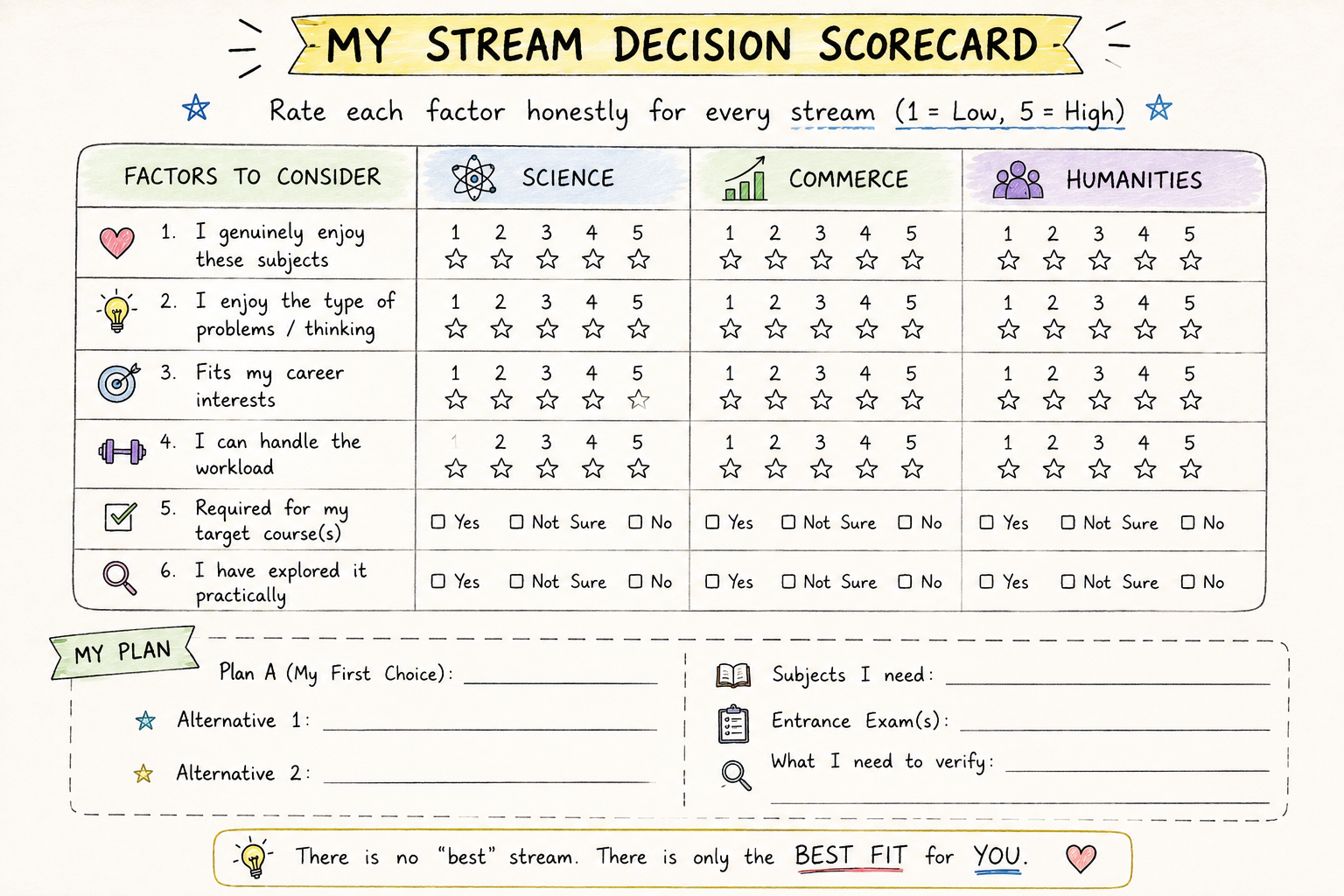
Week 1 — Explore
Pick three areas you have never seriously explored.
For example:
Technology + Economics + Psychology
Spend a few hours learning what people actually do in these fields.
Week 2 — Test
Do something practical.
Build a small program.
Analyse a company.
Read and write an opinion piece.
Conduct a small psychology observation project.
Make a design.
Try a science experiment.
The goal is to experience the work, not just read about the career.
Week 3 — Talk
Speak with:
- A teacher
- A senior student
- A college student
- A working professional
- Your parents
Ask them what the actual work and study path looks like.
Week 4 — Verify
For your top 3 career choices, check:
Required Class 11–12 subjects → entrance exam → degree → university eligibility → approximate cost → alternatives
Use official examination and university websites wherever possible.
The Final Decision Rule
If you remember only one thing from this article, remember this:
Do not choose Science, Commerce or Humanities because one is considered “better”. Choose the subject combination that gives you the strongest combination of interest, ability, career fit and future eligibility.
For Class 9–10 students, focus more on exploration. You are collecting evidence about yourself.
For Class 11–12 students, become more strategic. Start mapping your target courses, entrance examinations, universities, scholarships and subject requirements.
And if you are confused right now, that does not mean you are behind. It means you need better information before making the decision.
The future is also moving toward more multidisciplinary education. NEP 2020 explicitly pushes flexibility and reduced separation between academic areas, while CBSE's current framework already allows subject choice rather than treating streams as an official board-level concept.
So don't ask: “Which stream is the best?”
Ask: “Which subjects will help me become the kind of person who can do the work I want to do?”
That is a much harder question.
It is also the right one.
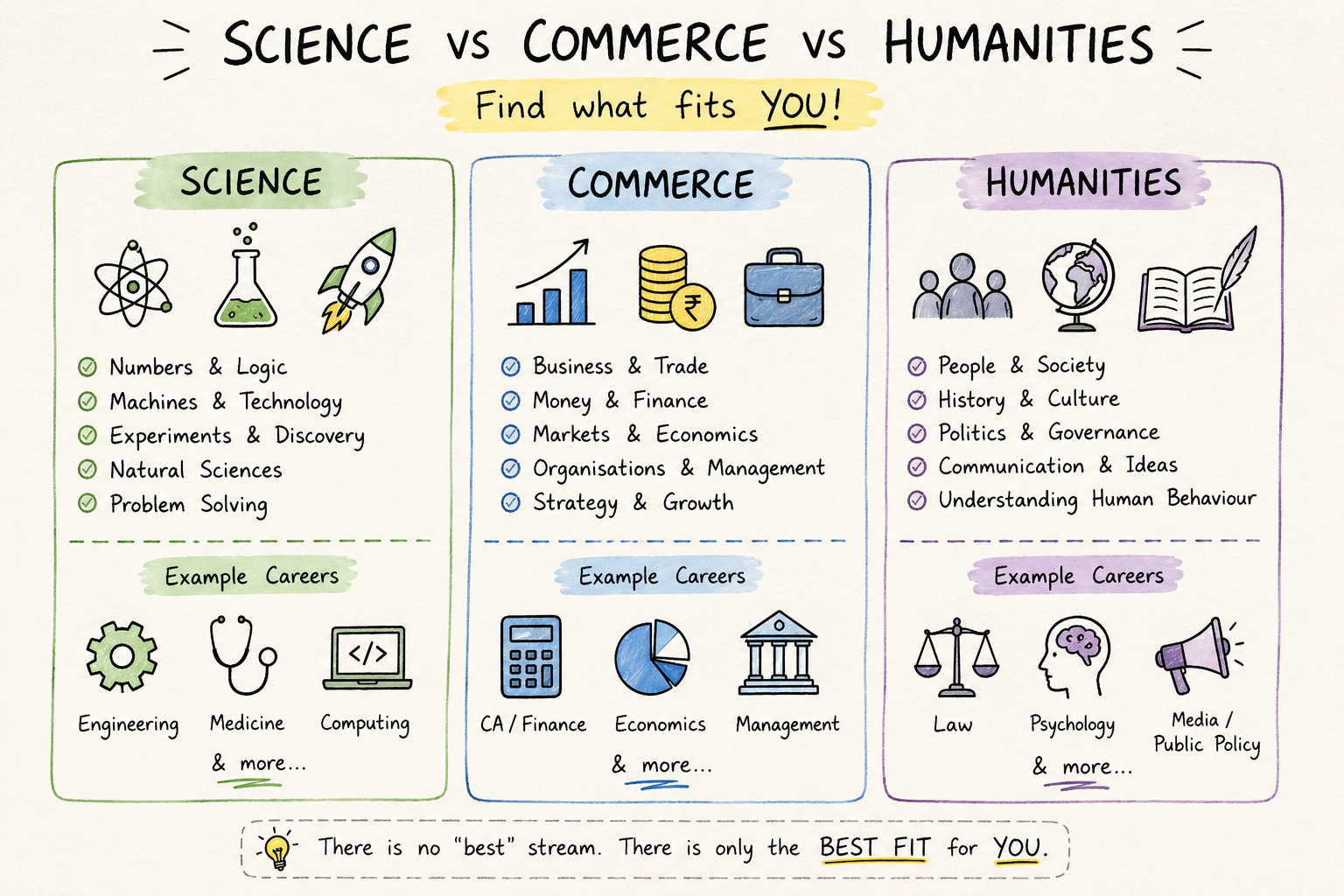
Quick Comparison: Science vs Commerce vs Humanities
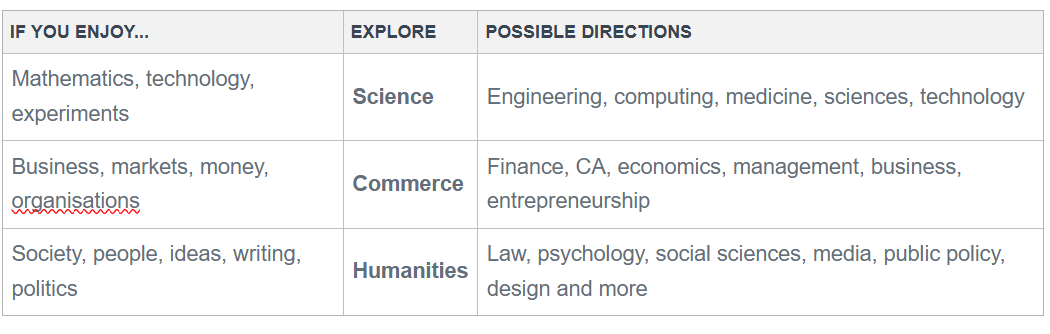
Important: These are broad patterns, not rigid career rules. Actual eligibility depends on the university, course and current admission rules.
Knowledge Corner: Three Terms Every Student Should Know
Stream: A common school label for a group of subjects such as Science, Commerce or Humanities. In CBSE's official framework, however, the Board says it does not have a formal concept of streams; students choose subjects from the available scheme.
Eligibility: The conditions a student must satisfy to apply for a particular course or examination.
Multidisciplinary: Learning or working across multiple academic areas instead of keeping subjects in rigid compartments.
Useful Official Resources
- CBSE 2026–27 curriculum: CBSE Academic Curriculum
- CBSE Parents' Handbook on Careers: CBSE Careers Handbook
- CBSE Career Guidance: CBSE Career Guidance Portal
- JEE Main: NTA JEE Main 2026
- NEET-UG: NTA NEET-UG 2026
- CUET-UG: NTA CUET-UG
- National Scholarship Portal: NSP 2026–27
- National Education Policy 2020: Ministry of Education — NEP 2020