What if your smartphone could actually move its camera to follow you?
That idea is no longer limited to science-fiction concepts. Honor has built the Robot Phone, an Android flagship with a motorized gimbal camera that can physically rise from the back of the phone, rotate and track subjects. Honor describes it as a “new species of smartphone”, and the idea is certainly different from the conventional smartphone design we have become used to.
The Robot Phone was launched in China on August 12, 2026, with a starting price of 9,999 yuan. Its defining feature is not simply a high-resolution camera, but a camera system that can physically move and respond to its surroundings. This makes the phone particularly interesting for content creators, vloggers and users who want more automated camera control without carrying a separate gimbal.
What Is the Honor Robot Phone?
The Honor Robot Phone is a flagship Android smartphone built around one unusual concept: the camera itself can move. Instead of keeping every camera permanently fixed inside the rear panel, Honor has placed the main camera on a motorized titanium-alloy gimbal that can rise from the body when required and fold back into the phone when not in use.
The mechanism allows the camera to pan, tilt and follow a subject rather than simply recording from a fixed position. This gives the Robot Phone capabilities that are difficult to reproduce with a conventional smartphone camera, especially when someone is recording themselves without another person operating the camera.
The hardware is also connected to Honor's AI software, allowing the phone to respond to commands, track movement and perform different camera motions. In some demonstrations, the camera can even behave almost like a small robotic head by moving and reacting to instructions.
Why the Robotic Camera Matters
The robotic camera is not just designed to look impressive. Its main purpose is to give the smartphone a degree of physical movement that normally requires an external gimbal or camera operator.
For example, imagine placing the phone on a table and walking across a room while recording yourself. Instead of staying pointed at the same location, the camera can follow your movement. A creator could potentially use this for vlogs, dance videos, demonstrations, presentations and other situations where keeping the subject inside the frame is difficult.
This is where the Robot Phone becomes more than a novelty. Honor is trying to combine smartphone convenience, mechanical camera movement and AI automation inside a single device.
Honor Robot Phone Camera: 200MP Gimbal Camera and More
The moving camera is supported by flagship-level camera hardware. The Robot Phone features a 200MP main gimbal camera, a 200MP periscope telephoto camera and a 50MP ultrawide camera.
Honor has also brought professional video technology into the device. The phone supports ARRI LogC3 video recording, which comes from Honor's collaboration with ARRI, a company widely associated with professional cinema cameras and filmmaking equipment.
The combination is important because Honor is not presenting the robotic mechanism as a replacement for camera quality. Instead, it is combining high-end imaging hardware with physical camera movement and AI tracking to create a different type of mobile photography and video experience.
AI Turns the Camera Into an Active Part of the Phone
The Robot Phone becomes more interesting when its mechanical hardware is combined with AI.
Instead of simply opening the camera application and manually moving the phone, the device can use AI to understand commands, track subjects and control the movement of the gimbal. Honor has also developed YOYO Pro, an AI system designed to understand more complex instructions and carry out actions across the device.
This means the phone is not just using AI to improve photos or answer questions. The AI can also influence the physical behaviour of the hardware.
That is a significant shift in smartphone design. Most AI features today exist entirely inside software. Honor is experimenting with a model where software can directly control a physical mechanism.
Honor Robot Phone Specifications
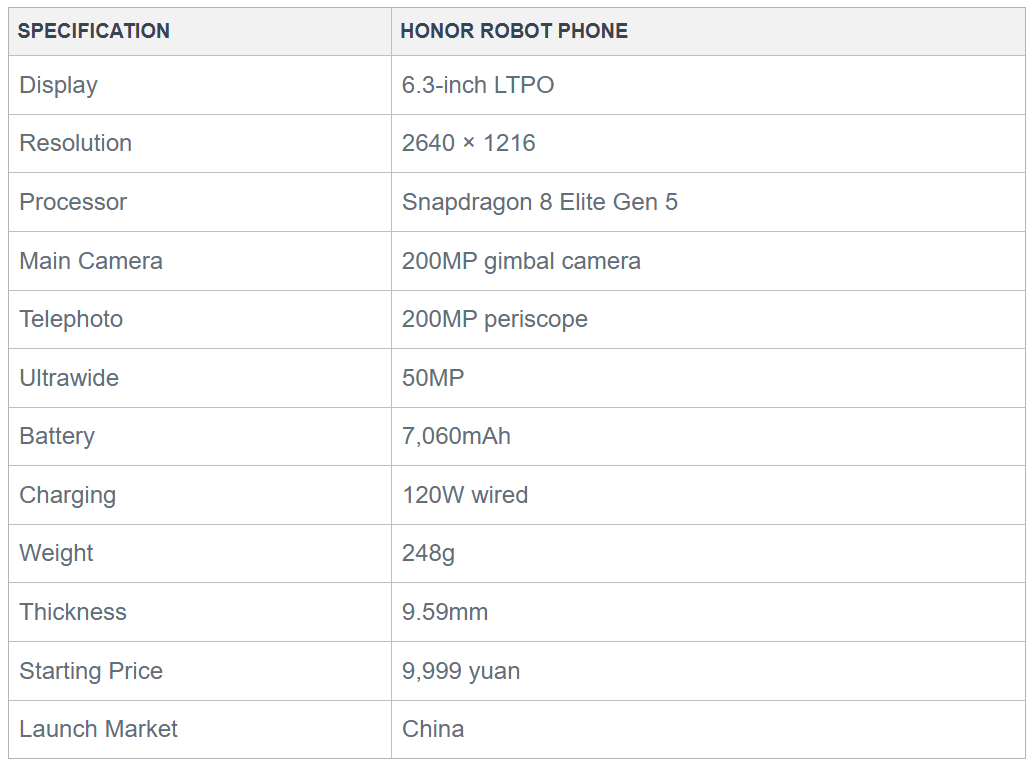
Despite its unusual camera mechanism, the Robot Phone is still built like a flagship smartphone. The large battery, powerful processor, high-resolution cameras and fast charging make it a complete high-end device rather than a simple technology demonstration.
Honor Robot Phone Price and Availability
The Honor Robot Phone starts at 9,999 yuan in China, while the higher-end configuration can cost up to 12,999 yuan depending on the specification.
At present, the phone is aimed at the Chinese market, and a broad international launch has not been announced. That means users outside China may have to wait before the device becomes widely available through official channels.
The limited availability also makes the Robot Phone more of a technology showcase for the global smartphone market right now. Its larger significance may come from the ideas and technologies Honor eventually brings to more conventional devices.
The Biggest Problem: The Robot Phone Is Heavy and Thick
There is a clear physical trade-off to fitting a moving camera mechanism inside a smartphone.
The Robot Phone weighs around 248 grams and measures roughly 9.59mm thick, which makes it bulkier than many traditional flagship phones. That may not sound like a major issue on paper, but the difference becomes noticeable when the device is carried every day.
For several years, smartphone manufacturers have generally tried to make flagship devices thinner and lighter. Honor has moved in the opposite direction by prioritising mechanical camera functionality.
This creates an important question for buyers: is the extra size and weight worth it for a feature that some people may use only occasionally? A content creator who regularly records videos may think so, while someone who mostly uses their phone for messaging, social media and normal photography may not find enough value in the trade-off.
Why Honor Built Such a Different Smartphone
The smartphone market has become highly competitive, and the basic formula is now familiar. Most flagship phones offer a powerful processor, large display, multiple cameras, a large battery and increasingly sophisticated AI.
That makes it difficult for manufacturers to create a feature that immediately feels new.
Honor's robotic camera is an attempt to solve exactly that problem. Instead of competing only on specifications such as processor speed or megapixel count, the company is introducing a feature that changes how the phone physically behaves.
The Robot Phone can attract attention because it is unusual, but the technology could also serve as a testing ground. Honor has already indicated that some of the imaging technology developed for the Robot Phone could move into more mainstream products.
That makes the device interesting even for people who never intend to buy one.
Honor Robot Phone vs a Normal Flagship
The biggest difference is not simply the camera resolution. It is the philosophy behind the device.
A conventional flagship is designed to be compact, durable and predictable. You hold it, point the camera and take a photo or record a video.
The Robot Phone is trying to make the phone more active. The camera can move, track, react and work together with AI to change what the device can do.
That comes with advantages, particularly for creators, but also introduces more complexity, greater weight and potentially higher repair costs.
In other words, the Robot Phone is not automatically better than a normal flagship. It is simply trying to solve a different problem.
Who Is the Honor Robot Phone Really For?
The Robot Phone makes the most sense for people who can actually use its robotic camera regularly.
Vloggers, content creators, mobile filmmakers and social-media creators could benefit from a camera that can track them automatically. Someone recording tutorials, presentations, dance routines or demonstrations could potentially reduce the need for a separate tripod, gimbal or camera operator.
For a typical smartphone user, however, the value is less obvious. If most of your usage involves calls, messaging, browsing, gaming and occasional photos, paying more and carrying a heavier phone for the robotic camera may not make much sense.
The Robot Phone is therefore better understood as a specialised flagship with mainstream smartphone capabilities, rather than a phone designed around the needs of every type of user.
Is the Honor Robot Phone the Future of Smartphones?
The Robot Phone is unlikely to become the standard design for every future smartphone, at least in its current form. The added weight, mechanical complexity and repair costs create real limitations, and many users will probably continue to prefer thinner and simpler devices.
However, the technology is still important because it shows what can happen when smartphone companies stop treating the camera as a fixed sensor and start treating hardware as something that can physically move and respond.
The most important idea may not be the robotic arm itself. It is the combination of AI, mechanical hardware and mobile photography in a single device.
That could influence future smartphone designs even if the exact Robot Phone concept remains a niche product.
Honor Robot Phone: Advantages and Disadvantages
Advantages
- Motorized gimbal camera with physical movement and subject tracking
- 200MP main and telephoto cameras
- Professional video capabilities including ARRI LogC3
- Large 7,060mAh battery
- AI-controlled camera movement and device actions
- Strong potential for creators and vloggers
- A genuinely different smartphone design
Disadvantages
- Heavy at around 248g
- Thicker than many traditional flagship phones
- Expensive compared with conventional smartphones
- Complex moving mechanism creates additional repair concerns
- Gimbal replacement can be costly
- Currently focused on the Chinese market
- The robotic camera may be unnecessary for many everyday users
Frequently Asked Questions About the Honor Robot Phone
What is the Honor Robot Phone?
The Honor Robot Phone is an Android flagship smartphone with a motorized gimbal camera that can physically rise from the rear of the device, rotate and track subjects.
What makes the Honor Robot Phone different?
Its biggest difference is the moving camera system. Instead of keeping the main camera fixed, Honor has integrated a motorized gimbal that can physically change direction and work with AI to track subjects.
How much does the Honor Robot Phone cost?
The phone starts at 9,999 yuan in China, while higher-end configurations can reach around 12,999 yuan.
Is the Honor Robot Phone available globally?
The device was launched in China, and broad international availability has not been announced.
What cameras does the Honor Robot Phone have?
It features a 200MP main gimbal camera, 200MP periscope telephoto camera and 50MP ultrawide camera.
What is a smartphone gimbal?
A gimbal is a mechanical system that uses motors and moving joints to stabilise or control a camera. In the Honor Robot Phone, that mechanism is integrated directly into the smartphone.
Is the Honor Robot Phone useful for vloggers?
Yes. The ability to move and track a subject could be particularly useful for vloggers, creators and people who frequently record themselves without another person operating the camera.
Is the Honor Robot Phone waterproof?
It has an IP54 rating when the camera mechanism is stored, but buyers should pay attention to how the moving camera system affects durability and protection.
How much does it cost to repair the Robot Phone's gimbal camera?
The reported replacement price for the main 200MP camera and gimbal system is around 3,079 yuan in China, making it one of the more expensive components to replace.
Is the Honor Robot Phone worth buying?
For creators who can regularly use the automated moving camera, it offers capabilities that conventional smartphones do not. For most everyday users, however, its higher weight, mechanical complexity and price may make a normal flagship a more practical choice.
Final Verdict
The Honor Robot Phone is one of the more unusual smartphone designs to appear in recent years because it does something most smartphones have never attempted: it gives the camera physical movement and allows AI to control that movement.
That makes the device genuinely interesting, especially for creators who want automated tracking without carrying a separate gimbal or camera setup. At the same time, the concept comes with clear compromises, including greater weight, a thicker body, higher mechanical complexity and expensive potential repairs.
For most users, a conventional flagship will remain the simpler and more practical option. But for people who regularly create video and want a smartphone that can do more than simply point and shoot, the Robot Phone represents a compelling experiment in where mobile hardware could go next.
The real importance of the Honor Robot Phone may therefore not be whether everyone eventually buys one. It is that Honor is testing a different idea of what a smartphone can be—and that experiment could influence the next generation of mobile devices.