A college degree still gives students the foundation for a career, but the gap between what is taught in classrooms and what employers expect from graduates is becoming harder to ignore. AI, cybersecurity, cloud computing, data analytics, semiconductor technology and other emerging fields are changing faster than traditional academic curricula can. In response, the Indian government has been building a growing ecosystem of digital-skilling platforms that students can use alongside their degree rather than waiting until graduation to start developing job-ready skills.
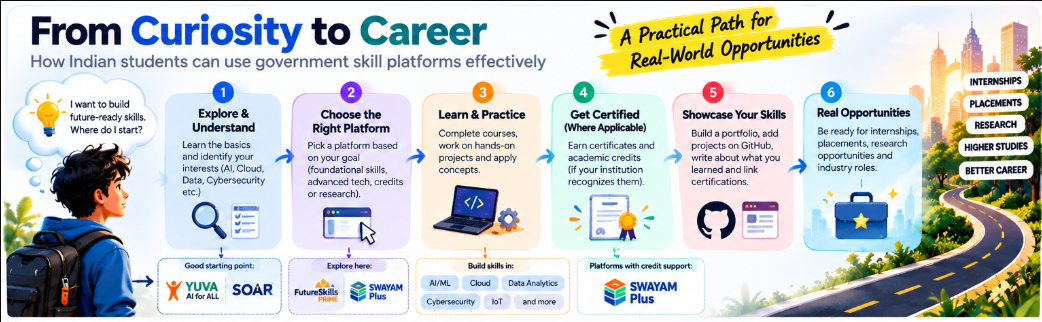
What makes 2026 particularly interesting is the scale of this ecosystem. FutureSkills PRIME has crossed 34 lakh registrations and 13 lakh certified candidates, while the government's SOAR programme has recorded more than 5.17 lakh learners and over 1 lakh certifications. SWAYAM Plus now lists more than 500 industry-oriented courses and has over 6.8 lakh registered learners. At the same time, programmes such as YUVA AI for ALL and the IndiaAI Fellowship are giving students more direct routes into AI literacy, projects and research.
The important point, however, is not to collect certificates randomly. Students need to understand which platform is meant for what, which courses can complement their degree, and how to turn government-backed learning into something employers can actually see in a resume or portfolio.
The Government Skill Ecosystem Is Getting Much Bigger
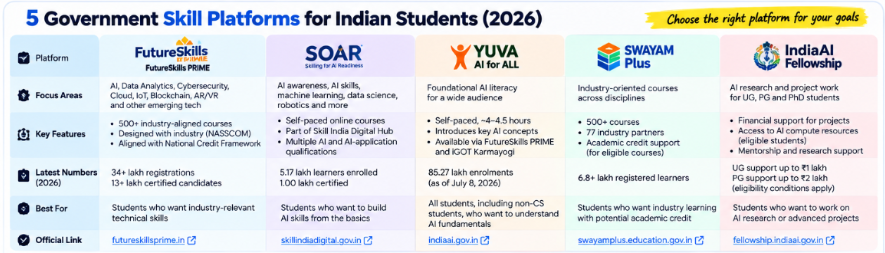
India's skilling strategy is no longer limited to traditional vocational training. Government programmes now cover areas such as artificial intelligence, machine learning, big data analytics, cloud computing, cybersecurity, IoT, blockchain, robotics, semiconductors and other emerging technologies. MeitY's FutureSkills PRIME, for example, was developed with NASSCOM to provide industry-aligned training in emerging technologies, with courses designed in consultation with industry. As of August 2026, the platform reported more than 500 courses, 34 lakh-plus registrations and more than 13 lakh certified candidates.
This scale is significant for students because access is no longer restricted to students at a handful of elite institutions. The government says more than 86% of FutureSkills PRIME participants are from Tier-2 and Tier-3 cities, while more than 2,000 academic institutions and universities have signed agreements related to adopting FutureSkills PRIME courses into academic curricula under the National Credit Framework.
The broader message is clear: students are increasingly being given ways to build skills outside the traditional semester structure. The opportunity is there; the challenge is figuring out how to use it intelligently.
1. FutureSkills PRIME: For Students Who Want Industry-Relevant Tech Skills
FutureSkills PRIME is one of the most useful starting points for students who already know which technical direction they want to explore. The programme covers areas including AI, big data analytics, cybersecurity, IoT, blockchain, AR/VR and other emerging technologies. The official programme currently lists more than 500 industry-aligned courses, and the government says these courses are continuously updated to reflect changing skill requirements.
That makes FutureSkills PRIME different from treating online courses as an endless library. A student studying computer science, for example, could use it to build a focused track around AI, cybersecurity or cloud computing rather than attempting to learn everything simultaneously. The platform also has a substantial reach beyond major metros, with government data showing more than 1.24 lakh candidates enrolled or trained in Uttar Pradesh and over 72,000 completions/certifications as of August 2026.
Best use: Pick one technology aligned with your career goal, complete a relevant learning path and connect the learning to a practical project. A certificate is useful evidence that you studied something; a working project is what demonstrates that you can actually use it.
2. SOAR: A Government Route Into AI Skills
Students who want to understand AI without immediately jumping into advanced machine learning research should look at Skilling for AI Readiness, or SOAR, available through the Skill India Digital Hub. The programme began with four online, self-paced courses—AI to be Aware, AI to Acquire, AI to Aspire and AI for Educators—and has since expanded into a much broader set of AI and AI-application-oriented qualifications.
The scale has grown rapidly. According to the Ministry of Skill Development and Entrepreneurship, 5,17,477 learners had enrolled in SOAR courses and 1,00,664 had completed certification as of August 6, 2026. The programme is also part of a wider push to integrate AI into India's national skilling ecosystem, alongside areas such as machine learning, data science, robotics, cybersecurity and cloud computing.
For students, the practical value is that SOAR can act as an entry point. Someone who has never worked with AI can start with foundational concepts before moving toward more specialized study. It is particularly relevant for non-CS students as well, because AI is increasingly appearing in fields such as finance, healthcare, business, design and education rather than remaining confined to software engineering.
3. YUVA AI for ALL: The AI Basics Course More Students Should Know About
Not every student needs to become an AI engineer, but almost every student will encounter AI in their future workplace. That is the reasoning behind YUVA AI for ALL, a foundational AI-literacy initiative launched under the IndiaAI Mission. The course is self-paced, designed to introduce AI concepts to a broad audience and is available through platforms including FutureSkills PRIME and iGOT Karmayogi. Government information describes it as a roughly 4–4.5-hour course and reports 85.27 lakh enrolments as of July 8, 2026.
This is important because there is a tendency among students to treat AI learning as a race toward advanced frameworks, LLM APIs and AI agents. But understanding what AI can and cannot do, how prompting works, how AI-generated information should be evaluated and how responsible AI affects real-world applications is becoming a useful baseline skill even for students who never plan to become ML engineers.
For a first-year student, a YUVA AI for ALL-style foundational course can be the starting point. For an engineering student already building AI projects, it is better viewed as basic literacy rather than advanced technical preparation.
4. SWAYAM Plus: Where Industry Learning Can Meet Academic Credit
SWAYAM Plus is particularly interesting for college students because it sits closer to the boundary between education and employment. It is an initiative of the Ministry of Education implemented through IIT Madras and currently lists 500+ industry-oriented courses, 77 industry partners and more than 6.8 lakh registered learners. It also supports credit recognition for applicable courses aligned with the National Credit Framework.
The platform is not limited to coding. Its current catalogue spans multiple disciplines and includes courses from industry partners, with both free and paid offerings. Some courses are explicitly marked as credit-eligible, meaning students should not assume every course automatically counts toward their university programme; they need to check the course details and whether their institution recognizes the relevant credits.
This makes SWAYAM Plus especially useful for students who want to add an industry-oriented subject to their academic profile without treating extracurricular learning as something completely separate from their degree. The best use case is to select courses that complement what you are already studying—such as industrial IoT for an electronics student, project management for an engineering student, or finance analytics for a commerce student.
5. IndiaAI Fellowship: For Students Who Want to Go Beyond Courses
There is a major difference between learning AI and working on an AI research project. The IndiaAI Fellowship is aimed much more toward the second category.
The programme supports eligible undergraduate, postgraduate and PhD students working on AI-related projects or research. According to the current IndiaAI Fellowship portal, final-year undergraduate students must generally have completed at least three AI-related courses and meet an 80% or equivalent academic threshold; eligible undergraduate students can receive financial support of up to ₹1 lakh, while postgraduate support can reach ₹2 lakh depending on the enrolment stage and conditions. The programme also provides specific support structures for doctoral researchers.
For a student who already has a strong academic record and is working on a serious AI project, this is fundamentally different from completing another online certificate. The goal is to support project work and research rather than simply course consumption. IndiaAI also provides an AI Compute Portal through which eligible student projects can access AI compute resources, subject to the programme's eligibility requirements.
Students considering this route should read the current fellowship eligibility and institute nomination requirements carefully rather than assuming that being interested in AI is sufficient.
Which Platform Fits Which Student?
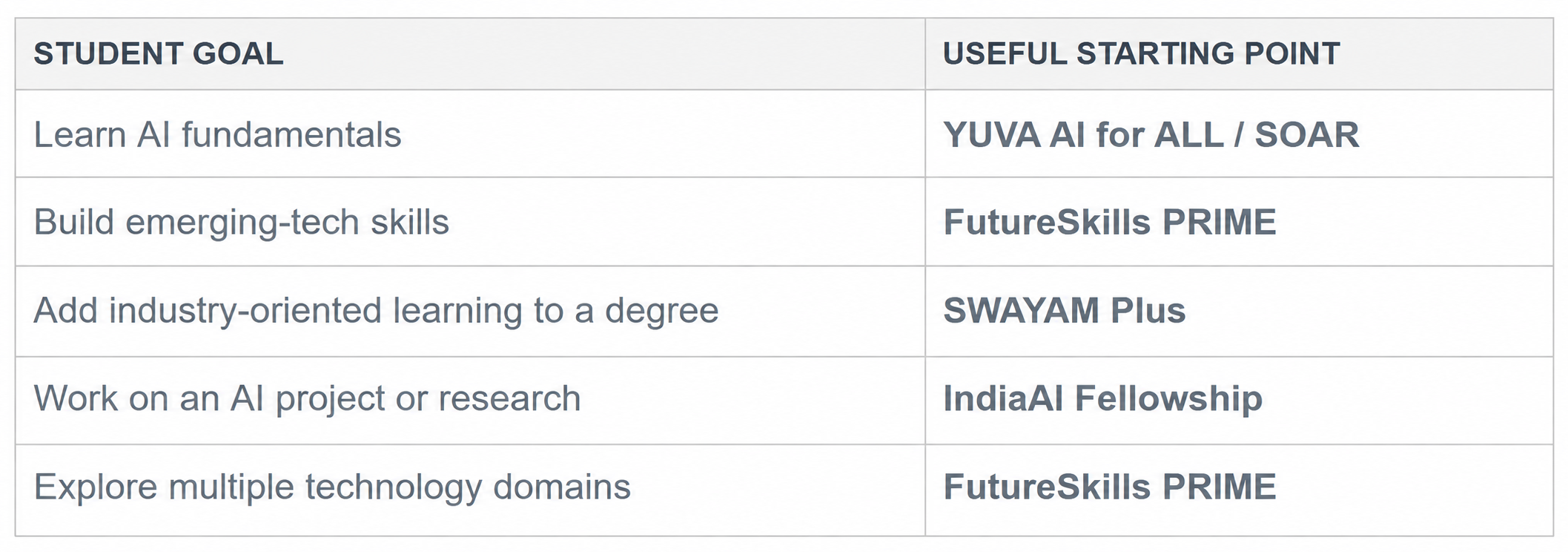
The mistake would be to register on all five platforms and start collecting certificates. A stronger strategy is to build a skill chain: foundation → technical skill → project → evidence. A student interested in AI, for example, could begin with foundational AI literacy, move into a deeper technical course, build a project around a real problem and then explore a fellowship or research opportunity when eligible.
Knowledge Corner: What Is the National Credit Framework?
The National Credit Framework (NCrF) is designed to create a common credit-based structure across different forms of learning, including school education, higher education, vocational education and skill development. In practice, this matters because some government-backed courses are now being designed with academic recognition in mind. However, “credit-eligible” does not automatically mean that every university will transfer those credits in the same way. Students should confirm recognition with their institution before assuming that an external course will replace a university subject or count toward graduation. FutureSkills PRIME and SWAYAM Plus are both examples of platforms where this credit-linked direction is becoming more visible.
What Should Students Do Now?
The smartest approach is not to chase the largest number of certificates; it is to build a profile where every course has a purpose. Choose one career direction for the next three to six months, identify one government-backed platform that fits that direction and complete a meaningful learning path instead of jumping between unrelated courses. Then convert the learning into something visible: a GitHub repository, research project, case study, technical blog, competition submission or portfolio project.
A student who completes a cloud course but cannot explain how cloud services were used in a project has limited evidence of practical ability. A student who completes a cybersecurity course and then documents a small security lab, or learns AI and builds an evaluated AI application, can demonstrate far more. The course is the input; the project is the proof.
The Bigger Opportunity Is Not the Certificate
India's government-backed skilling ecosystem is becoming large enough that students no longer have to depend entirely on whatever optional training their college happens to provide. FutureSkills PRIME is expanding access to emerging-technology training, SOAR is bringing structured AI learning into the Skill India ecosystem, YUVA AI for ALL is targeting foundational AI literacy at national scale, SWAYAM Plus is connecting industry learning with academic recognition, and the IndiaAI Fellowship is creating a route for stronger students to pursue AI projects and research.
The real advantage, however, will go to students who use these programmes as part of a larger career strategy. One relevant course, one serious project and one demonstrable skill can be far more valuable than a resume filled with twenty disconnected certificates. The opportunity in 2026 is not simply to learn more. It is to learn with a direction—and use the growing public skilling infrastructure to get there.
Official Sources
FutureSkills PRIME — Government/NASSCOM skilling platform
Skill India Digital Hub — SOAR and skilling programmes
IndiaAI — YUVA AI for ALL and IndiaAI initiatives
SWAYAM Plus — Ministry of Education / IIT Madras
IndiaAI Fellowship
PIB — FutureSkills PRIME 2026 update
PIB — AI integration into the Skill Development ecosystem