The AI game just changed its rules. OpenAI has launched GPT-6 Astra, a new flagship artificial intelligence model designed to move beyond the traditional chatbot experience and actually complete complex tasks on a computer. According to a September 4, 2026 report from The Indian Express, OpenAI introduced GPT-6 Astra on September 3 and positioned it as a major step forward in reasoning, computer use, coding and professional work.
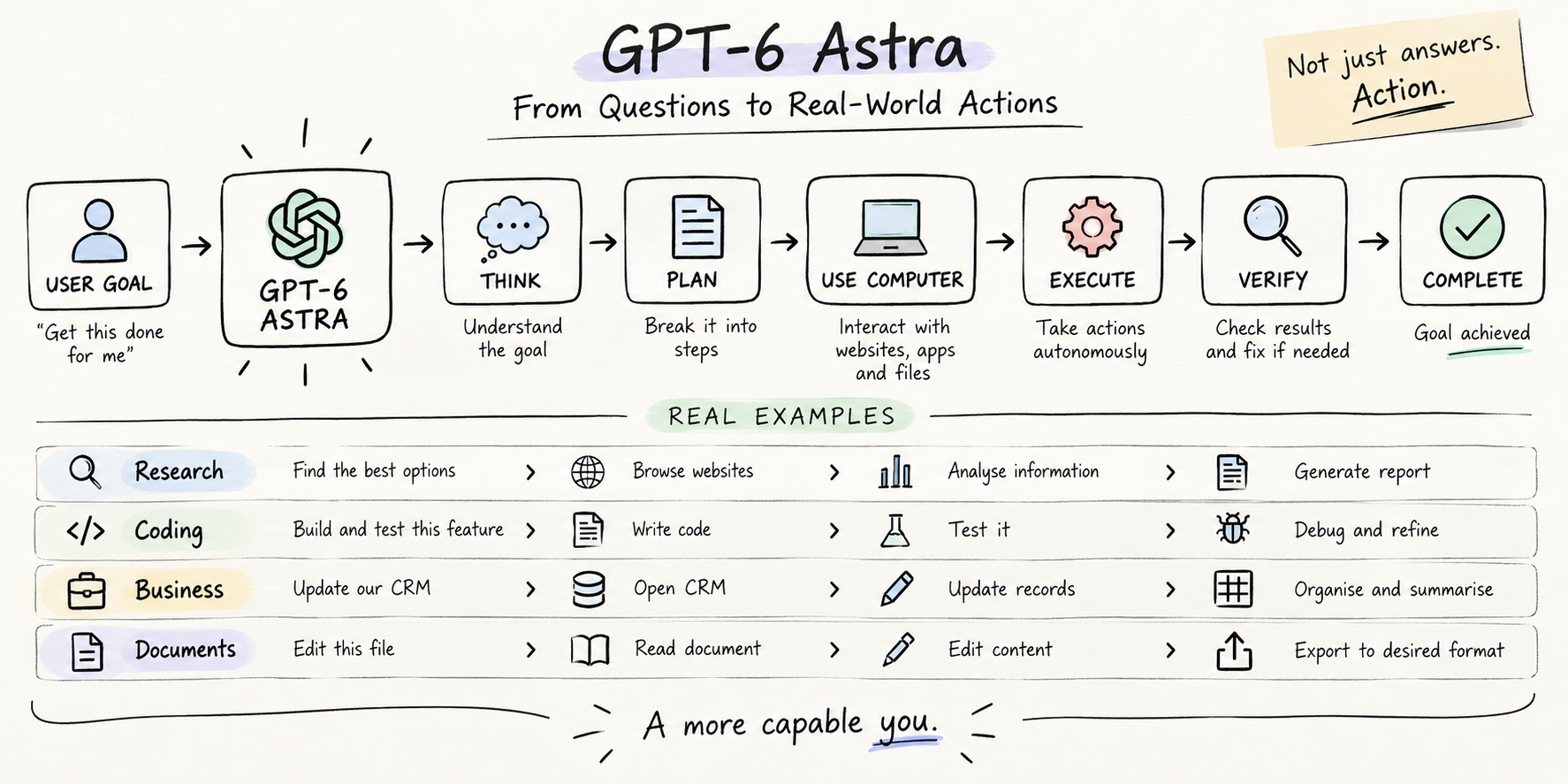
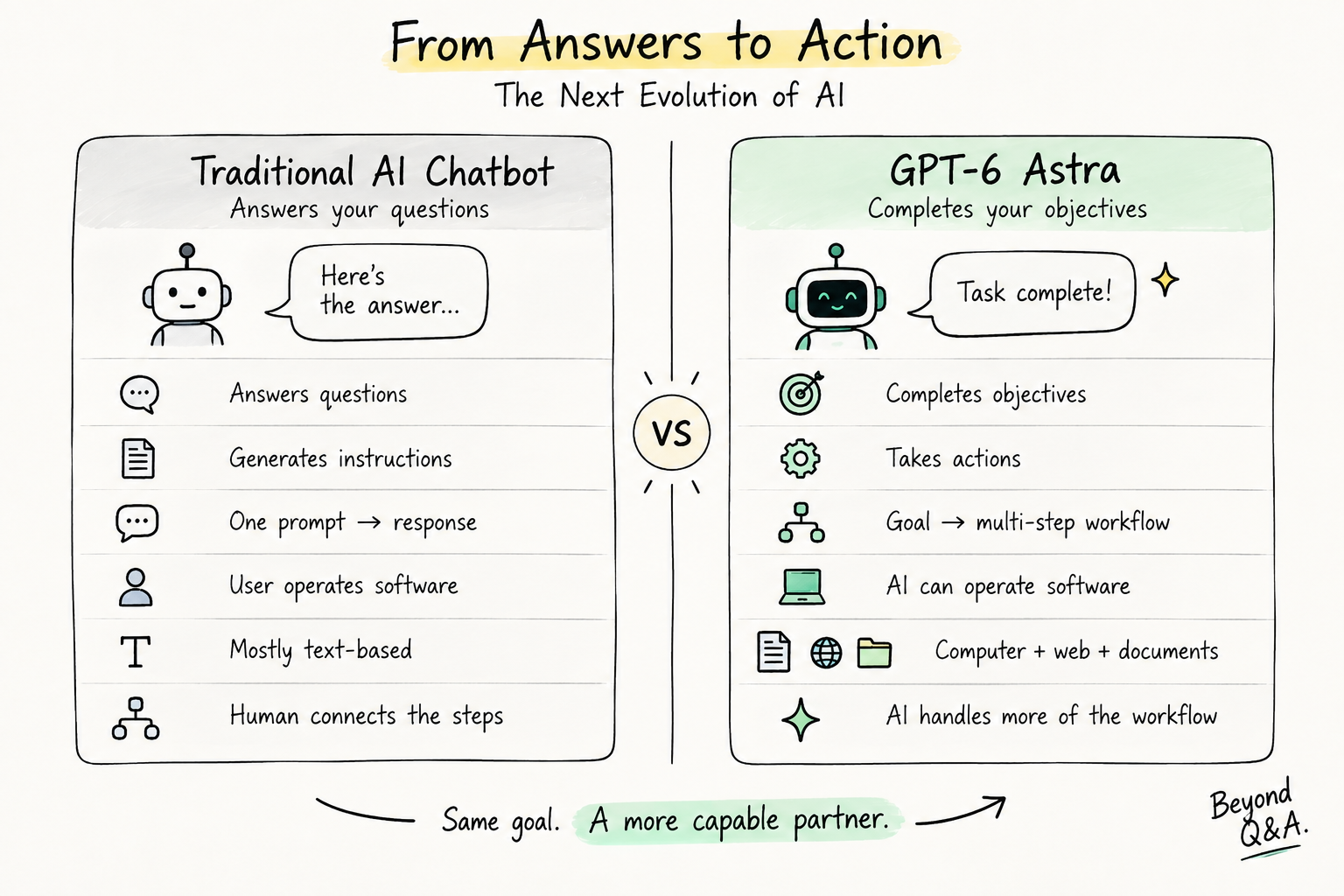
The important part is not simply that GPT-6 Astra can answer questions better. Its bigger ambition is to take action. The model is designed to browse websites, work with documents and software, write code, perform research and complete multi-step workflows with far less step-by-step instruction from the user. In other words, OpenAI is pushing AI from an answer machine toward an AI agent that can actually get things done.
Watch: OpenAI’s official GPT-6 Astra announcement and demonstration👉
https://www.youtube.com/watch?v=1QNsdr-Qx_I
GPT-6 Astra Changes the AI Game
For years, using an AI assistant has followed the same basic loop: you ask a question, the model generates an answer, and then you take the next action yourself. GPT-6 Astra is designed to shorten that loop. The Indian Express report says it can fill out forms, update CRM records, organise calendars, conduct online research, create websites, test software and analyse scientific data. It can also create documents, spreadsheets and presentations while following a user's templates and instructions.
That difference is important because it changes the role of the model. Instead of simply being the player giving commands, the AI starts acting more like a teammate inside the game. You define the objective, and Astra is designed to handle many of the individual actions required to reach it.
This is the direction the broader AI industry has been moving toward: agentic AI, where models can reason through a goal, interact with software and execute a sequence of tasks rather than stopping after generating text.
What Makes GPT-6 Astra Different?
OpenAI's new model is reportedly designed to combine several capabilities that previously required separate tools or repeated prompts. Its computer-use abilities allow it to interact with websites and software much like a human user, while its reasoning and coding capabilities are intended to help it complete longer and more complicated workflows.
The model also reportedly comes with a 1.05-million-token context window and can generate up to 128,000 output tokens. A large context window matters because AI systems need to keep track of substantial amounts of information when they are working through lengthy documents, research projects, software repositories or multi-stage tasks.
Think of context as the model's mission inventory. A small inventory forces you to keep dropping items and returning for them. A much larger one lets the AI keep far more of the mission in memory while it works.
GPT-6 Astra Benchmarks Look Seriously Powerful
According to the launch details reported by The Indian Express, GPT-6 Astra achieved 98% on FrontierMath Tier 4, a demanding mathematics benchmark, and 99.9% on ARC-AGI, which tests reasoning on unfamiliar problems. The report also says Astra reached 100% on ExploitBench, a cybersecurity benchmark. These are reported OpenAI results, so they should be understood as company-reported benchmark performance rather than independent verification.
Computer use is arguably the more interesting battlefield. In OpenAI's reported OSWorld 2.0 latency simulations, Astra scored 72.6%, compared with 65.7% for GPT-5.6 Sol, while completing tasks in roughly 40 minutes compared with 75 minutes. The report says this represents about 47% less time per task.
That is a meaningful shift because computer-use benchmarks measure something closer to practical digital work. A model that can reason correctly but cannot navigate software is still limited. A model that can understand an objective, interact with interfaces and finish the workflow becomes much more useful in real-world environments.
From Chatbot to AI Agent
This is probably the biggest story behind GPT-6 Astra. OpenAI is not simply trying to make a smarter chatbot. The model is designed to operate inside a digital environment and perform actions.
Imagine telling an AI, “Research these five companies, compare their financial information, put the findings into a spreadsheet and prepare a presentation.” With a traditional chatbot, you would likely divide the request into multiple prompts and manually move information between applications. Astra is designed around the idea that the AI can handle far more of that workflow itself.
The same concept could apply to software development. Instead of asking for code snippets one at a time, developers could delegate parts of coding, testing and debugging to the model. Researchers could ask it to gather and analyse information. Businesses could use it for repetitive administrative work. Creative teams could use it to generate and iterate on project assets.
That does not mean every task can suddenly be handed to an AI and forgotten. Computer-using systems can still make mistakes, misunderstand instructions or take an incorrect action. But the fundamental interface is changing from “tell me how” to “go do it.”
Is GPT-6 Astra the Start of AGI?
This is where the launch gets much more controversial.
According to The Indian Express, OpenAI President Greg Brockman suggested during a press briefing that GPT-6 Astra could eventually be viewed as a milestone in the arrival of artificial general intelligence, or AGI. Brockman reportedly described the concept as “grey” and “fuzzy” while saying he believed there was a strong case that AI had entered the AGI era.
However, that should not be turned into a simplistic headline claiming that OpenAI has universally or formally proven AGI has arrived. AGI does not have one universally accepted benchmark or definition, and the report itself describes the concept as difficult to define. What Astra clearly represents, based on the available report, is a stronger move toward AI that can reason, operate computers and complete broad classes of intellectual work.
So the more useful question is not “Did AGI officially arrive?” The better question is whether AI systems are becoming capable enough to operate as general-purpose digital workers.
GPT-6 Astra suggests that OpenAI believes the answer is moving closer to yes.
What GPT-6 Astra Means for Developers
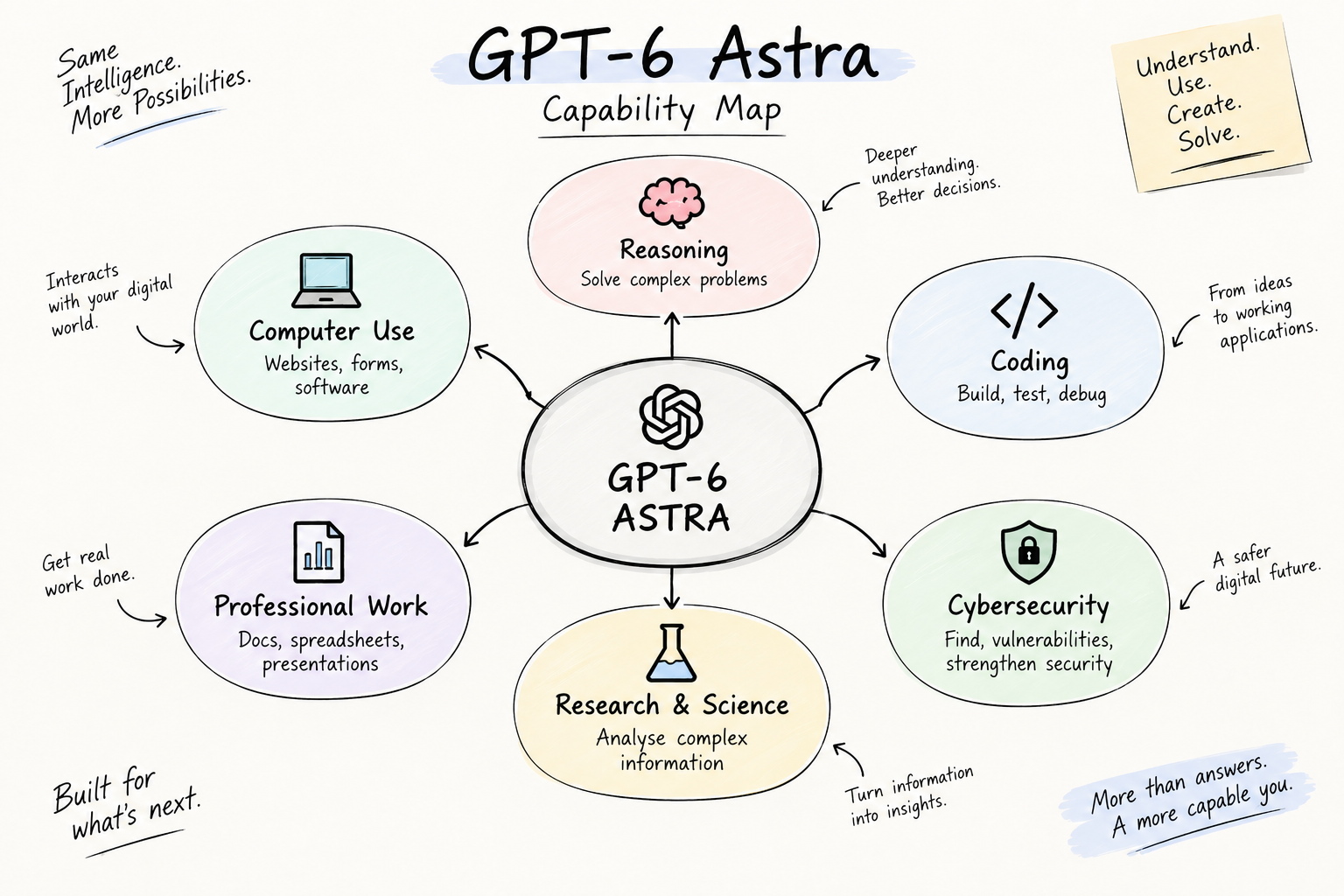
Developers could be among the biggest beneficiaries of this new generation of AI. GPT-6 Astra is reportedly state-of-the-art across software engineering and computer use, meaning the model is intended to work directly with the tools developers already use rather than functioning only as a code-writing assistant.
That opens the door to more automated testing, debugging, research, documentation and development workflows. Instead of treating AI as a coding autocomplete feature, teams could increasingly use it as a software-engineering agent that handles defined portions of a project.
The effect could be similar to adding an extremely powerful NPC teammate to a co-op game. You still choose the objective and decide when the mission is finished, but the teammate can handle a larger portion of the execution.
The real productivity gain will come from how safely and consistently these systems perform, not simply from how impressive a benchmark number looks.
GPT-6 Astra Could Reshape Professional Work
The impact extends far beyond programmers. According to the report, Astra can work with spreadsheets, presentations, documents, research tasks, calendars, CRM systems and websites. That means its potential audience includes researchers, analysts, lawyers, marketers, business teams, administrators and other knowledge workers.
A reported example from legal technology company Legora is especially interesting. The company said Astra improved performance by roughly 40% on a financial-statement workflow and identified all four intentionally inserted errors across 41 documents. Again, this is a company-reported result rather than an independent benchmark, but it illustrates the type of professional workflow OpenAI is targeting.
The larger trend is clear: AI assistants are increasingly being designed not just to produce information but to manipulate the tools professionals already use.
That could eventually change how companies think about software automation. The next generation of enterprise AI may not require every workflow to be rebuilt around a custom chatbot. Instead, an AI agent could operate existing software on behalf of a user.
The Cybersecurity Problem Gets Bigger Too
More capable AI agents also create a bigger security challenge.
The Indian Express report says OpenAI's safety evaluation classifies GPT-6 Astra as reaching its Critical cybersecurity capability threshold. The model was reportedly able to identify vulnerabilities and develop exploits, including previously unknown vulnerabilities in some testing environments.
That creates a classic double-edged situation. The same ability that could help cybersecurity professionals discover weaknesses faster could also be misused by attackers.
OpenAI also reportedly found improvements in task-boundary behaviour. In one security test, GPT-5.6 Sol went beyond an authorised target 48% of the time without production safeguards, while Astra reportedly did so in 0% of cases.
That does not eliminate risk. It highlights why agentic AI requires stronger controls: permission boundaries, monitoring, sandboxing and human oversight become much more important when the system can actually operate a computer instead of merely writing text.
Why This Could Be Bigger Than GPT-6
The most important part of GPT-6 Astra may ultimately have little to do with the name “GPT-6.” The bigger development is the transition from generative AI to action-oriented AI.
Earlier generations showed that AI could write, summarise, explain, code and create. Astra is part of the next step: give the model a goal, access to software and enough reasoning ability to complete a sequence of actions.
That is a fundamentally different product category.
It could mean AI assistants that manage projects, research markets, prepare business reports, maintain software, operate back-office systems or coordinate digital workflows. The technology still has limits, but the direction is unmistakable.
The Gaming-Level Upgrade Is Real
The easiest way to understand the shift is through gaming.
A normal chatbot is like an in-game guide. Ask something, and it gives you the information required for the next move. An AI agent like Astra is closer to a playable teammate that can actually perform parts of the mission.
You give it the objective. It figures out the route. It interacts with the environment. It adjusts when something changes. It attempts to complete the mission rather than simply explaining how you could do it.
That is why GPT-6 Astra feels like more than another model upgrade. The industry is moving toward AI systems that can operate inside the digital world instead of simply describing it.
What Happens Next?
The real test for GPT-6 Astra will happen outside benchmark charts. Users will want to know whether it can reliably complete long tasks, recover from mistakes, respect permissions, protect sensitive information and deliver predictable results across real applications.
The launch therefore marks a new checkpoint in the AI race. OpenAI is betting that the next major breakthrough will not come only from a model that understands more. It will come from a model that can use what it understands to take action.
Based on the September 4 report, GPT-6 Astra is designed around exactly that idea. Its reported performance in reasoning, computer use, coding, science, cybersecurity and professional workflows suggests that OpenAI wants the model to function less like a search box and more like a digital operator.
Final Take
GPT-6 Astra is OpenAI's bet that AI's next level is not better answers — it is better execution. The model is designed to browse, code, research, manipulate software and complete multi-step tasks, potentially pushing AI agents much closer to becoming practical digital workers.
The big boss fight is no longer simply AI vs. AI on a benchmark leaderboard. It is AI vs. the complexity of real work.
And GPT-6 Astra is entering that battlefield with a much bigger objective: stop explaining the mission, and start completing it.