Do you have an idea that could solve a real problem in your community? You may be able to turn it into something useful through the Seva First Innovation Challenge 2026.
The challenge invites eligible students to develop solutions for problems related to education, healthcare, agriculture, the environment and public safety. Winners can receive prizes of up to ₹10 lakh, along with possible support from experts, access to laboratories and help with developing their projects.
The last date to submit an entry is October 24, 2026. However, there is an important rule: this edition is open only to students from five southern states and three union territories. Students also cannot register individually. Their schools, colleges or other educational institutions must submit their entries through a nominated coordinator.
Here is everything you need to know about eligibility, themes, prizes and the application process.
Seva First Innovation Challenge 2026: Key Details
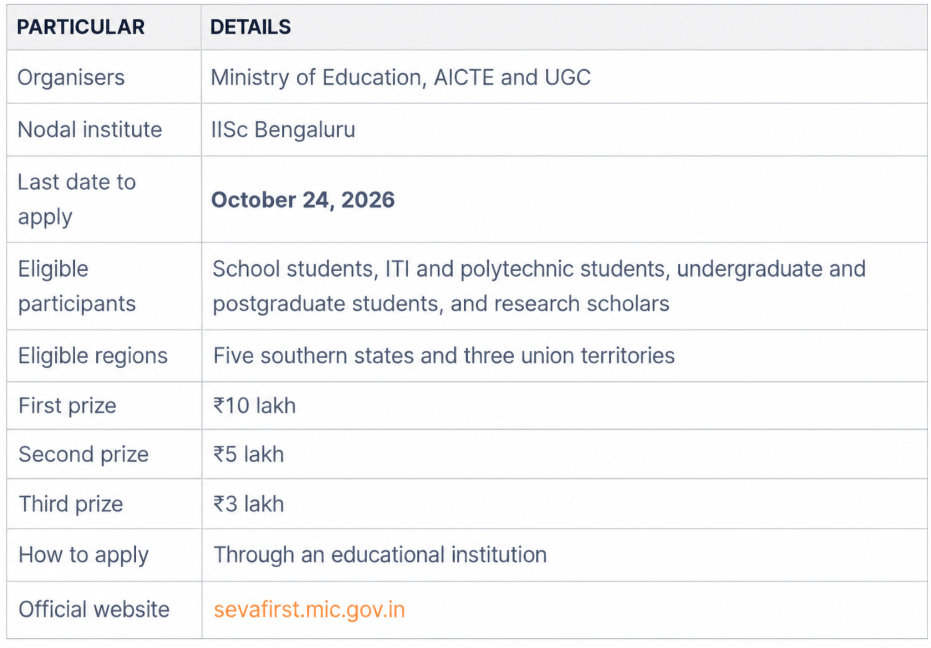
The challenge was launched under the Seva Sankalp Abhiyan to encourage students to identify problems around them and develop useful solutions. IISc Bengaluru is the nodal institute for the programme.
Official announcement: Ministry of Education — Press Information Bureau.
Who Can Participate in the Seva First Innovation Challenge?
The competition has three categories based on the participant's level of education.
Junior category — Classes VI to XII: School students can identify a problem in their school or community and suggest a practical solution. Building a working model is encouraged, but it is not compulsory for this category.
Technical category — ITI and polytechnic students: Students should show their practical skills in areas such as engineering, electronics, manufacturing or fabrication. A working prototype is expected for technology-based entries.
Open category — Undergraduate and postgraduate students and research scholars: Participants should present a working model or a small-scale test of their idea. They should also explain how the solution could be used in real life, how much it might cost and who would benefit from it.
Which States and Union Territories Are Eligible?
This edition is open to students from the following regions: Andhra Pradesh, Karnataka, Kerala, Tamil Nadu and Telangana, Andaman and Nicobar Islands, Lakshadweep and Puducherry.
Students from other states should not assume that they can participate in this edition. Check the eligibility rules on the official challenge website before preparing your entry.
The Five Innovation Themes: Choose a Problem Worth Solving
The challenge focuses on five areas that affect people's everyday lives. Your idea should fit into one of these themes.
1. Swachh & Sustainable Bharat
This theme covers waste management, water conservation, recycling, clean energy and environmental protection. For example, students could develop a low-cost system to reduce water wastage or improve waste collection in their neighbourhood.
2. Samriddh Annadata, Samriddh Bharat
This theme focuses on agriculture, farmers, rural communities and small businesses. Ideas could include affordable farming tools, better irrigation systems or technology that helps farmers manage their work.
3. Swasth & Samavesh Bharat
This theme is about healthcare, well-being, accessibility and inclusion. Students could work on assistive devices, healthcare support tools or solutions that make everyday services easier to access.
4. Shikshit & Kaushal Bharat
This theme covers education, digital learning, skill development and sports. Projects could help students learn more effectively or give people better access to useful skills.
5. Surakshit Bharat
This theme focuses on safety, transport, infrastructure, manufacturing and public services. Ideas could include road-safety solutions or tools that make public services more efficient.
You do not need to solve a problem across the entire country. A simple, affordable solution to a local problem can also be useful if you clearly explain how it works and who it helps.
Two Ways to Participate: Build a Product or Improve a Process
The challenge offers two tracks, and both have equal standing in the evaluation.
Track A — Product or Technology: Build a device, prototype, software tool or engineering solution that can be demonstrated and potentially used in real life. Examples include a water-leak detection system, an assistive device or a tool that helps farmers manage irrigation.
Track B — Business Model or Governance: Find a better way to deliver a service or manage a process. For example, students could suggest a more efficient waste-collection system or a better way to connect rural communities with essential services.
Remember, innovation does not always mean building an app or using advanced technology. A simple process that solves a real problem can also make a meaningful difference.
What Are the Prizes and Other Benefits?
The official challenge website lists the following prizes:
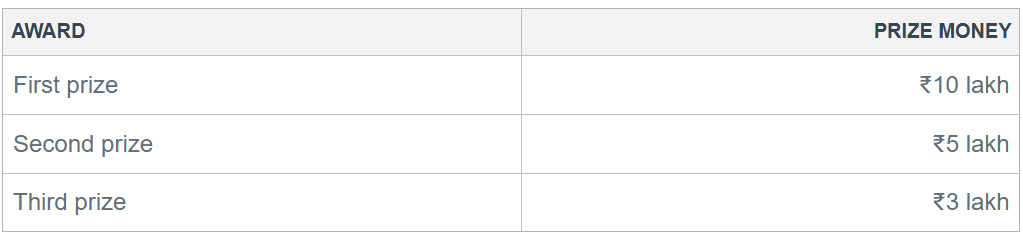
These awards are listed across the challenge's themes and participant categories. Check the official rules for the exact prize structure.
The benefits may go beyond prize money. Selected students may receive guidance from experts, access to laboratories and equipment, help with developing prototypes, incubation support and opportunities to test their ideas.
This can be valuable for students who want to turn a college project into something people can actually use. They may get help improving their designs, testing their solutions and understanding how to put their ideas into practice.
However, winning is not guaranteed. Judges consider how clearly the problem is explained, how useful and practical the solution is, how much it may cost and how many people it could help.
How to Apply Before October 24, 2026
The first step is to contact your school or college. Students cannot register individually. An educational institution must nominate a coordinator to manage the registration and submit entries.
Follow these steps:
- Visit the official Seva First website.
- Ask your school, ITI, polytechnic or college whether it has nominated a coordinator.
- If your institution has not registered, share the official challenge details with the administration as soon as possible.
- Prepare your idea and decide which category, theme and track it fits.
- Work with the coordinator to complete and submit the entry before October 24, 2026.
The official website also lists daily sessions for guidance and questions from 12 noon to 1 pm and 3 pm to 4 pm. Visit the portal to check the latest instructions.
Do not wait until the last day. Your institution needs time to complete the required registration and submission steps.
How to Make Your Innovation Entry Stand Out
A good entry begins with a clear explanation of the problem. You should show that you understand who is affected, why the problem matters and how your idea could help.
Your proposal should explain five things: the problem, your solution, the cost and resources needed, any supporting evidence or demonstration, and the benefits your solution could provide.
For example, suppose your team wants to build a smart irrigation system. Explain how it works, what parts it needs and how it could help farmers use water more efficiently. If your idea is about improving waste collection, describe the current problem and show how your proposed process would make collection easier or faster.
Keep your idea practical and easy to understand. A simple solution with a clear plan can be stronger than a complicated project that is difficult to build or use.
Frequently Asked Questions
What is the last date for the Seva First Innovation Challenge 2026?
The official website lists October 24, 2026, as the submission deadline.
Can students from every state in India participate?
No. This edition is open to students from Andhra Pradesh, Karnataka, Kerala, Tamil Nadu, Telangana, Andaman and Nicobar Islands, Lakshadweep and Puducherry.
Can I register on my own?
No. You must participate through your educational institution, which must nominate a coordinator to handle registration and submissions.
Do I need to build a working prototype?
Not necessarily. A prototype is encouraged but not compulsory for Junior participants. Technical and Open category entries have stronger demonstration requirements, depending on the chosen track.
Where can I find the official guidelines?
Visit the Seva First Innovation Challenge website for information about eligibility, themes, participation categories and the application process.