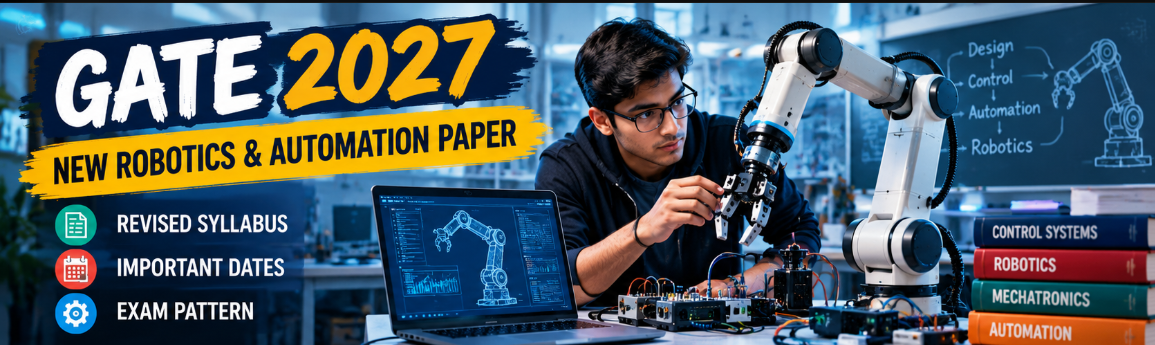
GATE 2027 Gets a Robotics Twist: New RA Paper, Revised Syllabus and Key Dates Students Must Know
Published: October 19, 2026
Engineering students preparing for GATE 2027 have more to track this year than their usual revision schedule. IIT Madras, the organising institute for the examination, has introduced a new Robotics and Automation (RA) paper, revised the syllabus across test papers and changed the sectional codes used in Engineering Sciences, Humanities and Social Sciences, and Life Sciences.
These updates matter because candidates need to prepare from the correct syllabus, understand the revised paper structure and avoid relying on outdated preparation material. The official website has also announced a deadline for resolving application scrutiny defects, while the regular registration process is now closed.
Here is what students need to know about GATE 2027, including the new paper, examination dates, question pattern and the practical steps to take before the exam.
GATE 2027: Important Dates at a Glance
The Graduate Aptitude Test in Engineering (GATE) is a national-level examination used by participating institutions for postgraduate and doctoral admissions. Some public sector undertakings also use GATE scores in their recruitment processes, although qualifying does not guarantee admission, financial assistance or employment.
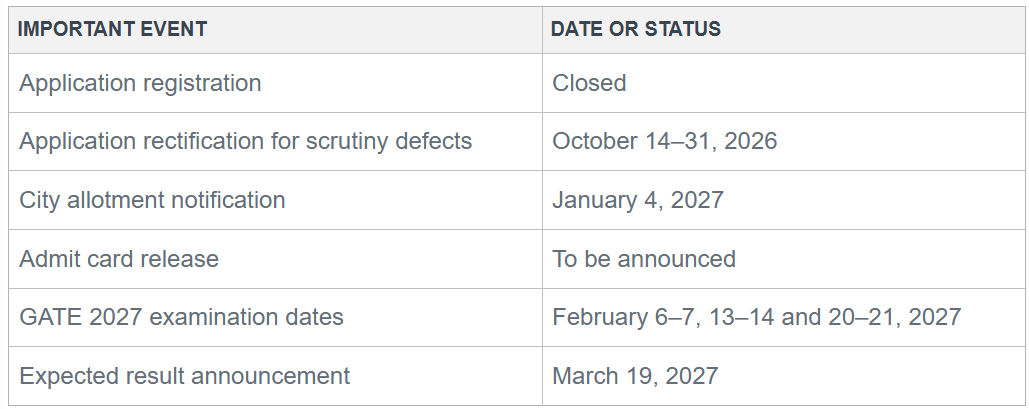
Source: Official GATE 2027 website. Dates may change, so candidates should check the official schedule before making plans.
What should applicants do now?
If you have already registered, log in to the official GATE Online Application Processing System and check your application status. The current rectification window is intended for applicants who have been notified of scrutiny defects. Follow the instructions in the official email and portal rather than assuming that every application field can be edited.
The deadline for the general data-correction window, where applicable, is listed separately as yet to be announced. Students who missed registration should not assume that the correction window allows them to submit a new application.
1. The Biggest Change: A New Robotics and Automation Paper
One of the major developments in GATE 2027 is the introduction of the Robotics and Automation paper, identified by the code RA. The new paper creates a dedicated examination option for students interested in robotics, mechatronics and automated engineering systems.
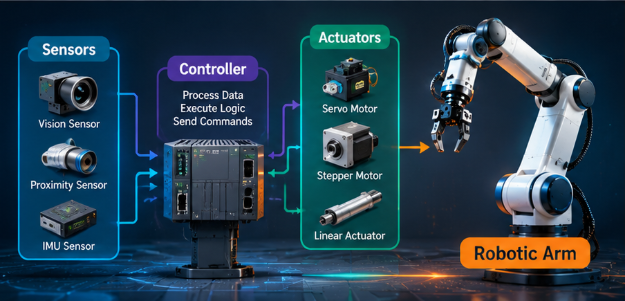
Robotics and automation bring together multiple engineering disciplines. Robots depend on mechanical structures, sensors, electronic circuits and control systems, while automation connects these components to industrial processes and programmable equipment.
The official RA syllabus reflects this interdisciplinary approach. Its common section covers Engineering Mathematics, basics of mechatronics, principles of robotics and automation, and computer-integrated manufacturing. Candidates then choose between an Electrical Engineering section and a Mechanical Engineering section.
The paper may be particularly relevant to students whose academic interests span mechanical systems, electronics, embedded systems and industrial automation. However, choosing RA should be based on the official syllabus and a candidate's preparation, not simply because robotics is a growing technology field.
Read the official GATE 2027 RA syllabus before deciding whether the paper matches your strengths.
2. What Is Covered in the GATE Robotics and Automation Syllabus?
The RA syllabus is broader than robot programming alone. It combines mathematical foundations with the engineering principles required to understand and control physical systems.
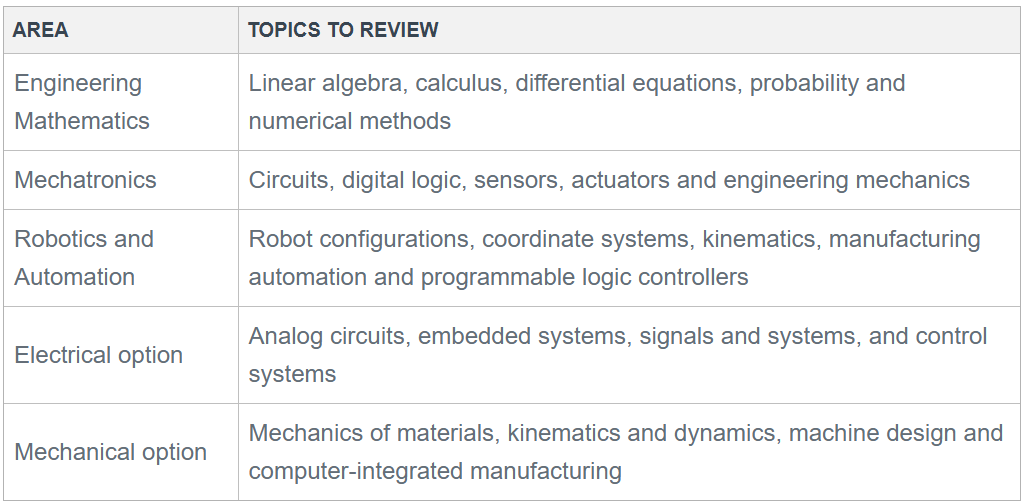
The Electrical and Mechanical topics above are representative areas listed in the official syllabus, not a substitute for the complete document.
Students should download the official syllabus and break it into manageable topics. A practical preparation plan should allocate time for concepts, numerical problem-solving, previous-year questions where relevant and timed practice. Since RA is a newly introduced paper, candidates should be especially careful about assuming that older papers from another GATE subject directly match its structure.
3. GATE 2027 Syllabus Changes: Why Students Should Check Again
IIT Madras has revised the GATE syllabi and announced changes to sectional paper codes. The Textile Engineering and Fibre Science paper, previously identified as TF, has been incorporated as section XE9 under Engineering Sciences.
Changes have also been made to the sectional codes in XE, XH and XL. For example, the previous sectional codes have been replaced with new codes such as XE0 for Engineering Mathematics and XH0 for Reasoning and Comprehension.
These details might look administrative, but they matter when downloading study material, selecting sections and checking the instructions for an examination. A candidate using an old syllabus or code table may overlook a topic or misunderstand the required paper structure.
The safest approach is to use the GATE 2027 syllabus—not an older year's syllabus—as the final reference for preparation. Official updates and downloadable subject syllabi are available on the GATE 2027 test papers and syllabus page.
4. GATE 2027 Exam Pattern: Duration, Marks and Question Types
GATE 2027 will be conducted as a computer-based test in English. The examination lasts three hours and contains 65 questions for a total of 100 marks. The questions can be multiple-choice questions (MCQs), multiple-select questions (MSQs) or numerical-answer-type questions (NATs).
For the RA paper, the official pattern allocates 15 marks to General Aptitude, 60 marks to the common section and 25 marks to the selected Electrical or Mechanical section. Candidates should consult the detailed paper pattern to understand how the sections are presented during the exam.
A key scoring rule is negative marking for incorrect MCQ answers: one-third of the mark is deducted for a wrong one-mark MCQ, and two-thirds for a wrong two-mark MCQ. There is no negative marking for incorrect MSQ or NAT answers, and MSQs do not receive partial marks.
These rules influence test strategy. Candidates should avoid blind guessing in MCQs, while practising the numerical and multiple-select formats separately. A timed mock test can help identify whether mistakes are caused by weak concepts, calculation errors or poor time management.
Official reference: GATE 2027 question paper pattern.
5. Who Can Appear for GATE 2027?
According to the official eligibility criteria, students currently studying in the third year or higher of an eligible undergraduate degree programme, as well as candidates who have completed an eligible degree, can appear for GATE 2027.
Eligible programmes cover several disciplines, including engineering, technology, architecture, science, commerce, arts and humanities. Specific degree conditions apply, so students should check the official criteria instead of relying on a simplified eligibility summary.
GATE scores can support applications to postgraduate and doctoral programmes at participating institutions. Some institutions and organisations may also use them for other opportunities. However, the requirements vary, and a qualifying score does not itself guarantee a seat, scholarship or job.
Check the official GATE 2027 eligibility criteria before making plans around admissions or recruitment.

6. How Students Should Prepare From Here
With examinations scheduled across February 2027, candidates should now move from broad planning to syllabus-based preparation. First, download the correct syllabus and mark topics as not started, in progress or ready for revision. This gives a realistic view of the remaining workload.
Next, prioritise fundamental concepts and regularly solve questions under timed conditions. Keep a record of repeated mistakes, formulas that need revision and topics that consume too much time. Candidates preparing for RA should give attention to the common section before moving deeply into their selected Electrical or Mechanical topics.
Preparation materials should match the current exam code and syllabus. Online lectures and coaching resources can be useful, but verify their topic coverage against the official source. Avoid switching resources every few days; consistent practice and regular revision are generally more productive than collecting large amounts of study material.
A practical weekly routine
- Concept revision: Study a defined set of syllabus topics and revise the previous session's material.
- Problem-solving: Practise numerical questions and work through topic-specific exercises.
- Timed practice: Take a sectional test or mock test, then analyse mistakes.
- Weekly review: Update your progress tracker and adjust the next week's study plan.
- The ideal allocation depends on how much of the syllabus is already complete. Students with weaker fundamentals should spend more time rebuilding concepts, while those who have covered most topics should increase timed practice and revision.
7. DigiLocker and Application Verification: A Detail Not to Ignore
GATE 2027 applicants were required to use DigiLocker as part of the registration process. The official website specifically warns candidates not to delete the verified or unverified DigiLocker account used for application submission and payment.
Future communications will be associated with the same account used during the application process. Applicants should therefore preserve access to their account and regularly check the registered email address and GOAPS portal for updates.
If your application is marked defective, follow the instructions provided by the examination authorities. Do not create duplicate applications or rely on unofficial instructions circulating on social media.
Knowledge Corner: GATE Terms Explained
- RA paper: The Robotics and Automation test paper introduced for GATE 2027.
- Application rectification: The process for resolving defects identified during the scrutiny of an application. It is different from a general data-correction window.
- MCQ, MSQ and NAT: Multiple-choice questions have one correct option; multiple-select questions may have more than one correct option; numerical-answer-type questions require a numerical response.
- GATE score validity: The official GATE 2027 information states that the score remains valid for three years from the date results are announced. Individual institutions may set additional eligibility and admission requirements.
What Should You Do Now?
If you have registered for GATE 2027, check your application status and review any scrutiny-defect instructions before the current rectification window closes on October 31, 2026. Then download your updated syllabus, verify your paper code and map the remaining topics into a weekly preparation plan.
If you are interested in Robotics and Automation, review the full RA syllabus and compare it with your academic strengths before choosing how to prepare. For all candidates, the official GATE 2027 website should remain the primary source for examination dates, syllabus changes, eligibility, application updates and instructions.
Frequently Asked Questions
What is new in GATE 2027?
The examination introduces a Robotics and Automation (RA) paper, revises syllabi and changes the sectional codes for XE, XH and XL. Textile Engineering and Fibre Science has also been converted into section XE9 under Engineering Sciences.
Is GATE 2027 registration still open?
No. The official website states that registration is closed. The current application rectification window is for resolving scrutiny defects in submitted applications, not for starting a new application.
When is the GATE 2027 exam?
The examination is scheduled for February 6–7, 13–14 and 20–21, 2027. Check the official website for any changes.
What is the last date to rectify a defective GATE 2027 application?
The official website currently lists October 31, 2026, as the closing date for rectification of scrutiny defects. Candidates should follow the instructions sent to them and check the portal for their application status.
Does qualifying GATE guarantee an IIT admission or PSU job?
No. Admission, financial assistance and recruitment depend on the eligibility rules and selection process of the individual institution or organisation.