Gaja Alternative Asset Management IPO GMP Today: GMP at ₹17, Subscription Hits 31.33x — What Investors Should Know
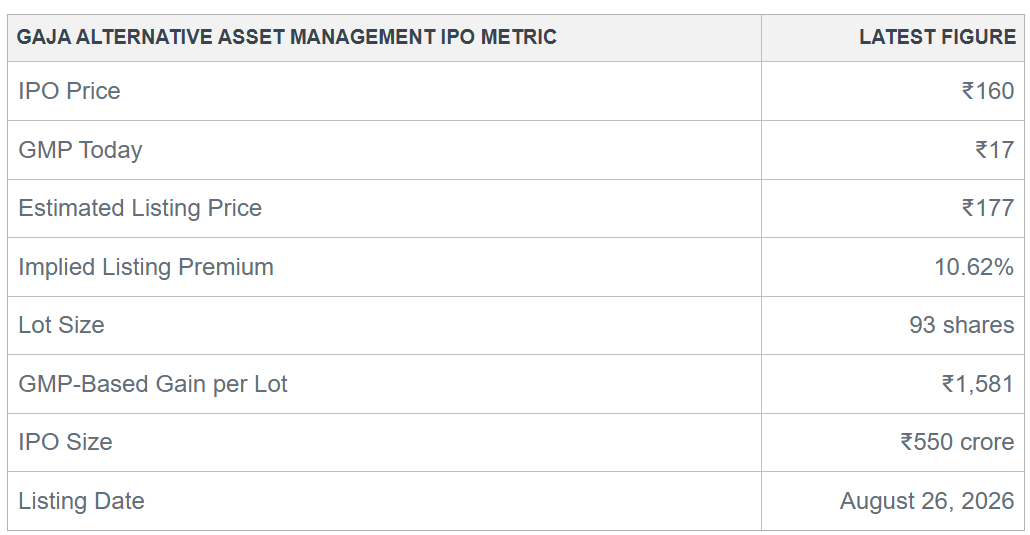
Gaja Alternative Asset Management IPO GMP Today: ₹17 per share
Estimated Listing Price: ₹177
Estimated GMP Premium: 10.62%
IPO Price Band: ₹152–₹160
Overall Subscription: 31.33x at the end of bidding on August 21, 2026
IPO Size: ₹550 crore
Listing Date: August 26, 2026
Lot Size: 93 shares
Minimum Investment: ₹14,880 at the upper price band
The Gaja Alternative Asset Management IPO has reached an interesting point: the subscription numbers are getting stronger while the grey market premium has moved sharply lower from its peak.
The latest reported Gaja Alternative Asset Management IPO GMP today is ₹17, implying an estimated listing price of about ₹177 against the ₹160 upper issue price. That represents a potential GMP-based listing premium of 10.62%. The GMP had touched ₹30 on August 18 before falling to ₹23 on August 19, ₹18 on August 20 and ₹17 on August 21.
But there is a second signal investors should not ignore.
By the end of the IPO's final bidding day, subscription had surged to 31.33x, with institutional investors at 43.58x, NIIs at 62.35x, and retail investors at 11.03x, according to the latest exchange-linked figures displayed by Zerodha.
So what does the combination of ₹17 GMP + 31.33x subscription + a roughly 27.5x post-issue P/E actually tell us?
That is where the Gaja IPO becomes more interesting than a simple “GMP today” story.
Gaja Alternative Asset Management IPO GMP Today
As of August 21, 2026, the latest GMP is reported at ₹17 per share.
Using the upper IPO price of ₹160:
Estimated listing price = ₹160 + ₹17 = ₹177
The implied listing premium is:
₹17 ÷ ₹160 × 100 = 10.62%
For one retail lot of 93 shares:
Potential GMP-based gain = 93 × ₹17 = ₹1,581
That does not mean an investor is guaranteed to make ₹1,581. GMP is an unofficial and unregulated market indicator, and the actual listing price can be materially different.
Gaja IPO GMP Trend: From ₹0 to ₹30 and Back to ₹17
The most revealing part of the Gaja Alternative Asset Management IPO GMP story is not today's ₹17 figure. It is how quickly the premium changed.
The reported trend shows GMP at zero before rising to ₹7 on August 17 and then jumping to ₹30 on August 18. Since then, it has fallen steadily.
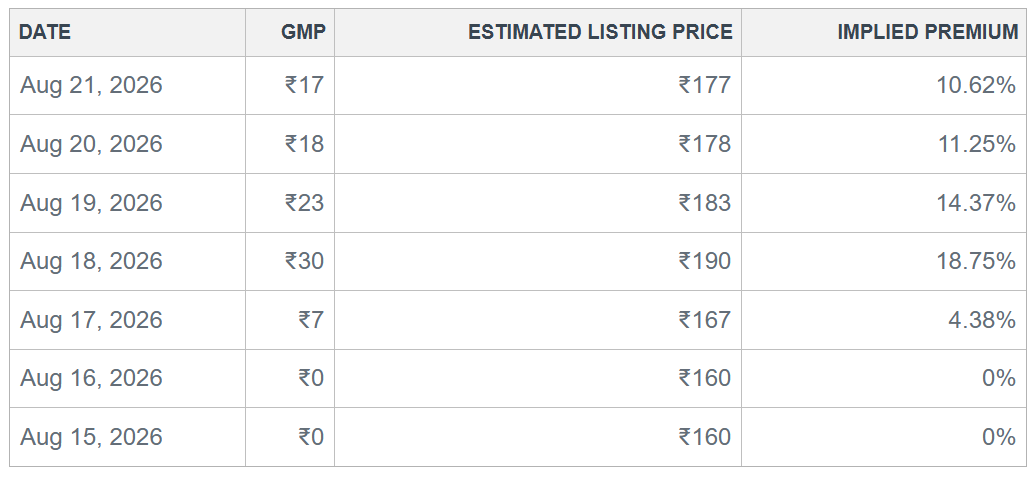
The ₹17 GMP is therefore ₹13 below the August 18 peak of ₹30, a decline of roughly 43.3% from the peak GMP.
What does that fall mean?
A falling GMP during an IPO is not automatically bearish.
It can mean that grey-market expectations have cooled, that some speculative demand has disappeared, or simply that the market is repricing the expected listing premium as more information enters the market.
More importantly, GMP and subscription are measuring different things.
GMP reflects an unofficial grey-market expectation around the listing, whereas subscription data reflects actual demand for the IPO application categories. Zerodha itself notes that GMP is unofficial and unregulated and that exchange subscription data is a more reliable demand indicator.
That distinction matters enormously in the Gaja IPO.
Gaja Alternative Asset Management IPO Subscription Status
An earlier August 21 snapshot reported by India Infoline showed the IPO at 4.54x overall subscription, with particularly strong NII and retail demand. That snapshot was published at 11:47 AM.
By the end of the bidding period, the numbers were dramatically higher.
According to the latest exchange-linked data shown by Zerodha:
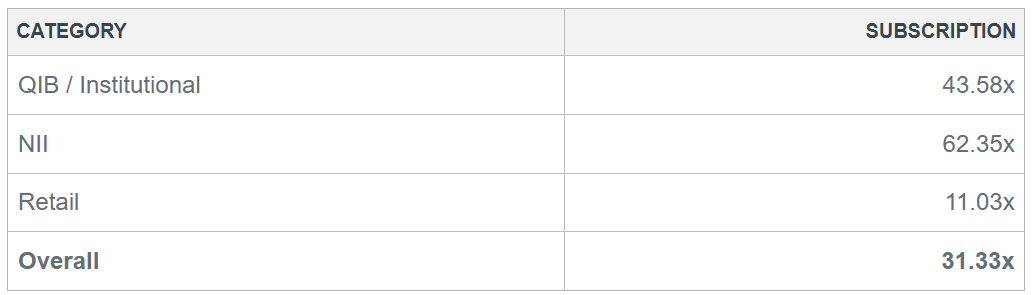
The final demand picture is therefore much stronger than the earlier intraday 4.54x figure.
This is an important editorial point for anyone searching “Gaja Alternative IPO GMP today”: always check the timestamp attached to subscription data. An intraday subscription figure can become obsolete within hours on the final bidding day.
Why Is the Gaja IPO Getting Attention?
At first glance, Gaja Alternative Asset Management may sound like just another financial-sector IPO.
It isn't.
Gaja operates in the alternative asset management and private-equity ecosystem, managing and advising India-focused investment funds. Its economics are different from a conventional retail mutual fund AMC.
The company generates income primarily through:
Management fees + carried interest + income from sponsor commitments/investments.
The RHP shows that in FY2026, management fees contributed about ₹60.08 crore, carried interest about ₹75.41 crore, and income from sponsor commitments/investments about ₹16.74 crore. Together, these streams accounted for the overwhelming majority of operating income before other income.
That creates both the company's attraction and its biggest analytical problem.
When portfolio companies perform well and funds generate realizations, carried interest can materially enhance earnings.
When performance-linked income weakens, earnings can become much less predictable.
Gaja Capital: What Does the Company Actually Do?
For someone new to AIFs, the easiest way to understand Gaja is to compare it with a conventional mutual fund company.
A conventional mutual fund AMC typically manages money pooled from investors and earns recurring fees based on assets under management.
Gaja operates deeper inside the private-market investment ecosystem. Its funds invest in businesses that may not be publicly listed, with the aim of creating value through business growth, operational improvements and eventual exits.
Gaja's portfolio has included businesses such as Fractal Analytics, LeadSquared and Xpressbees. The company generates income primarily through management fees, carried interest and income from sponsor commitments and investments.
The company's IPO is valued at ₹550 crore, comprising a ₹450 crore fresh issue and a ₹100 crore offer for sale (OFS). The fresh issue is particularly important because a substantial portion of the proceeds is intended to support sponsor commitments to existing and new funds, as well as bridge-loan repayment, while the remaining amount is intended for general corporate purposes.
Gaja IPO Valuation: Is 27.5x Earnings Expensive?
This is where investors should stop looking only at GMP.
At the ₹160 upper price band, Gaja is being valued at roughly 27.5x FY2026 earnings on a post-issue basis, with an implied post-issue market capitalisation of approximately ₹2,256 crore.
FY2026 figures available from company and IPO-related sources show:
| Financial Metric | FY2024 | FY2025 | FY2026 |
|---|---|---|---|
| Operating Revenue | ₹95.64 cr | ₹122.00 cr | ₹135.53 cr |
| Total Income | ₹103.96 cr | ₹123.31 cr | ₹157.80 cr |
| Profit After Tax | ₹44.74 cr | ₹61.95 cr | ₹81.96 cr |
The figures show a meaningful rise in profitability over the period, although the composition of earnings matters just as much as the headline PAT growth.
A 27.5x P/E is not obviously cheap.
But it also cannot be evaluated like a commodity business.
Listed financial and asset-management businesses often command premium valuations because of scalable fee income, capital-light models and strong return potential. At the same time, comparing Gaja directly with traditional mutual-fund AMCs can be misleading because Gaja's revenue mix contains materially more performance-linked income.
That is why quality of earnings matters more here than the P/E number alone.
The Gaja IPO's Biggest Strength: A Different Kind of Asset Manager
One of the most compelling parts of the Gaja story is its position within India's growing private-capital ecosystem.
The company has built a long track record in Indian private markets and has relationships with investors across multiple geographies.
The business also benefits from the structural growth of alternative investments as institutional and sophisticated investors look beyond traditional public-market assets.
For long-term investors, that creates a potential growth runway.
But there is an important catch:
A growing industry does not automatically guarantee growing shareholder earnings.
The company must continue raising funds, deploying capital effectively, generating exits and earning performance-linked income.
The Biggest Risk: Carried Interest Can Be Lumpy
This is probably the single most important concept for an investor new to Gaja.
Carried interest is performance-linked income.
It can become extremely valuable when investments perform strongly and funds cross the relevant return hurdles.
But it can also be volatile.
The company's own financial history illustrates the problem. Income from sponsor commitments was around ₹7 crore in FY2024, fell to zero in FY2025 and then rose to around ₹17 crore in FY2026, according to the financial discussion cited in coverage of the IPO. The RHP also records that sponsor-commitment income was nil in FY2025 primarily because of a fair-value loss.
For a trader, this means the stock may react sharply to earnings developments.
For a long-term investor, it means FY2026's earnings should not simply be extrapolated in a straight line forever.
Gaja Alternative Asset Management IPO: Key Risks
1. Earnings concentration
A significant part of profitability depends on the performance of managed/advised funds and investment realizations.
2. Carried-interest volatility
Performance-linked income can fluctuate substantially between financial periods.
3. Private-market exit risk
The company can create value only if portfolio investments ultimately perform and generate successful realizations.
4. Limited comparable-company fit
Gaja is an alternative asset manager rather than a conventional mutual fund AMC, making peer valuation comparisons imperfect.
5. First-time public-company risk
Once listed, market expectations, liquidity and quarterly earnings scrutiny can create additional share-price volatility.
These risks are reflected in IPO-related analyses, which highlight dependence on fund performance, uncertainty around carried interest and concentration in a limited number of investment vehicles.
Gaja IPO GMP vs Subscription: Which Signal Matters More?
This is the question traders are likely to care about most.
The current setup is unusual:
GMP: ₹30 → ₹23 → ₹18 → ₹17
Subscription: ultimately → 31.33x
One signal is weakening while another has strengthened dramatically.
That does not mean the two indicators are contradicting each other.
Think of them as two different clocks.
GMP asks:
“What is the unofficial market expectation for the listing?”
Subscription asks:
“How aggressively are investors applying for shares?”
The answer today appears to be:
Demand for the issue is extremely strong, but the premium investors appear willing to pay in the grey market has cooled from its peak.
That distinction is far more useful than simply writing “GMP is positive.”
What Does ₹17 GMP Actually Mean for Listing Day?
The mathematical estimate is straightforward:
₹160 issue price + ₹17 GMP = ₹177 implied listing price
At ₹177, the stock would debut approximately 10.62% above the upper issue price.
For one retail lot of 93 shares:
Potential GMP-based gain = 93 × ₹17 = ₹1,581
However, this is only a GMP-based estimate, not a guaranteed listing gain. GMP is an unofficial and unregulated indicator, and the actual listing price can be materially different.
For listing-gain traders, the most useful approach is to look at several signals together.
1. GMP Trend
The GMP has fallen from ₹30 on August 18 to ₹17 on August 21. That indicates that grey-market expectations have cooled significantly.
2. Final Subscription
Despite the falling GMP, the IPO ended with very strong demand, with overall subscription reaching 31.33x. Institutional and NII participation was particularly strong.
3. Broader Market Conditions
Even an IPO with strong subscription can open differently from its GMP-based estimate if the broader market turns risk-off.
The key is therefore not to chase one number.
A trader should consider:
Subscription strength + GMP direction + broader market sentiment + actual opening price
The important distinction is that GMP reflects an unofficial expectation around the listing, while subscription data reflects actual demand for shares.
So the current Gaja setup can be described as:
Very strong IPO demand, but a cooling grey-market premium.
That makes the listing setup interesting—but not risk-free.
Final Verdict: Is Gaja Alternative Asset Management IPO Interesting?
Yes—but for different reasons depending on the investor.
For listing-gain traders, the setup has become more nuanced. A ₹17 GMP still indicates a positive unofficial premium, but the sharp fall from ₹30 shows that grey-market enthusiasm has cooled.
For long-term investors, the more important story is Gaja's exposure to India's alternative asset management ecosystem, its established investment track record, rising FY2026 profitability and the use of fresh IPO capital to support future fund commitments.
For risk-conscious investors, the earnings structure deserves close attention. Carried interest and investment-linked income can be volatile, and historical fund performance should not be treated as a guaranteed roadmap for future earnings.
So the headline may be:
Gaja Alternative Asset Management IPO GMP Today: ₹17
But the deeper story is:
The premium has cooled, the demand has exploded, and now the real question is whether Gaja's earnings engine can justify the valuation after the IPO.
That is the part worth watching beyond listing day.
Important Disclaimer
GMP is an unofficial and unregulated indicator and should not be treated as a guaranteed prediction of the listing price. The final listing price can differ materially from GMP-based calculations. IPO subscription figures can also change rapidly during the bidding period, so readers should check the latest exchange disclosures and company filings before making an investment decision. This article is for informational and educational purposes and is not investment advice or a recommendation to buy or sell securities. Investors should read the offer documents carefully and consider their own risk profile or consult a SEBI-registered investment adviser where appropriate.