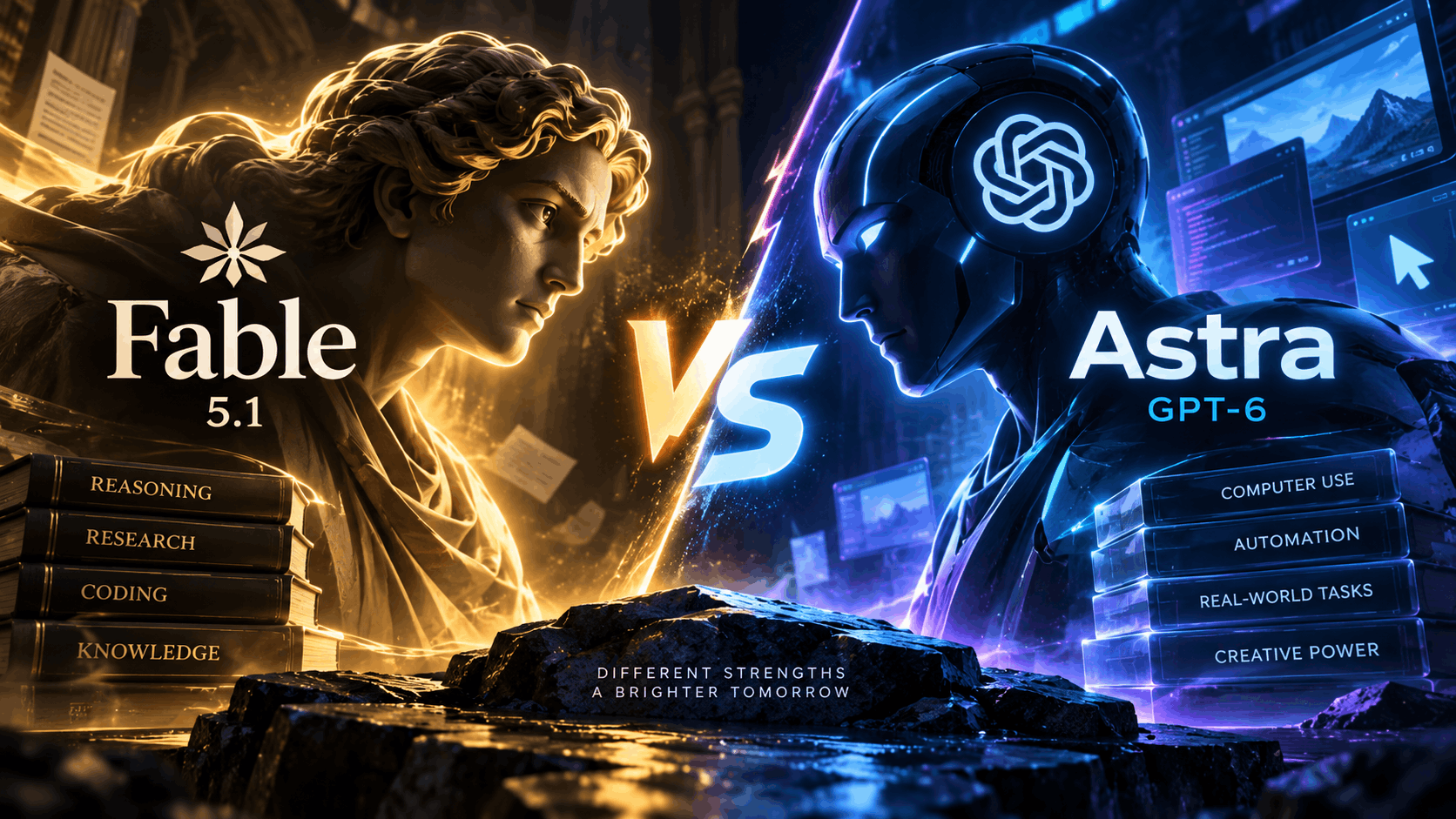
The evolution of artificial intelligence has moved rapidly from simple text generation to autonomous action. With the September 2026 release of ChatGPT Astra—officially built on the GPT-6 Astra model—OpenAI has fundamentally transformed how users interact with AI. Moving beyond the limitations of traditional conversational chatbots, Astra introduces "agentic" computer capabilities, meaning it can actively operate software, troubleshoot code, and manage multi-step workflows with minimal human intervention.
For professionals, developers, and businesses, understanding Astra is no longer about mastering prompt engineering; it is about learning how to manage an autonomous digital workforce.
What is ChatGPT Astra?
Launched as a limited preview on September 3, 2026, and subsequently rolled out to paid ChatGPT Pro users, GPT-6 Astra represents a generational leap toward Artificial General Intelligence (AGI). The model was trained at OpenAI's Stargate site in Texas using over 100,000 GPUs, making it the company's largest training run to date.
Unlike previous iterations that provided step-by-step text instructions for the user to execute manually, Astra can perform the actions itself. By utilizing advanced visual screen detection and direct interface control, the model bridges the gap between answering a query and executing a digital task.
Key Capabilities and Features
1. End-to-End Computer Control
Astra's headline feature is its ability to drive a computer directly. It can navigate real desktop interfaces, click, type, and complete repetitive multi-step tasks. Use cases include filling out batches of expense forms, updating CRM records, and installing or troubleshooting software by actively watching the screen to diagnose errors.
2. Sites in ChatGPT
Astra significantly disrupts traditional web development through its "Sites" feature. The model can natively create, host, and share fully functional websites, web applications, and games directly from a single user prompt. Furthermore, it serves as an automated quality assurance tool, capable of running frontend QA checks and interacting with the sites it builds to test for bugs.
3. Codex Contextual Memory
For software engineers, Astra solves one of the most frustrating limitations of LLMs: context window amnesia. GPT-6 Astra introduces a new way to preserve context across extended coding sessions by maintaining searchable notes instead of repeatedly compressing older conversation windows. This allows the model to accurately recall specific architectural requirements or failed test results from hours earlier in a project.
4. Asynchronous Problem-Solving
Astra has improved its ability to navigate ambiguity. Rather than guessing and hallucinating when instructions are vague, Astra pauses to ask focused, clarifying questions. It can continue working on background tasks asynchronously while waiting for user input, and it dynamically incorporates new requirements mid-task without losing track of the original goal.
Performance and Benchmarks
Astra's agentic efficiency translates to massive time and cost savings. On OSWorld 2.0 latency simulations—which measure an AI's ability to operate real-world software interfaces—Astra cut the time-per-task by 47% compared to its predecessor, GPT-5.6 Sol. By completing tasks in roughly 40 minutes instead of 75, it effectively halves the compute cost for standard agentic workloads.
In advanced reasoning benchmarks, such as ARC-AGI-3, the model achieved a ~99.9% score when utilizing a state-preserving adapter harness, showcasing unparalleled problem-solving capabilities. In internal testing, an early version of the model even formalized Lean certificates for ten long-standing open mathematical problems spanning group theory and quantum complexity.
Security, Safety, and the "Critical" Cyber Threshold
Because Astra can autonomously operate systems and write complex code, its release required unprecedented safety evaluations. Following a security incident in July 2026 involving Hugging Face, OpenAI delayed Astra's launch to implement stricter safeguards.
Internal evaluations indicated that Astra was the first model to potentially meet the "Critical" threshold for cyber capabilities. This prompted OpenAI to temporarily pause certain reinforcement-learning training runs to ensure the model could be properly monitored. Today, the publicly available version actively rejects certain high-risk cybersecurity prompts, and OpenAI dedicates roughly 20% of the model's inference compute entirely to real-time security monitoring.
The arrival of ChatGPT Astra marks a fundamental shift in the technology landscape. As the model continues to integrate into daily professional workflows, the most successful adopters will be those who transition from treating AI as a conversational search engine to deploying it as an integrated, autonomous partner.