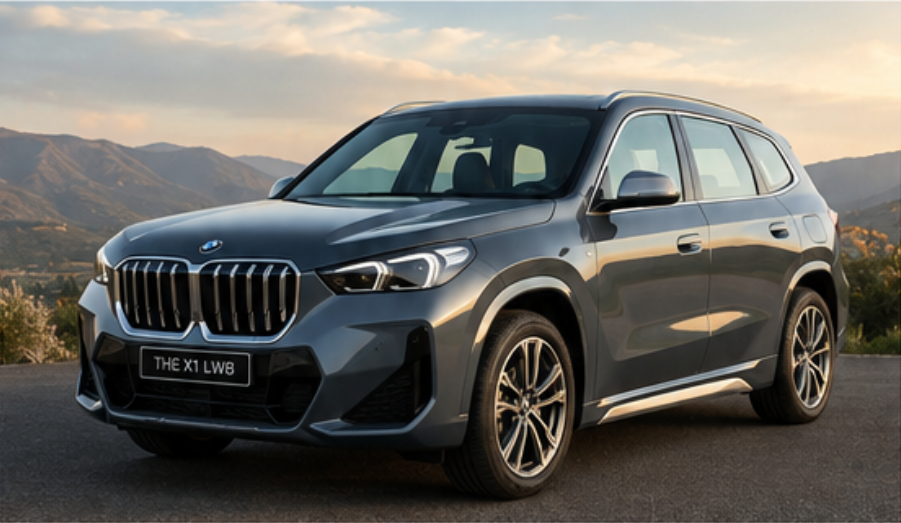
The BMW X1 Long Wheelbase (LWB) is BMW's latest attempt to make its entry-level luxury SUV more appealing to Indian buyers who want something that feels premium but also gives rear passengers more space.
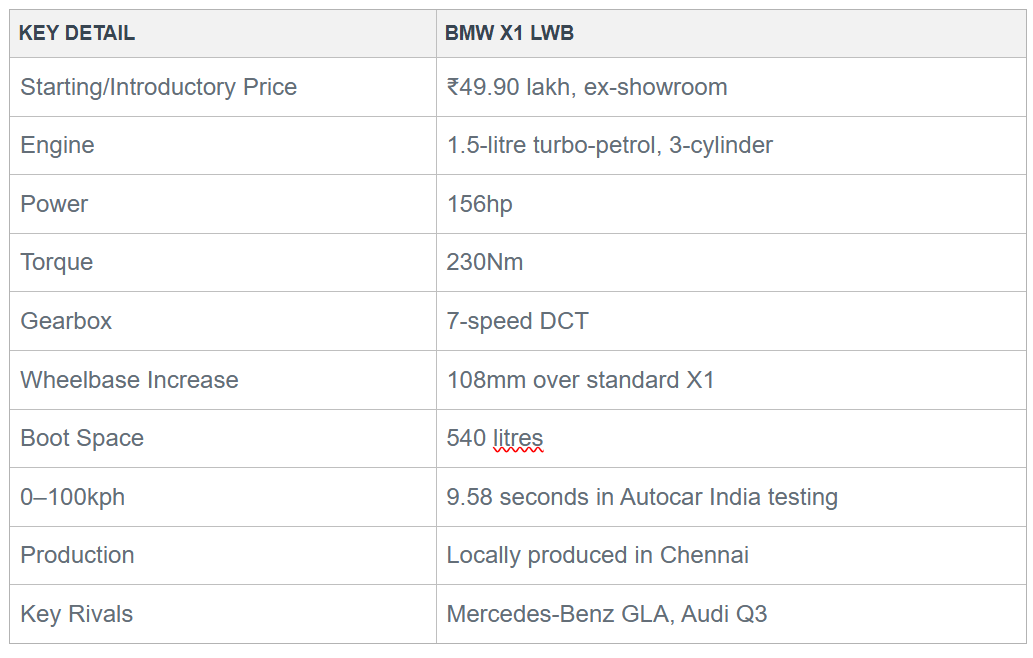
Priced at an introductory ₹49.90 lakh (ex-showroom), the X1 LWB is positioned as a more spacious alternative to the standard X1. BMW is also targeting first-time luxury-car buyers, with the company saying that more than 50 percent of X1 customers enter the luxury segment for the first time.
But the bigger question is simple: is the extra space enough to make the X1 LWB a better buy, or does the longer body come with too many compromises?
Here is what you should know before considering one.
BMW X1 LWB: Price and Positioning
The BMW X1 LWB is priced at ₹49.90 lakh ex-showroom. Interestingly, it is positioned at ₹1 lakh less than the standard-wheelbase X1, while also offering substantially more space for rear passengers. Compared with the Mercedes-Benz GLA, the X1 LWB is up to ₹5.1 lakh more affordable, according to Autocar India's comparison.
BMW is also using the X1 LWB to bring more first-time luxury buyers into the brand. According to BMW Group India, long-wheelbase models already contribute more than 50 percent of the company's sales, making the strategy particularly important for the Indian market.
The X1 LWB is also locally produced at BMW's Chennai plant, helping BMW position it competitively in the Indian market.
The Biggest Advantage: More Rear-Seat Space
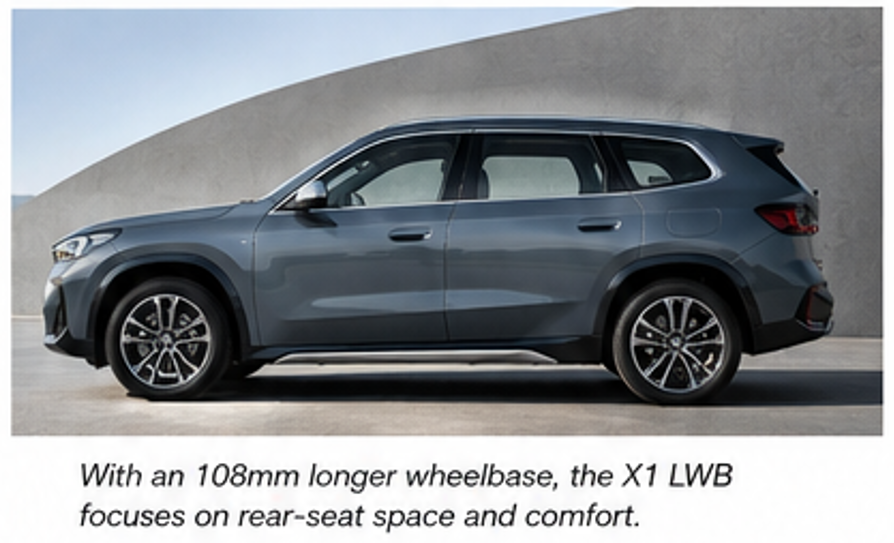
The main reason to choose the BMW X1 LWB over the regular X1 is simple: space.
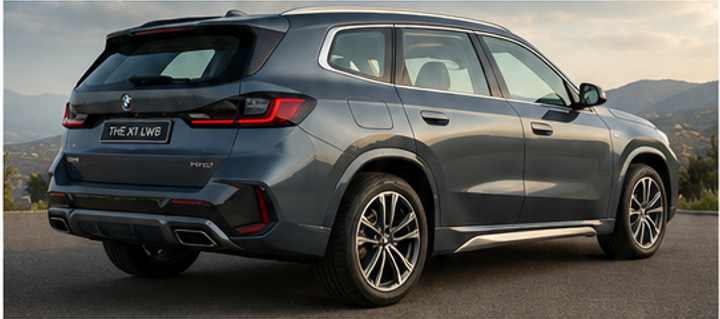
The wheelbase has increased by 108mm compared with the standard X1. That extra length is most noticeable in the second row, where even taller passengers get significantly more room to stretch out.
BMW has also redesigned the rear seats. The outer seats get improved cushioning and a 15mm longer seat base, which provides better under-thigh support. The rear backrests can also recline, making the cabin more comfortable on longer journeys.
There are also dedicated rear AC vents, USB Type-C charging ports and a centre armrest with cup holders. The large glasshouse and fixed panoramic sunroof add to the feeling of openness inside the cabin.
For buyers who regularly travel with family or prefer to be chauffeured, this is where the X1 LWB makes the strongest case for itself.
A Bigger Boot Too
The extra length is not only useful for rear passengers.
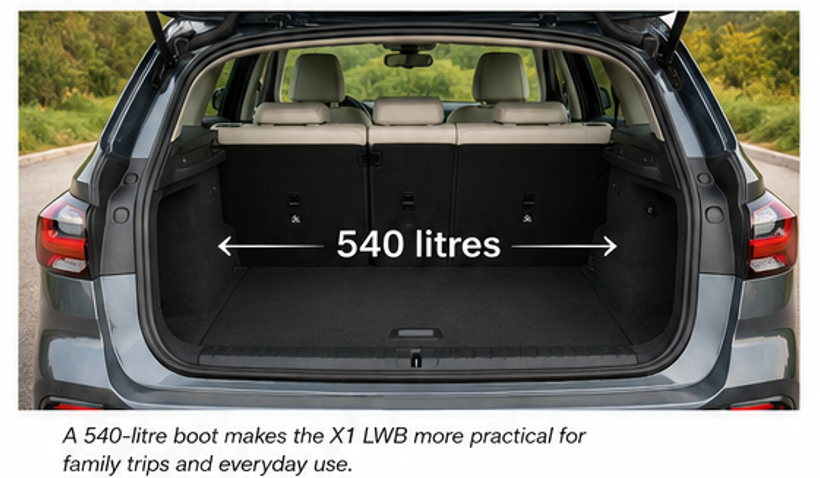
The X1 LWB gets a 540-litre boot, which is larger than the boot capacity offered by the Mercedes-Benz GLA and Audi Q3 according to Autocar India's comparison.
That makes the SUV more practical for family trips, airport runs and everyday luggage use.
So, while the long-wheelbase treatment is primarily about rear-seat comfort, the additional space also improves the car's overall practicality.
More Comfortable Than the Standard X1
BMW has revised the suspension setup for the X1 LWB, with the focus shifting more towards comfort.
Compared with the standard-wheelbase X1, the LWB offers a more pliant ride and does a better job of absorbing rough patches and uneven roads. Instead of feeling overly sporty, the suspension works quietly in the background and prioritises comfort.
That does not mean the X1 LWB feels disconnected from the road.
The steering still provides a good sense of connection, and the SUV can change direction confidently and quickly when required. It simply puts comfort higher on the priority list than outright sporty handling.
Parking the X1 LWB Is Easier Than You Might Expect
A longer SUV can sometimes feel intimidating in tight Indian parking spaces, but BMW has equipped the X1 LWB with useful parking assistance technology.
The SUV gets a 360-degree camera, which provides a clear view around the car while parking. It also gets a Reversing Assistant that can automatically retrace the vehicle's previous path for up to 50 metres.
For urban buyers dealing with narrow parking spaces, these systems can make the additional length much easier to manage.
BMW X1 LWB Engine and Performance
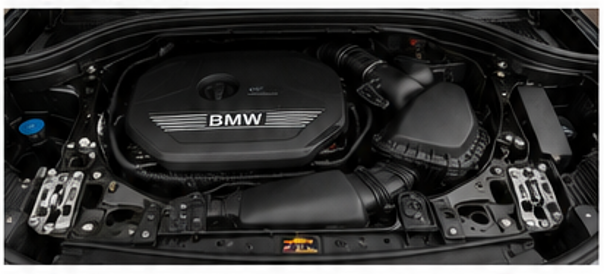
Under the bonnet is a 1.5-litre three-cylinder turbo-petrol engine producing 156hp and 230Nm. The engine is paired with a 7-speed dual-clutch transmission (DCT).
BMW has actually increased the engine's power output compared with the standard-wheelbase version, with the X1 LWB making 20hp more.
For city driving, the engine is generally sufficient and feels easy enough to use in everyday conditions. But the character changes when you start demanding more performance.
When overtaking quickly or accelerating hard, there can be a noticeable delay before the SUV builds speed. The three-cylinder engine also becomes more vocal under hard acceleration, without producing a particularly sporty soundtrack.
In Autocar India's testing, the X1 LWB completed 0–100kph in 9.58 seconds.
That means the X1 LWB is better understood as a comfort-focused luxury SUV rather than a performance-focused BMW.
The Cabin Looks Modern, But the Infotainment Can Be Confusing
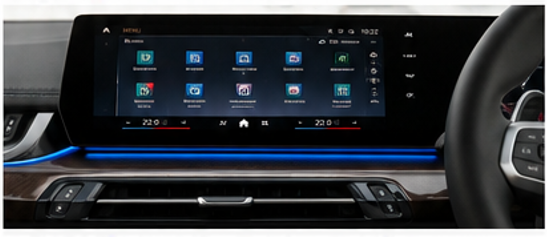
The BMW X1 LWB gets a 10.7-inch touchscreen infotainment system that looks sharp and responds quickly to inputs.
The problem is the amount of information packed into the interface.
There are multiple menus to navigate, and some functions require more attention than they ideally should. Even the climate-control system is managed through the touchscreen, which means the driver may need to take their eyes off the road for certain adjustments.
The technology is modern, but the learning curve may be frustrating for users who prefer simple physical controls.
BMW X1 LWB Misses Some Features You Might Expect
The biggest compromise with the X1 LWB is not space or comfort. It is equipment.
The long-wheelbase version misses several features that could be expected in a luxury SUV at this price. These include rear sunshades, ventilated seats and massaging seats. Even the front USB ports are not backlit, which can make them difficult to locate in the dark.
The rear passengers also do not get a dedicated climate-control zone.
There is another significant omission in the driver-assistance package: the ADAS setup does not include adaptive cruise control.
So while the X1 LWB gives you more space, it does not necessarily give you the most feature-rich cabin in this segment.
4 Reasons to Buy the BMW X1 LWB
1. Excellent rear-seat space
The 108mm wheelbase increase makes a meaningful difference, particularly for taller passengers. The redesigned rear seats and reclining backrests make the second row one of the X1 LWB's biggest strengths.
2. More comfortable ride
The suspension is tuned to deliver a smoother, more comfortable ride than the standard X1, making the LWB better suited to Indian roads and family-oriented use.
3. Strong practicality
The 540-litre boot, large cabin and useful parking technology make the X1 LWB practical for everyday family use rather than simply serving as a luxury badge.
4. Competitive price
At ₹49.90 lakh ex-showroom, the X1 LWB is actually positioned below the standard X1 and offers a price advantage over the Mercedes-Benz GLA, strengthening its value proposition.
3 Reasons to Think Twice Before Buying the BMW X1 LWB
1. Several premium features are missing
The lack of rear sunshades, ventilated and massaging seats, a separate rear climate zone and adaptive cruise control may disappoint buyers expecting a fully loaded luxury SUV.
2. Performance is only adequate
The 156hp three-cylinder engine is sufficient for daily driving, but it can feel less exciting when you push the car. The 9.58-second 0–100kph time also makes it clear that outright performance is not the X1 LWB's strongest selling point.
3. The infotainment takes time to learn
The large touchscreen is responsive and modern, but the menu-heavy interface can make simple functions feel unnecessarily complicated.
BMW X1 LWB vs Standard X1: Who Should Choose Which?
The difference between the two models is more about what you value than which one is objectively better.
Choose the X1 LWB if rear-seat space, family comfort and a smoother ride are your priorities. It is especially appealing for buyers who regularly carry passengers in the back.
The standard X1 makes more sense for someone who prefers a more compact luxury SUV and does not need the additional rear-seat space.
BMW has effectively taken the X1 formula and shifted its priorities for the Indian market: less emphasis on compactness, more emphasis on rear-seat comfort.
BMW X1 LWB vs Mercedes-Benz GLA and Audi Q3
The X1 LWB competes with models such as the Mercedes-Benz GLA and Audi Q3 in India. However, BMW has an advantage that neither rival offers in the same way: a dedicated long-wheelbase version focused on rear-seat space.
The X1 LWB is priced at ₹49.90 lakh, while Autocar India's comparison notes that it can be up to ₹5.1 lakh more affordable than the GLA. The 540-litre boot is also larger than the boot capacities cited for both the GLA and Q3.
That gives BMW a clear practical angle in a segment where many buyers are not simply looking for the sportiest vehicle—they want a luxury SUV that works well for the entire family.
BMW X1 LWB: Who Is It Really For?
The X1 LWB is particularly interesting for first-time luxury buyers.
BMW says more than 50 percent of X1 customers are entering the luxury segment for the first time. That makes the X1 an important gateway into the BMW brand, and the LWB version is clearly designed to make that proposition more comfortable and family-friendly.
It is also a strong fit for buyers who care more about rear-seat comfort than outright driving performance.
If your idea of a luxury SUV is a spacious second row, a comfortable ride, a premium badge and enough technology to make everyday driving easier, the X1 LWB makes a compelling case.
But if you expect a sporty BMW engine, extensive luxury features and the latest driver-assistance technology, you may find the omissions harder to justify.
Final Verdict: Should You Buy the BMW X1 LWB?
The BMW X1 LWB is not simply a bigger X1.
It is a version designed around a very specific Indian buyer: someone moving into the luxury segment who wants more rear-seat space, more comfort and more practicality without moving too far up the price ladder.
At ₹49.90 lakh, it has a strong value argument, particularly because it undercuts the standard X1 by ₹1 lakh and can be significantly cheaper than the Mercedes-Benz GLA.
Its biggest strengths are clear: rear-seat space, ride comfort, boot capacity, parking assistance and competitive pricing.
Its weaknesses are equally clear: missing premium features, average performance and a somewhat complicated infotainment system.
So, is the BMW X1 LWB worth considering?
Yes—especially if rear-seat comfort is your priority.
But if you are buying an entry-level BMW primarily because you want the classic sporty BMW experience, the standard X1 or another model may better match your expectations.
The X1 LWB's philosophy is simple:
It is less about driving harder and more about making every passenger comfortable.
BMW X1 LWB at a Glance