Two of the most talked-about AI models launched recently are already facing the same problem: demand is growing faster than the computing infrastructure needed to support it.
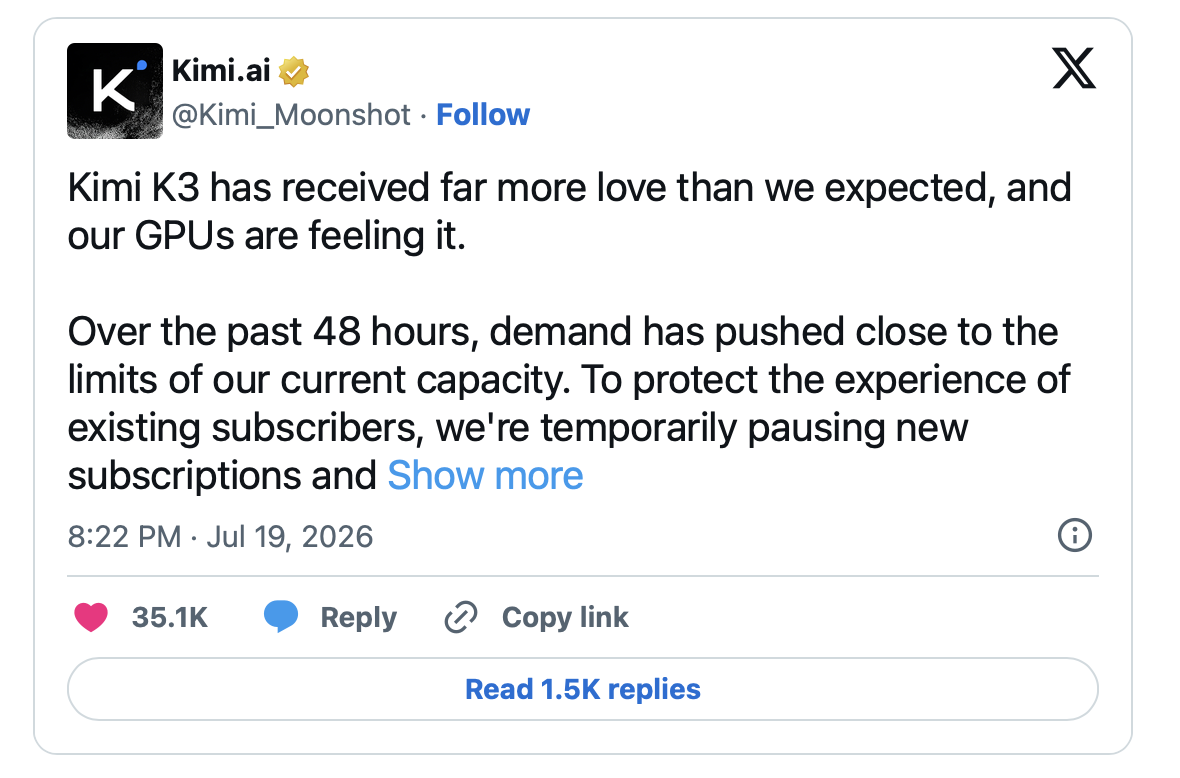
Moonshot AI’s Kimi K3, a 2.8 trillion-parameter open-weight model, attracted significant attention after performing strongly across several benchmarks. However, less than 48 hours after its launch, the company stopped accepting new subscriptions.
Moonshot said the response to Kimi K3 was much stronger than expected, placing considerable pressure on its GPU infrastructure. The company is now expanding its computing capacity and allowing new subscribers to join in smaller, controlled batches.
Existing paid users can continue using the model, but people who missed the initial launch window will have to wait until more capacity becomes available.
Fable 5 faces a more complicated rollout
Anthropic’s Claude Fable 5, the flagship model under its new Mythos tier, has faced an even more complicated rollout.
The model was launched on June 9 but went offline on June 12 following new export restrictions introduced by the US government. It returned on July 1 after those restrictions were removed. Since then, Anthropic has repeatedly changed its plans around how much access paid users will receive.
The company pushed back the deadline for including Fable 5 usage at no additional cost several times, moving it from July 7 to July 12 and then to July 19. In each case, the announcement came only hours before the deadline.
Starting this week, users on Max and Team plans will be able to use Fable 5 only up to 50 percent of their maximum usage limit. Anthropic has blamed the restriction on unexpectedly high demand.
The situation is notable because the company recently secured a $45 billion computing agreement with SpaceX and is reportedly exploring another $10 billion worth of computing support from Meta.
The real issue is inference capacity
The common factor in both cases is not the rivalry between Chinese and American AI companies or the debate between open and closed models. The real issue is the growing pressure on inference infrastructure.
Training a powerful AI model is only one part of the challenge. Once millions of users begin sending requests to it, companies need enough computing power to process those requests quickly and reliably.
Both Moonshot and Anthropic built highly capable models, but demand exceeded their internal capacity estimates. Their response was also similar: limit access, protect existing subscribers and describe the restrictions as temporary.
For Kimi K3, the release of its open weights on July 27 could ease some of that pressure. Developers will be able to run the model on their own infrastructure instead of depending entirely on Moonshot’s servers.
What this means for developers
For developers and businesses, the bigger question is not which AI model is currently leading the race. The real concern is whether any provider can guarantee stable access to advanced AI models at a predictable price.
Companies planning to build products around Fable 5 or Kimi K3 should avoid depending on a single model. A more practical approach would be to use a cheaper or more widely available model for routine tasks and reserve frontier models for complex requests where their capabilities are genuinely required.
For the current generation of AI products, computing capacity may be a bigger limitation than the intelligence of the models themselves.