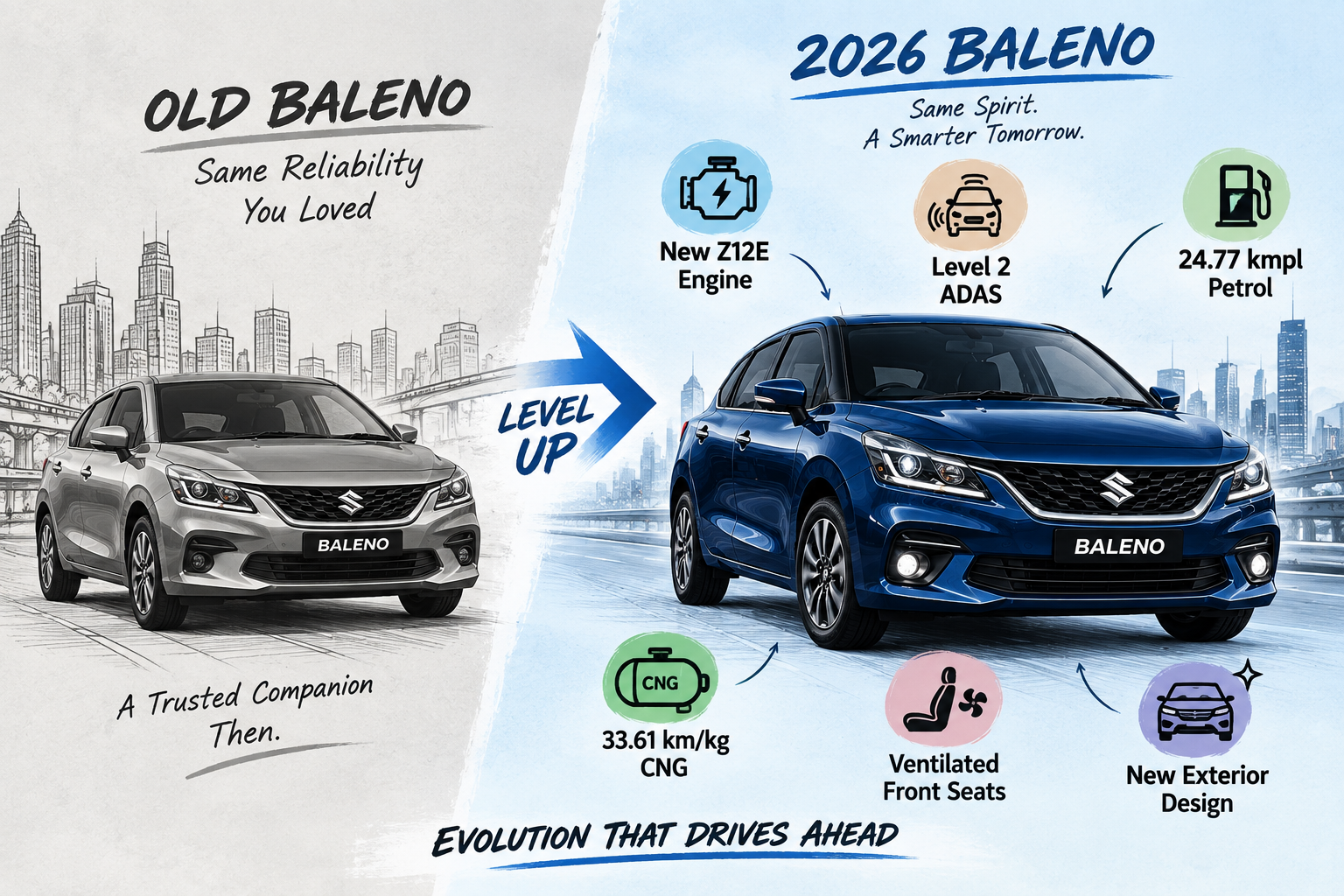
The Maruti Suzuki Baleno 2026 facelift has officially entered the Indian market, and this is more than a cosmetic refresh. Maruti Suzuki has given its popular premium hatchback a sharper design, a new Z12E petrol engine, improved fuel efficiency, Level 2 ADAS, ventilated front seats and several new technology features. The new Baleno starts at ₹6,09,900 ex-showroom, commonly rounded to ₹6.10 lakh, making the latest model one of the most interesting upgrades in the premium hatchback segment.
For a car that has traditionally won buyers with practicality, mileage, space and easy ownership, Maruti has chosen an interesting upgrade strategy. Instead of turning the Baleno into a performance-focused hot hatch, the company has upgraded the areas that matter most to everyday buyers: safety, efficiency, comfort, connectivity and design. Think of it as the same familiar game character returning with a much better loadout.
The New Baleno Gets a Sharper Look
The biggest visual change is at the front, where Maruti has introduced a new NEXWave grille with a wider, more three-dimensional appearance and horizontal chrome treatment. The redesigned bumper gives the hatchback a more planted stance, while chrome detailing around the front adds a more premium appearance.
The overall silhouette remains familiar, which is deliberate. Maruti has not completely redesigned the Baleno because the existing proportions are one of the model's strengths. The facelift instead focuses on giving the car a fresher identity without sacrificing its compact dimensions and practical character.
The 2026 Maruti Baleno is available in seven colour options, including the new Enigmatic Teal shade. The car also retains LED lighting elements and gains exterior detailing intended to make the premium hatchback look more distinctive.
Level 2 ADAS Is the Big Boss Upgrade
The headline feature of the new Baleno is undoubtedly Level 2 Advanced Driver Assistance Systems (ADAS). Maruti says the system combines radar and camera technology and provides eight advanced safety and assistance functions. This is a major step for the Baleno because the update is no longer just about making the car look newer; it is about adding active driver-assistance technology to the package.
The new safety package works alongside features such as six airbags, Electronic Stability Programme, ABS with EBD, hill-hold control and tyre-pressure monitoring. Higher variants also continue to offer equipment such as a 360-degree camera, while the Baleno retains its established everyday safety and convenience package.
The ADAS addition is especially important because the premium hatchback segment has become much more technology-focused. Buyers are increasingly comparing cars not only on mileage and price, but also on active safety and driver assistance. Maruti is clearly trying to make the Baleno more competitive on that battlefield.
New Z12E Engine Brings More Efficiency
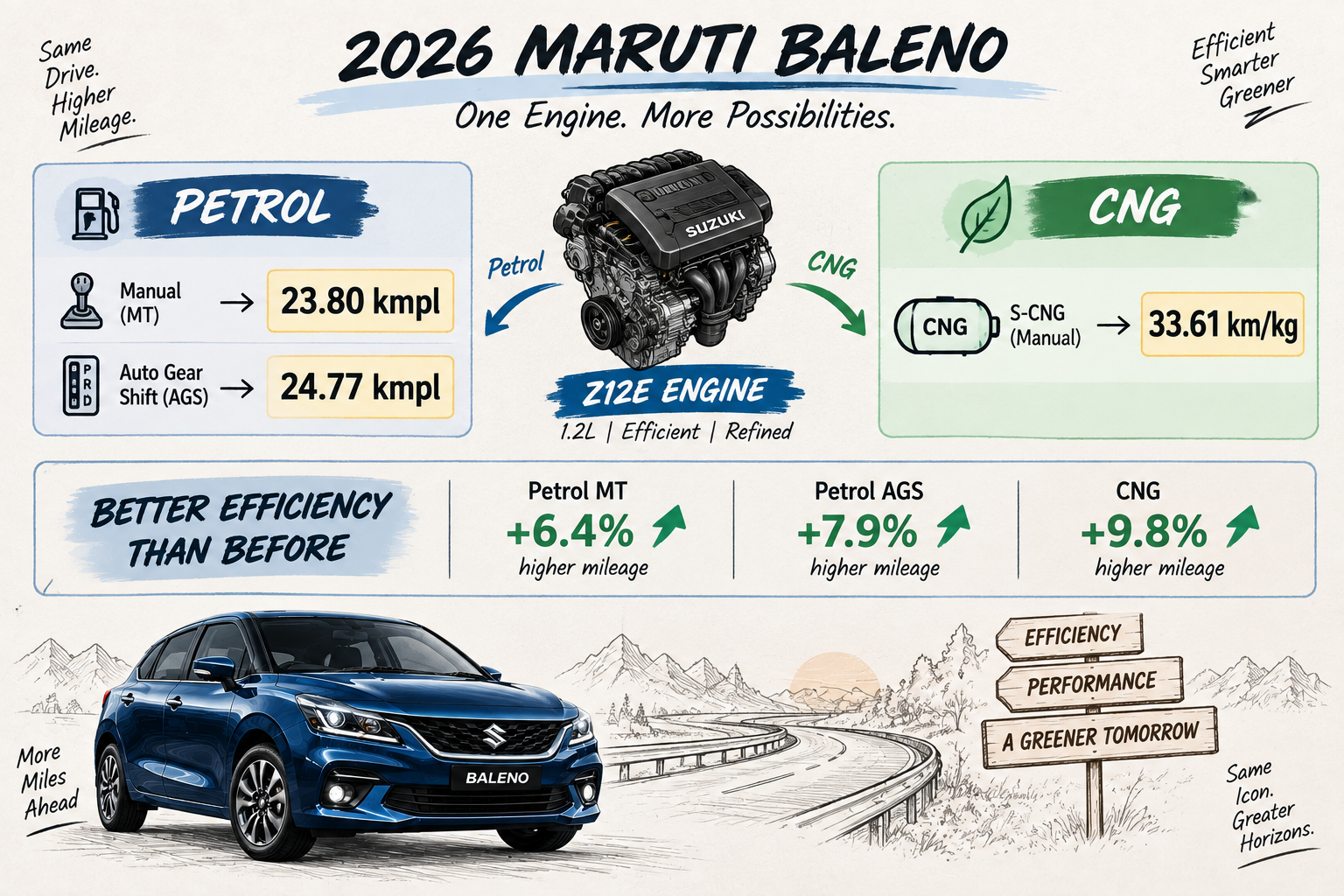
Under the bonnet, the biggest mechanical change is the introduction of Maruti Suzuki's 1.2-litre Z12E petrol engine. The naturally aspirated three-cylinder engine produces 82.93 PS and 112.4 Nm of torque, and it is equipped with idle start-stop technology and Dual VVT.
The petrol engine is available with a five-speed manual transmission as well as Maruti's Auto Gear Shift (AGS) automatic transmission. While the numbers do not suggest that the Baleno is trying to become a performance monster, the new powertrain is clearly tuned around efficiency and everyday usability.
Maruti claims 23.80 kmpl for the manual version and 24.77 kmpl for the AGS version. According to the company, those figures represent improvements of 6.4% and 7.9%, respectively, compared with the outgoing petrol model.
That is an important upgrade for Baleno buyers because fuel economy remains one of the strongest reasons people choose a Maruti hatchback.
Baleno S-CNG Now Claims 33.61 km/kg
The efficiency story becomes even more interesting with the Baleno S-CNG. The new CNG version uses the same Z12E engine and is offered with a five-speed manual gearbox. In CNG mode, it produces 69.75 PS and 101.8 Nm.
Its claimed fuel efficiency is 33.61 km/kg, which Maruti says is 9.8% higher than the previous model. For high-mileage users, that number could be one of the strongest reasons to consider the updated Baleno, particularly in cities where running costs matter more than outright performance.
The important point is that the Baleno is not abandoning its efficiency-first identity. Instead, Maruti is upgrading the engine while trying to retain the low-running-cost advantage that helped the car become a major player in India's premium hatchback market.
The Cabin Gets More Premium Too
The interior design remains broadly familiar, but Maruti has added several features intended to make the Baleno feel more premium. One of the biggest additions is ventilated front seats with leatherette upholstery, which Maruti describes as a segment-first feature.
The new Baleno also gets a Qi-certified wireless smartphone charger with active cooling and a Clarion premium sound system. These are relatively small additions individually, but together they strengthen the car's premium positioning without completely redesigning the cabin.
The familiar 9-inch SmartPlay Pro+ touchscreen continues to be offered with wireless Apple CarPlay and Android Auto, while Suzuki Connect adds more than 40 connected functions covering vehicle status, safety, driving information and remote operations through the connected-car ecosystem.
This is essentially Maruti's strategy with the facelift: keep the elements that already work and add enough new equipment to make the ownership experience feel like a substantial upgrade.
Size and Practicality Stay Familiar
Despite the visual refresh, the Baleno remains a compact hatchback built around urban practicality. It measures 3,990 mm long, 1,745 mm wide and 1,530 mm high, with a 2,520 mm wheelbase. The petrol version has a 37-litre fuel tank, while the CNG setup uses a 55-litre water-equivalent tank.
This familiar footprint is one of the Baleno's strongest advantages. It remains easy to position in city traffic and parking spaces while offering the kind of cabin room that buyers expect from a premium hatchback. HT Auto notes that the Baleno's dimensions have historically helped it strike a useful balance between urban manoeuvrability and passenger space.
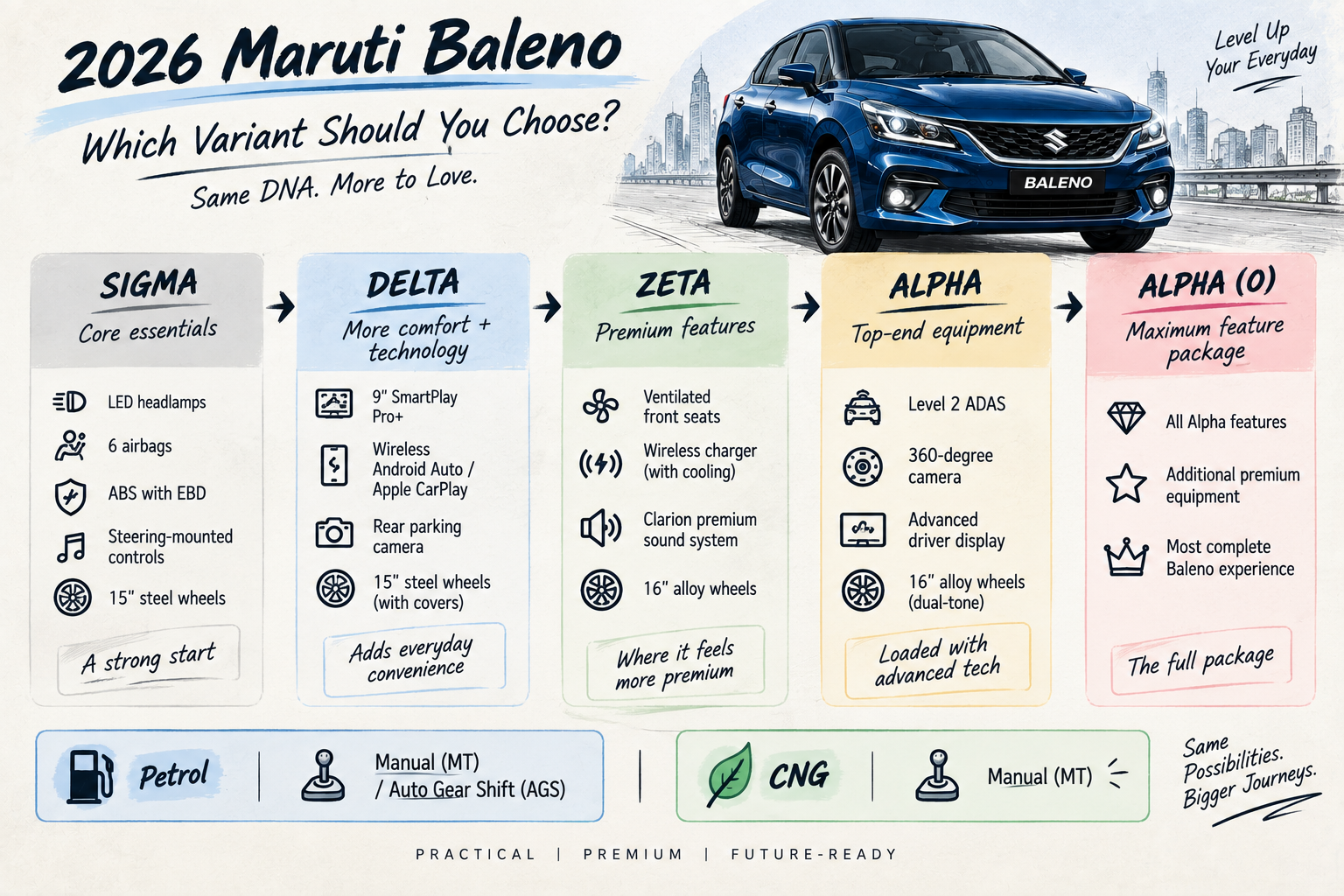
The Sigma and Delta variants use 15-inch steel wheels with 185/65 tyres, while the Zeta, Alpha and Alpha (O) versions move to 16-inch alloy wheels with 195/55 tyres.
2026 Maruti Baleno Price and Variants
The new Baleno has been launched with a starting price of ₹6,09,900 ex-showroom, with many reports rounding that figure to ₹6.10 lakh. This is the introductory starting price announced by Maruti. Bookings are open for ₹11,000 through the NEXA network and online channels.
The complete range is built around Sigma, Delta, Zeta, Alpha and Alpha (O) grades, with petrol manual, petrol AGS and CNG manual configurations depending on the variant. Not all variant prices were disclosed at the initial launch reporting, so buyers should check the final NEXA price list before comparing on-road costs.
That distinction matters because the ₹6.10 lakh figure is the entry price, not the price of a fully loaded Baleno with the ADAS and premium equipment.
Baleno vs Hyundai i20, Tata Altroz and Toyota Glanza
The 2026 Baleno continues to compete directly with cars such as the Hyundai i20, Tata Altroz and Toyota Glanza.
The competition is now more interesting because Baleno has added Level 2 ADAS while retaining its focus on fuel efficiency. The Hyundai i20 continues to appeal to buyers who want a feature-rich premium hatchback, the Tata Altroz brings a strong safety-focused reputation and distinctive design, while the Toyota Glanza shares the underlying Baleno formula.
The new Baleno's strongest weapon could therefore be its overall balance. It is not necessarily trying to win every category individually. Instead, Maruti is stacking enough advantages — mileage, practicality, features, safety technology and ownership familiarity — to make the package difficult to ignore.
Is the 2026 Baleno a Big Upgrade?
This facelift is not revolutionary in the traditional sense. The basic body proportions remain familiar and the cabin layout has not been completely transformed. But that does not mean the update is small where it matters.
The Z12E engine, improved fuel economy, Level 2 ADAS, ventilated seats, wireless charging, premium audio and refreshed exterior collectively make the 2026 Baleno considerably more feature-rich than before.
HT Auto's launch analysis makes a similar point: the Baleno's core identity has always been built around space, economy, convenience and ease of ownership rather than outright performance. The facelift continues that philosophy instead of attempting to turn the car into something completely different.
The Final Verdict
The 2026 Maruti Baleno facelift looks like a carefully calculated level-up rather than a complete reset. Starting at ₹6.09 lakh ex-showroom, it combines a refreshed exterior with a new Z12E petrol engine, up to 24.77 kmpl claimed petrol efficiency, 33.61 km/kg claimed CNG efficiency, Level 2 ADAS, ventilated front seats and additional premium technology.
Maruti has clearly understood what the Baleno's existing players like about it and upgraded those strengths instead of throwing away the formula. It is still practical, still efficiency-focused and still aimed at everyday Indian driving — but now it enters the next round with a much stronger safety and technology package.
In gaming language, the Baleno did not change its entire character class. It kept the same reliable build, upgraded the engine, unlocked new safety abilities and added premium gear.
And at around ₹6.10 lakh to start, that could be enough to make the 2026 Maruti Baleno one of the most closely watched premium hatchbacks in India right now.