Artificial intelligence has spent the last few years being treated primarily as a compute problem: more GPUs, larger models, bigger data centres and faster inference. Agentic AI changes that equation. Once AI systems stop waiting for a person to ask a question and start continuously calling models, retrieving context, accessing tools and interacting with other systems, the network becomes part of the AI system itself.
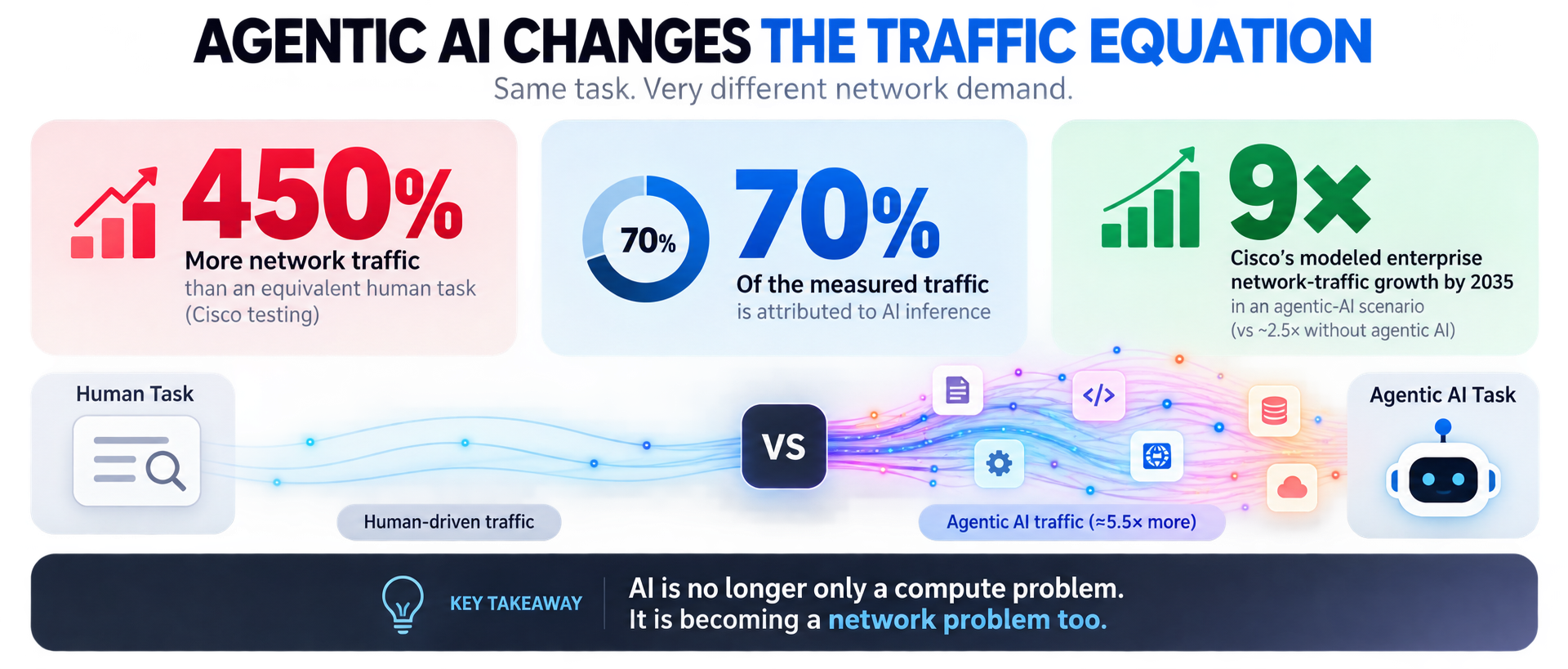
That is the significance behind a new Cisco finding that has attracted attention across the infrastructure industry: in Cisco's testing, an AI agent performing a task generated up to 450% more total network traffic than a human performing the same task, with roughly 70% of that traffic attributed to AI inference. In simple terms, that is potentially around 5.5 times the traffic for the same task, although it should not be interpreted as every agent workload producing exactly that increase. The important question is therefore no longer simply whether an enterprise has enough GPUs to run AI. It is whether the network, data layer, security controls, observability stack and operating model are capable of supporting AI systems that operate continuously and autonomously.
Why Agentic AI Changes the Infrastructure Equation
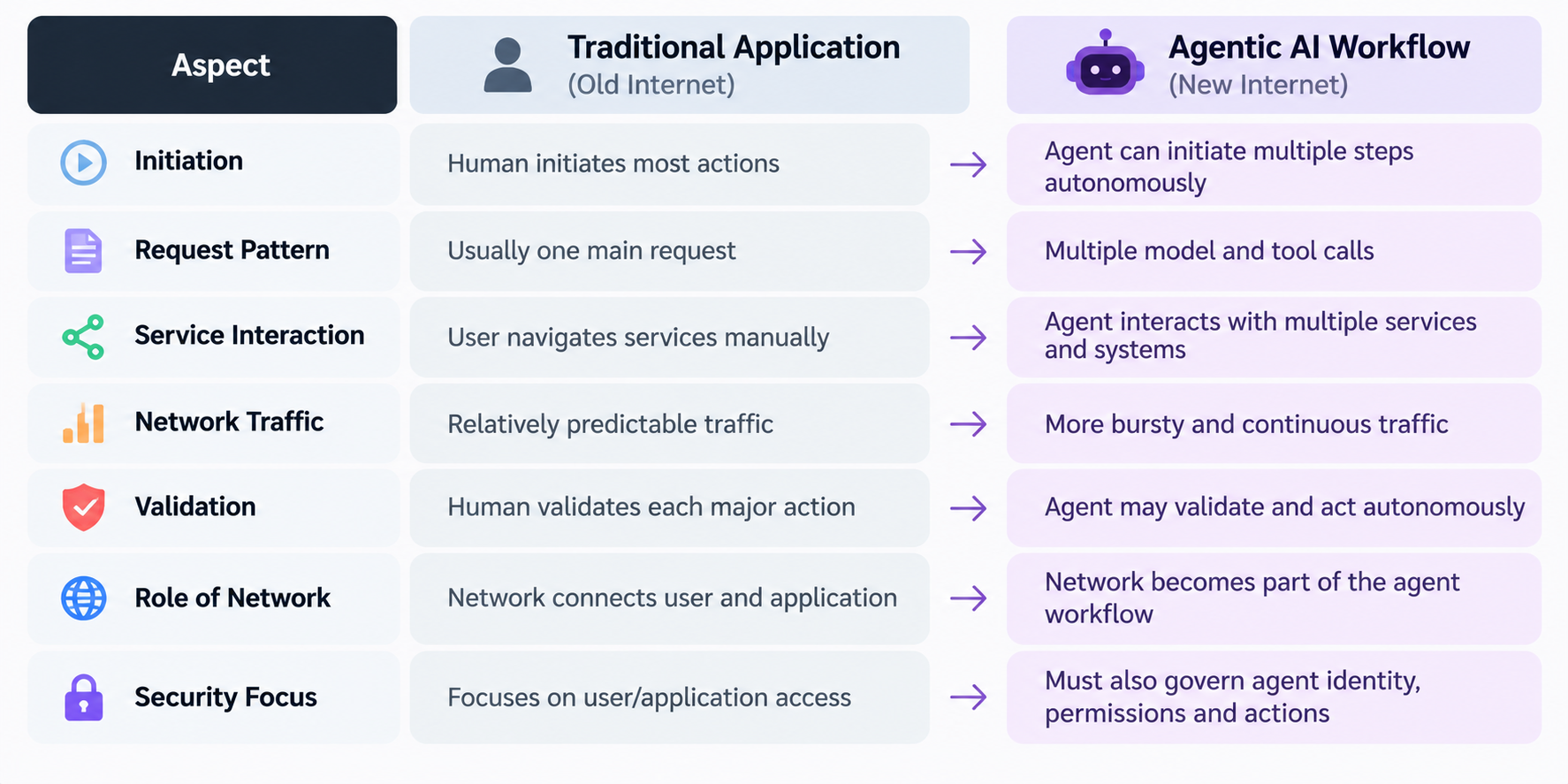
A conventional software application usually waits for a human action. A person opens an application, clicks a button, submits a request and waits for the system to respond. An AI agent can behave very differently: it can break a goal into several steps, call a model, retrieve information, invoke tools, communicate with other services, inspect the result and continue working until the task is completed. Every one of those actions creates additional communication.
A human may open a travel website, search for a flight and make a booking through a relatively straightforward sequence. An agent might query multiple services, compare information, call an LLM repeatedly, retrieve user context, access calendars or payment systems, validate the result and then perform the final transaction. The intelligence of the agent therefore creates a communication workload, not just a compute workload.
Cisco's 2026 research describes AI agents as new "network power users" because they operate at software speed rather than human speed. Its Wide Area Network research found that agentic tasks can generate up to 450% more traffic than equivalent human-driven workflows, while approximately 70% of that traffic is AI inference. Cisco also projects that enterprise network traffic could grow roughly ninefold by 2035 in an agentic-AI scenario, compared with about 2.5 times without agentic AI. The 450% figure describes a measured task-level difference in Cisco's testing; the longer-term projections are separate modeling exercises. Neither should be read as a universal prediction for every company, but together they illustrate the direction of the problem: agentic workloads can create much more communication and inference activity than traditional user-driven applications.
The Network Is Becoming Part of the AI System
For years, infrastructure teams could treat the network as the layer connecting applications and users. With agentic AI, that separation becomes less useful. Cisco's WAN research describes the connection between an agent's logic and the models it depends on as effectively the agent's "spinal cord." If that path becomes congested, unreliable or slow, the agent does not simply experience a minor networking problem—the AI workflow itself can degrade. Cisco's measurements also show that network latency is currently much smaller than model-processing latency in typical AI inference, but the company expects network effects to become more important as inference hardware continues to improve.
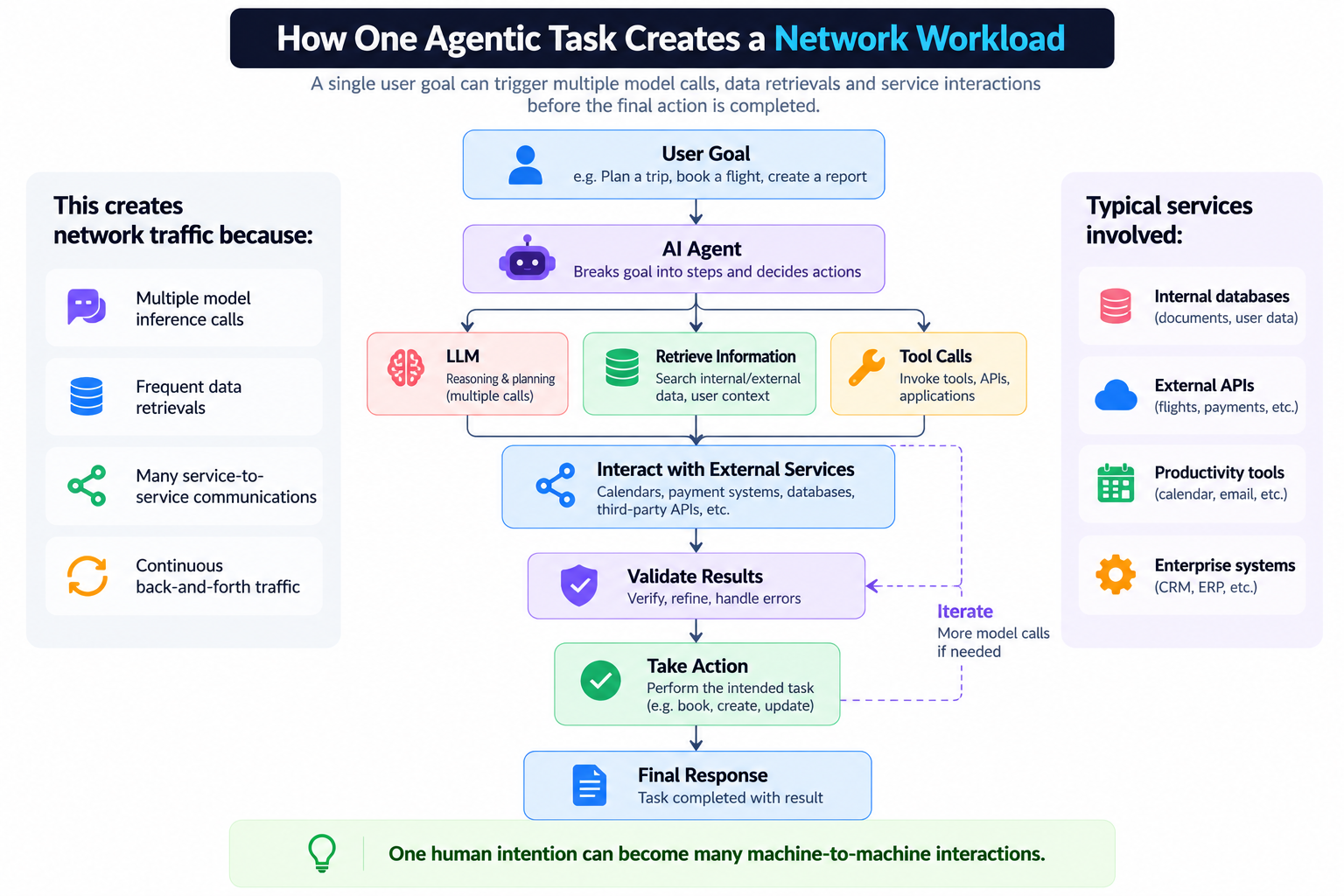
That changes what network engineers need to monitor. Traditional metrics such as bandwidth utilization, packet loss and latency remain important, but AI systems introduce additional concerns around inference paths, east-west traffic, burst patterns, workload placement and the relationship between application performance and model performance. Cisco's research on campus and branch networks reinforces this concern: the company reports that 97% of surveyed organizations have encountered AI-related network challenges, while 76% acknowledge that their networks need upgrades. It also says 34% have already seen increased network traffic because of AI, and organizations broadly deploying AI expect total network traffic to triple within three years. The practical conclusion is that network architecture and capacity planning designed around older application patterns may not be sufficient for an agent-heavy environment.
India Is Entering the Same Infrastructure Race
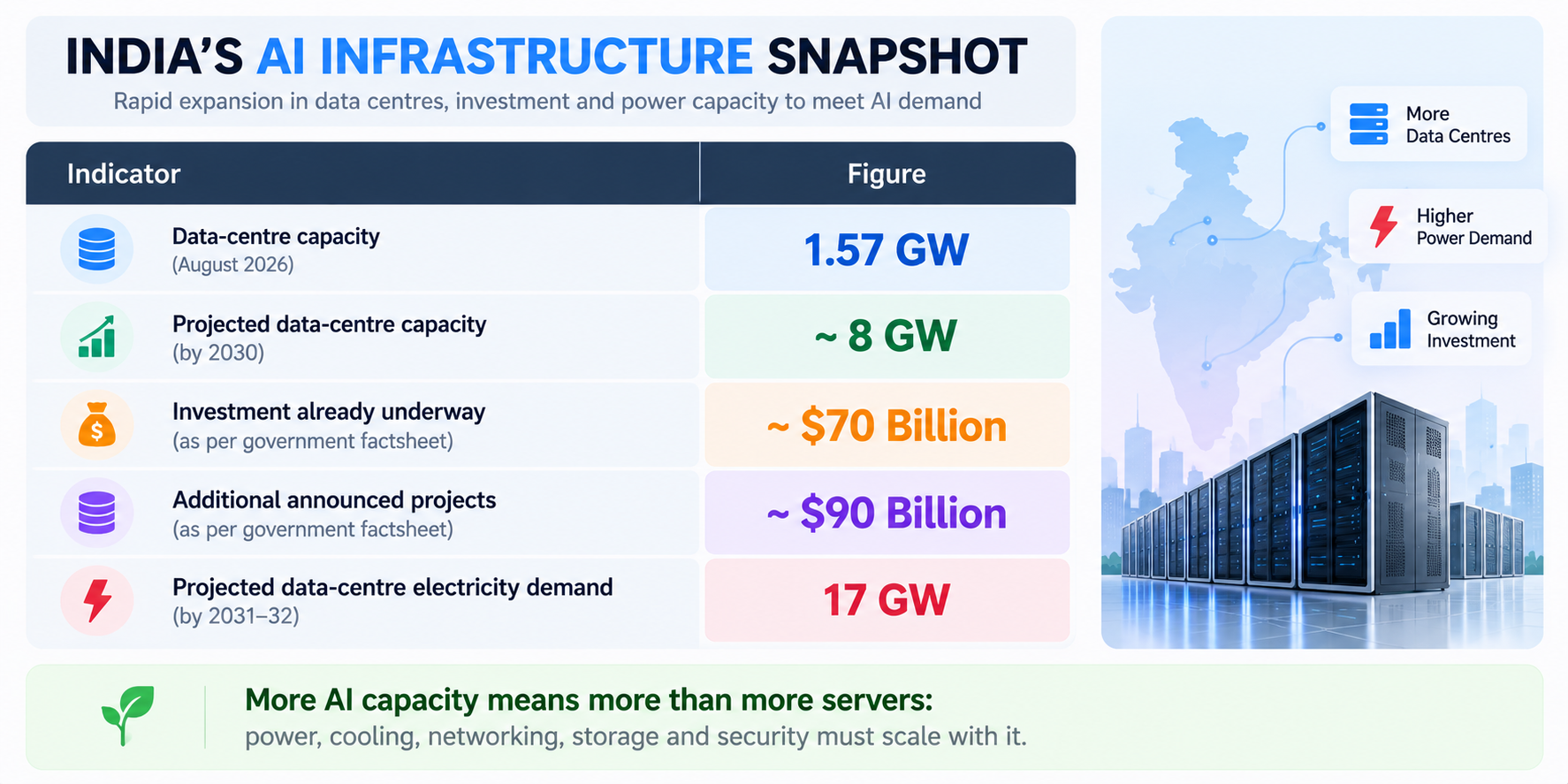
The issue is particularly significant for India because the country's data-centre footprint is already expanding rapidly. According to an official government factsheet released in September 2026, India's installed data-centre power capacity reached 1.57 GW in August 2026, up from about 375 MW in 2020, and is projected to approach 8 GW by 2030. The government says nearly $70 billion of investment is already underway, with another $90 billion in announced projects.
That investment cannot be viewed purely as a race to add server capacity. AI infrastructure also depends on power delivery, cooling, high-speed interconnects, storage, networking, cybersecurity and operational tooling. Data centres are becoming increasingly interconnected computational environments rather than simple places where servers are installed. The energy dimension is also becoming difficult to ignore: the Central Electricity Authority has projected that electricity demand from data centres could reach 17 GW by 2031–32, according to the same government reporting on India's data-centre expansion. As AI workloads grow, infrastructure planning will increasingly have to consider not only compute density but also the electricity and cooling required to keep that compute running continuously.
This makes India's AI opportunity partly an infrastructure challenge. The country has a large technology workforce, a growing cloud and data-centre ecosystem and expanding enterprise AI adoption, but those advantages only translate into production-scale systems when the underlying infrastructure can keep up.
The Real Bottleneck Is Bigger Than Bandwidth
It would be easy to look at the 450% figure and conclude that enterprises simply need larger network pipes. That would miss the bigger problem. AI systems are highly dependent on compute, data, networking and security at the same time, and increasing one without addressing the others can simply move the bottleneck elsewhere.
Data quality is a good example. An organization can invest heavily in GPUs and networking while still feeding models fragmented, outdated or poorly governed information. Cisco's AI Readiness research describes this broader problem as AI Infrastructure Debt: accumulated gaps, deferred upgrades and architectural compromises that eventually limit the ability to scale AI. Its global research found that more than half of organizations said their networks could not scale for complexity or data volume, while only 26% reported robust GPU capacity.
This is why moving an AI system from a successful demonstration to a production environment can expose problems that were invisible during a pilot. A prototype might process a limited dataset and serve a small number of users. A production agent could be querying multiple systems continuously, handling thousands of requests, maintaining context, calling tools and operating across sensitive enterprise data. The infrastructure requirement changes dramatically.
Security Becomes Part of the Architecture
Agentic AI also changes the security conversation because an agent can potentially take an action, not just generate an answer. A chatbot that produces a wrong response creates one kind of risk. An agent that sends an email, modifies a database record, accesses a sensitive document, changes an infrastructure configuration or triggers a transaction can create an operational event.
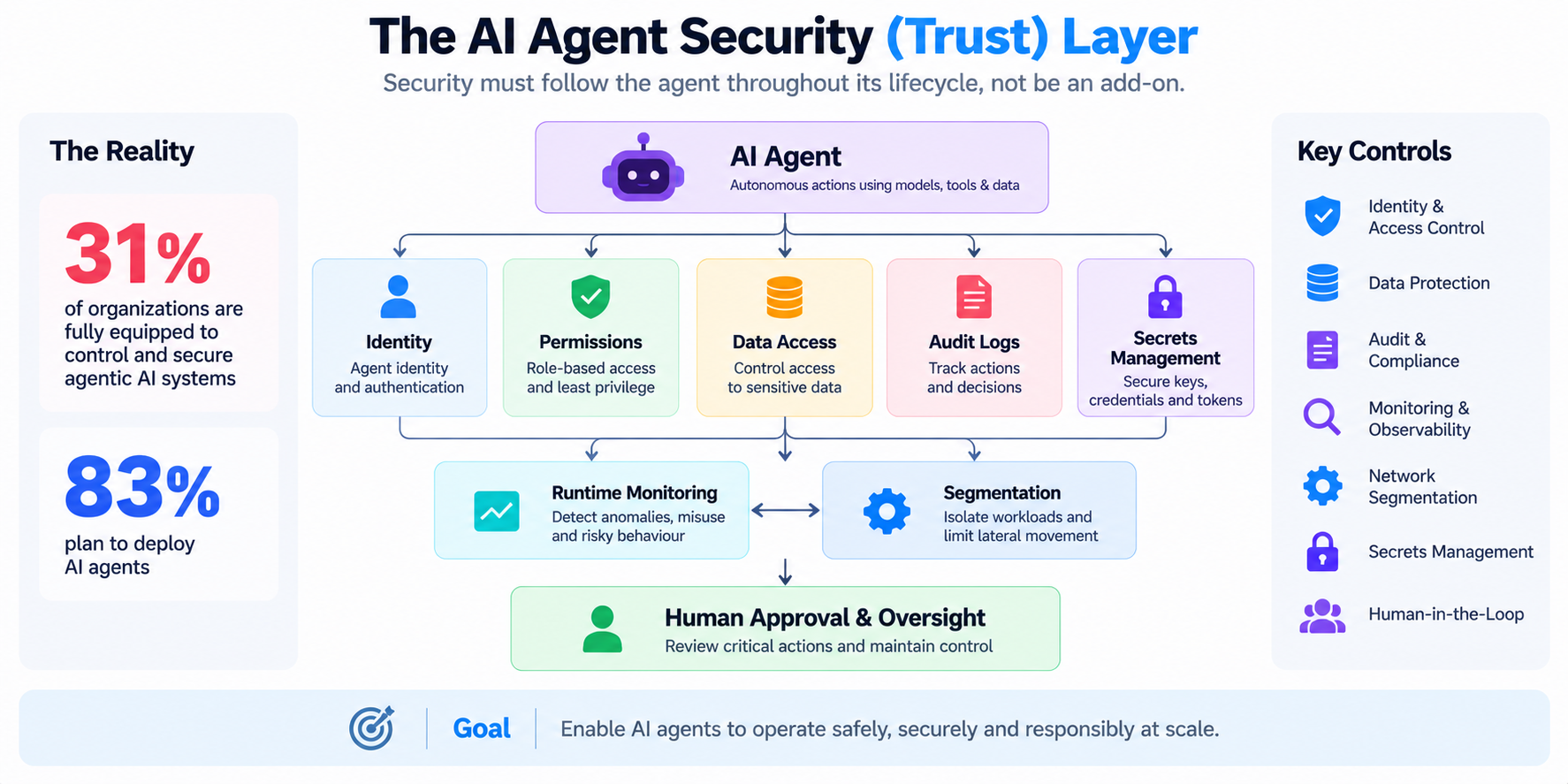
Cisco's 2025 AI Readiness Index found that only 31% of surveyed organizations globally said they were fully equipped to control and secure agentic AI systems, while 83% planned to deploy AI agents. The contrast is important: organizations are moving toward autonomous systems faster than their ability to govern them. India has a similar readiness gap, although the exact percentage depends on what is being measured. Recent reporting citing Cisco's India data said 45% of Indian organizations felt fully equipped to control and secure AI agents, while only 32% reported integrating AI into security frameworks. Earlier Cisco India reporting used a somewhat different measure and found 38% integrated AI into security and identity systems. These figures should therefore be read as different indicators rather than contradictory measurements.
The common message is clearer than any individual percentage: security cannot be added at the end of an agent deployment. Identity, permissions, audit trails, segmentation, secrets management, model access, data protection, runtime monitoring and human approval need to be part of the architecture from the beginning.
The Rise of the “AI Infrastructure Engineer”
This shift is already visible in the job market. Current LinkedIn postings in India are increasingly combining traditional infrastructure engineering with AI-specific requirements. Arm, for example, has advertised a Staff AI Infrastructure Engineer role in Bengaluru covering Kubernetes, cloud, identity, secrets, networking, telemetry and automation as part of a production AI control plane. A separate Bengaluru posting from A4I, a Microsoft–IIIT Bangalore initiative, asks for cloud infrastructure and agentic-systems experience alongside Azure, Kubernetes, Docker and Terraform. The role specifically discusses production AI workloads, multi-agent systems, security, cost governance, vector databases and infrastructure for multilingual AI services.
Networking itself is also becoming more specialized around AI data centres. Current Bengaluru listings from Tenarai call for engineers who can work across Layer 1/2/3 networking and high-density AI infrastructure, while another role focuses on network deployment for AI data centres. Skills mentioned include BGP, EVPN-VXLAN, RDMA, RoCEv2, optical infrastructure and automation. At the higher end, Nava's Bengaluru AI data-centre network engineering role combines GPU clusters with high-performance networking, RDMA fabrics, RoCEv2, InfiniBand, BGP, EVPN-VXLAN, Python, Ansible and Terraform. The job is explicitly about keeping training and inference from being constrained by the network.
These are individual job postings, not a complete measure of the Indian market. But they provide a useful real-world signal: AI infrastructure is becoming a multidisciplinary engineering field rather than simply a GPU procurement exercise.
What the New Architecture Looks Like
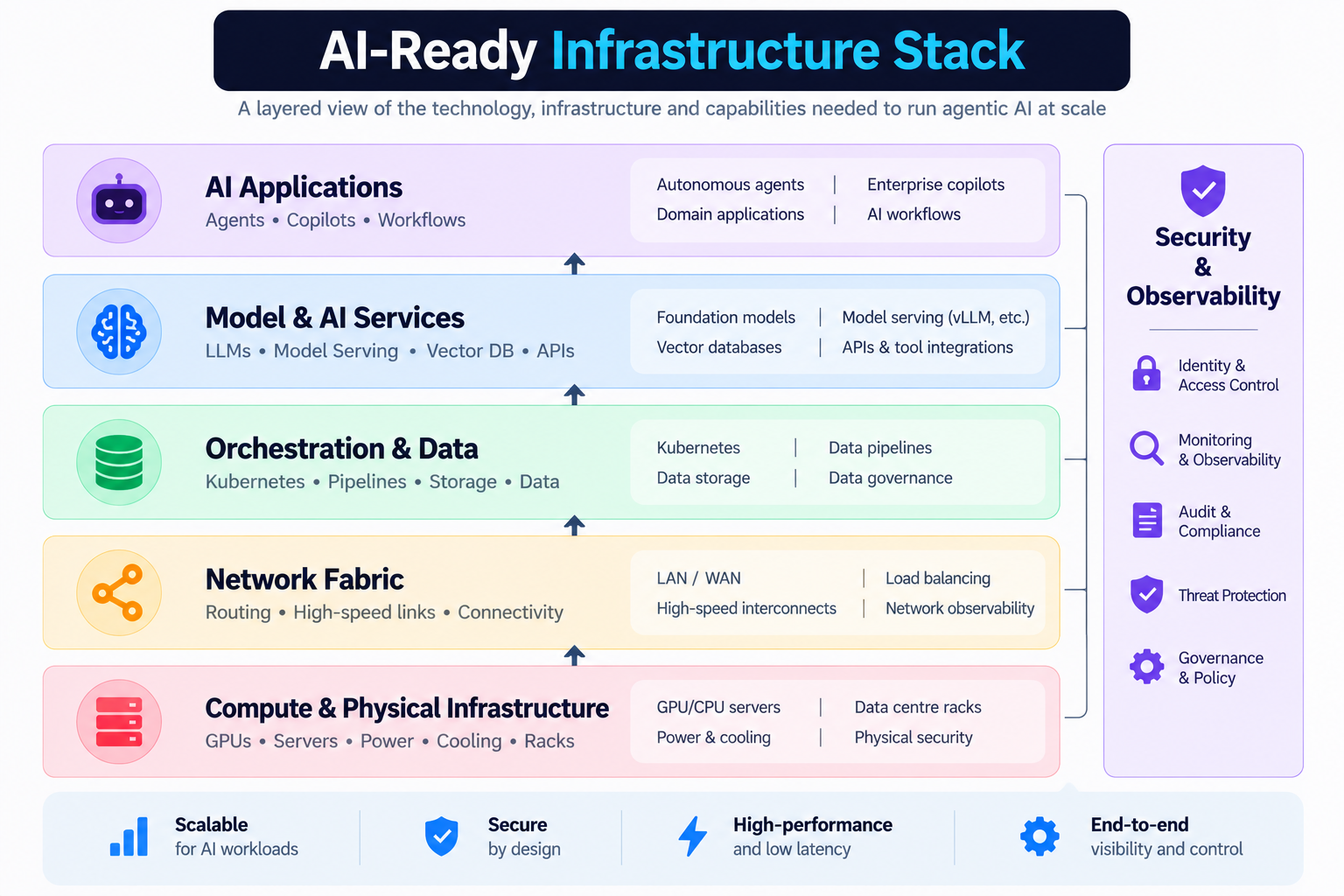
An AI-ready enterprise increasingly needs to think in layers. At the bottom is the physical foundation: power, cooling, servers, GPUs, storage and high-speed connectivity. Above that sits the networking fabric that connects compute, storage, users and external services. Then come Kubernetes or other orchestration systems, model-serving infrastructure, data pipelines, vector databases, APIs and observability, while above those layers sit the AI applications and agents themselves.
The crucial difference is that these layers can no longer operate as isolated teams with isolated dashboards. When an agent becomes slow, the cause might be the model, GPU utilization, a database query, network congestion, an API dependency or a security control. Finding the problem requires cross-domain visibility. That is one reason Cisco has been pushing Cloud Control as a unified operations layer. Cisco describes the platform as bringing networking, security, compute, observability and collaboration into one operational environment, with AI agents working alongside human operators and operating under defined policies and guardrails.
This is Cisco's product strategy, not an independent industry standard, but it reflects a broader architectural direction: AI operations increasingly require a common operational context rather than disconnected infrastructure silos.
From Dashboards to Agentic Operations
Traditional network operations are built around monitoring. Something breaks, an alert appears, an engineer investigates, and a human decides what to change. Agentic operations aim to shorten that loop. An AI system can correlate signals across networking, compute, security and observability, identify possible root causes, recommend an action and—where policies permit—execute part of the remediation.
Cisco's latest research says 92% of surveyed organizations report that performance issues commonly span multiple domains and require information from ten or more tools to resolve. The company also reports that 95% believe existing non-agentic AIOps tools fall short in at least one significant area. This is where the phrase “infrastructure rebuild” needs some nuance. The future does not necessarily require throwing away every existing switch, server or monitoring system. In many organizations, the more realistic transformation will involve improving observability, consolidating telemetry, modernizing network fabrics where necessary, introducing automation, strengthening security controls and creating an operational layer capable of coordinating AI agents with humans.
The rebuild is therefore as much about architecture and control as physical hardware.
What This Means for Enterprises
For enterprises that are still experimenting with AI, the lesson is to stop evaluating AI infrastructure only through model performance. An AI model can perform brilliantly in a controlled environment while the production system around it remains fragile. A serious production assessment should ask whether the network can handle the expected inference workload, whether data is centralized and trustworthy, whether GPU capacity is sufficient, whether the organization can observe agent actions, whether identities and permissions are controlled, and whether there is a recovery path when an agent behaves unexpectedly.
Cisco's AI Readiness research found that Pacesetter organizations are much more likely to architect networks for AI growth and invest in additional data-centre capacity. It also found that these organizations were considerably more likely to move AI use cases into production and to integrate security and identity into their AI systems. The important point is not to copy Cisco's “Pacesetter” category as a universal benchmark. It is the underlying pattern: organizations that treat AI as a systems problem, rather than only a model problem, are better positioned to scale it.
The Workforce Is Changing Along With the Infrastructure
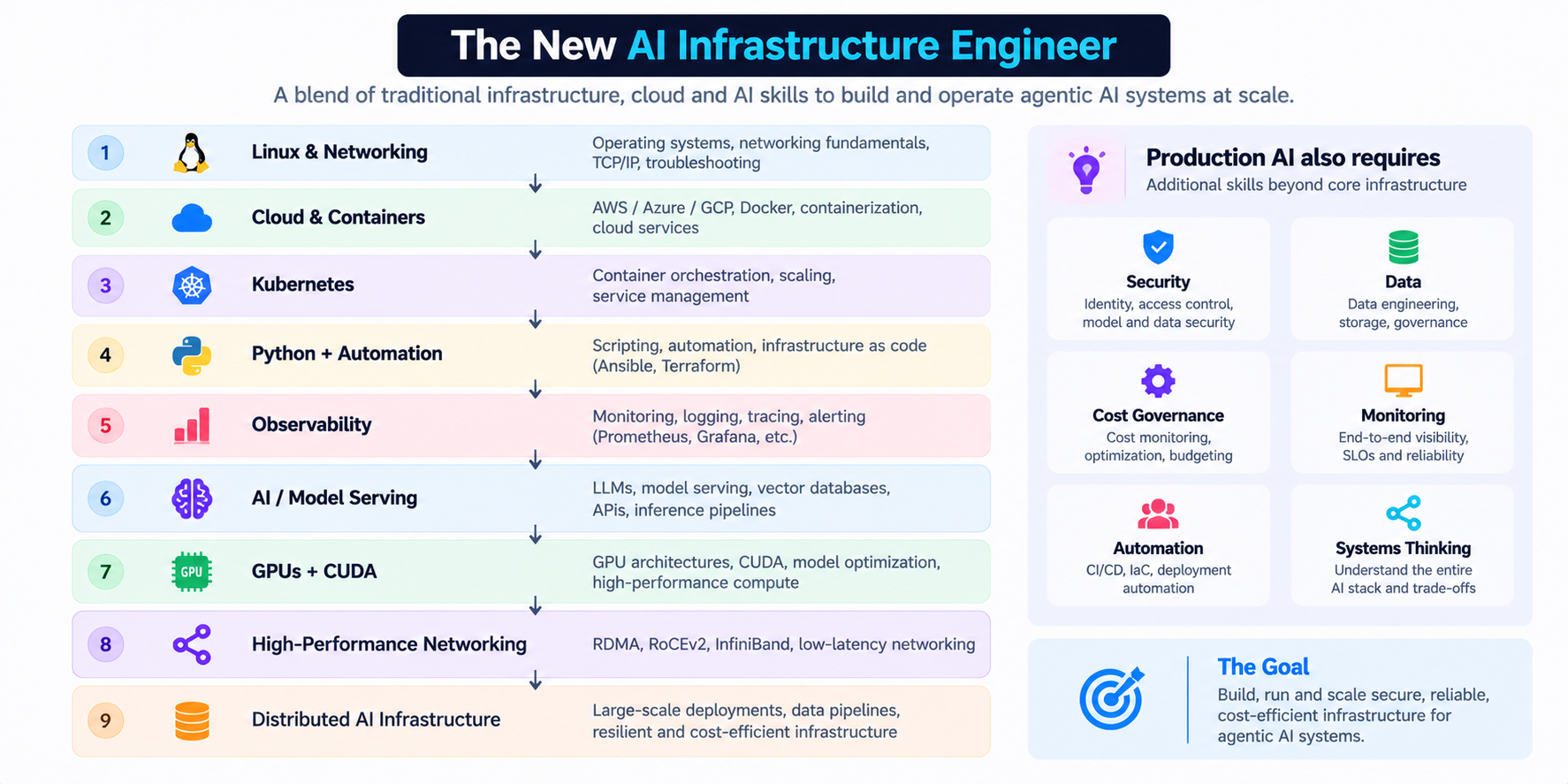
The infrastructure shift is creating a different kind of technical professional. AI infrastructure engineers increasingly need to understand several disciplines at once: Linux, cloud platforms, containers, Kubernetes, networking, GPUs, model serving, observability, security and automation. Current job listings already show this convergence. Arm's Bengaluru role combines AI runtime platforms with networking, identity, secrets and telemetry; A4I combines Azure, Kubernetes, Docker, Terraform and agentic systems; and specialized AI data-centre networking roles combine traditional routing with RDMA and GPU-cluster networking.
For students and engineers preparing for this market, that suggests a practical skill stack: Linux and networking fundamentals first, then cloud and containers, followed by Kubernetes, Python automation, observability and AI serving. For deeper AI infrastructure work, knowledge of GPUs, CUDA, model-serving systems such as vLLM or Triton, high-performance networking and distributed inference becomes increasingly useful. Current postings from Algoryq, DigitalOcean and other companies explicitly mention these areas. The important part is not to learn every tool listed in every job description. It is to understand the systems well enough that a new tool becomes something you can learn rather than something you fear.
What Comes Next
The agentic AI era is likely to make networks more dynamic, not simply larger. Traditional capacity planning often assumes relatively predictable application patterns: users connect to applications, consume information and occasionally upload data. Agents change that pattern because they can continuously retrieve context, communicate with models and call external systems.
Cisco's WAN research projects that AI and agentic AI could drive enterprise network traffic toward roughly nine times today's levels by 2035 under its model, while consumer AI could push overall network traffic to about 6.6 times today's levels, with AI inference potentially accounting for 25% of total network traffic. These are Cisco projections, not guaranteed outcomes, but they illustrate the scale of change that infrastructure planners are beginning to model.
That future also creates an opportunity. Networks that can understand AI traffic, prioritize inference workloads, maintain reliable model connectivity and expose useful telemetry can become a competitive advantage rather than just a utility layer. The companies that prepare early will not necessarily be the ones that buy the biggest amount of hardware. They will be the ones that understand where AI creates traffic, where inference creates bottlenecks, where agents need permission to act, and how to observe the entire chain from user request to model response to real-world action.
Final Perspective
The headline that agentic AI can generate 450% more network traffic sounds, at first, like a bandwidth story. It is not. It is a warning that the architecture underneath AI is changing. As agents move from answering questions to completing tasks, the network becomes part of the AI experience. Data centres become more important, inference becomes a critical traffic pattern, security has to follow agents rather than simply protect users, and infrastructure teams have to understand systems that operate at machine speed.
India is already expanding its data-centre capacity rapidly, with installed capacity at 1.57 GW in August 2026 and a projection of nearly 8 GW by 2030, alongside tens of billions of dollars in ongoing investment. At the same time, the job market is beginning to reflect a new category of infrastructure work combining AI, networking, cloud, Kubernetes, GPUs, security and automation.
The real infrastructure race, then, is not simply about building more AI. It is about building an environment capable of running AI continuously, securely, observably and at scale. And that is why agentic AI may end up changing the network just as fundamentally as it changes the software running on top of it.