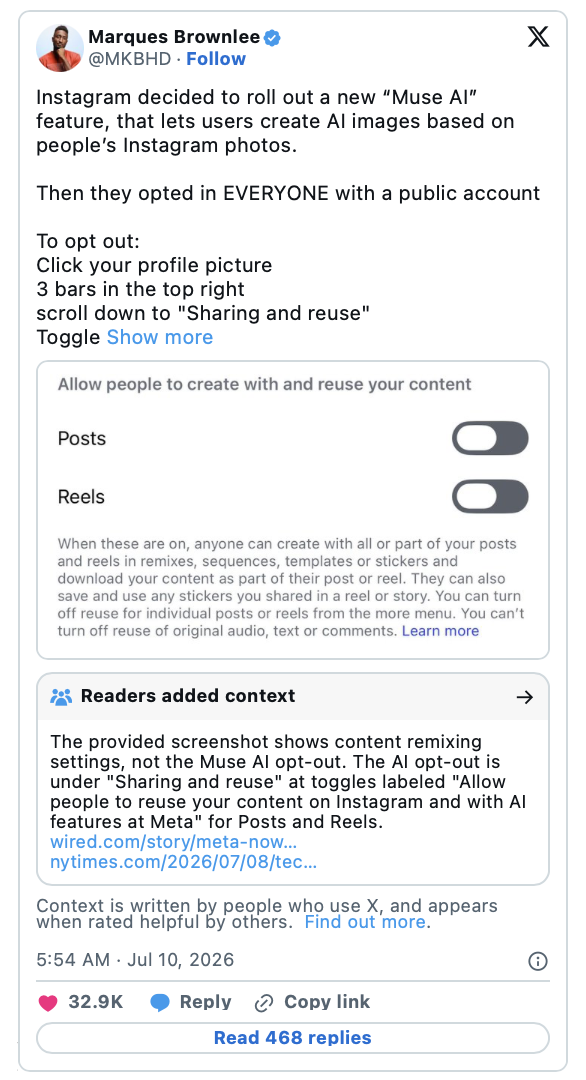
Last week, Meta introduced an Instagram feature that allowed users to generate AI images of people through public accounts without first seeking their permission. The backlash was immediate, forcing the company to withdraw the feature within days.
The controversy may feel familiar. It is the fourth time in less than two years that Meta has launched an AI product based on the same questionable assumption: that silence can be treated as consent.
In 2024, Meta announced plans to use publicly available content from Facebook and Instagram users in the European Union to train its AI models. Users were automatically included, and those who objected had to complete a separate opt-out form.
Privacy advocacy group NOYB described the process as a “charade”. It argued that Meta could not rely on “legitimate interest” to override people’s data protection rights, first for advertising and later for AI development.
Complaints were filed across 11 European Union countries. Technical reviews also found that users had to log in before they could even access the objection process, adding another barrier for anyone trying to protect their data.
Brazil took a stricter approach. The country’s National Data Protection Authority ordered Meta to immediately stop using Brazilian user data for AI training, warning that the practice created a risk of serious and irreversible harm.
The regulator was not opposing AI training itself. Its concern was the way consent had been designed.
Unlike users in Europe, Brazilian users reportedly received no clear email or in-app notification. The option to object was buried inside Meta’s Privacy Policy Centre and required users to navigate an eight-step process.
By 2025, the debate had moved beyond whether users had been adequately informed. The larger question was whether Meta should be allowed to use an opt-out model for AI training at all.
Meta continued to rely on “legitimate interest”, while also stating that objections made after AI training had begun would not remove information that had already been collected or used.
In practice, this meant that once a user’s data had entered an AI training system, exercising the right to object might not undo what had already happened. That raises serious questions about how such systems can comply with principles such as the right to be forgotten.
The recently withdrawn Instagram feature followed the same pattern, only much faster. Public accounts were included by default, people were not clearly notified that their likenesses could be used to create AI images, public anger grew rapidly and Meta quietly reversed the decision.
The most striking part of this recurring cycle is that the solution remains obvious every time: ask people first.
However, Meta rarely adopts consent-first design on its own. It usually waits until regulators threaten penalties or public backlash makes a feature too damaging to continue. The company then makes only enough changes to address the immediate controversy.
In Europe, it took roughly a year of regulatory pressure, delayed launches, revised notices and renewed objection mechanisms before Meta’s approach moved closer to an acceptable standard.
That progress did not happen because Meta suddenly decided that consent should come first. It happened because regulators made the cost of not asking users higher than the cost of asking them.
The issue therefore extends far beyond a single Instagram feature.
Meta clearly has the technical ability to build AI tools around explicit consent. It has introduced stricter safeguards in markets where governments have required them.
The reason it does not make opt-in consent the default is simple. Fewer people are likely to volunteer their content, images and personal data. A smaller dataset may reduce the scale and effectiveness of the AI product.
Each launch therefore becomes a calculated gamble that most users will not notice, object or take action.
That gamble often works. Last week, it did not.
The real question is no longer whether Meta will attempt a similar rollout again. Its record over the past two years suggests that it probably will.
The question is which future product will generate enough legal, financial or public pressure to finally make consent-first design cheaper than another backlash.