Imagine you're in the final round of an AI Product Manager interview at a fast-growing AI startup. The interviewer asks:
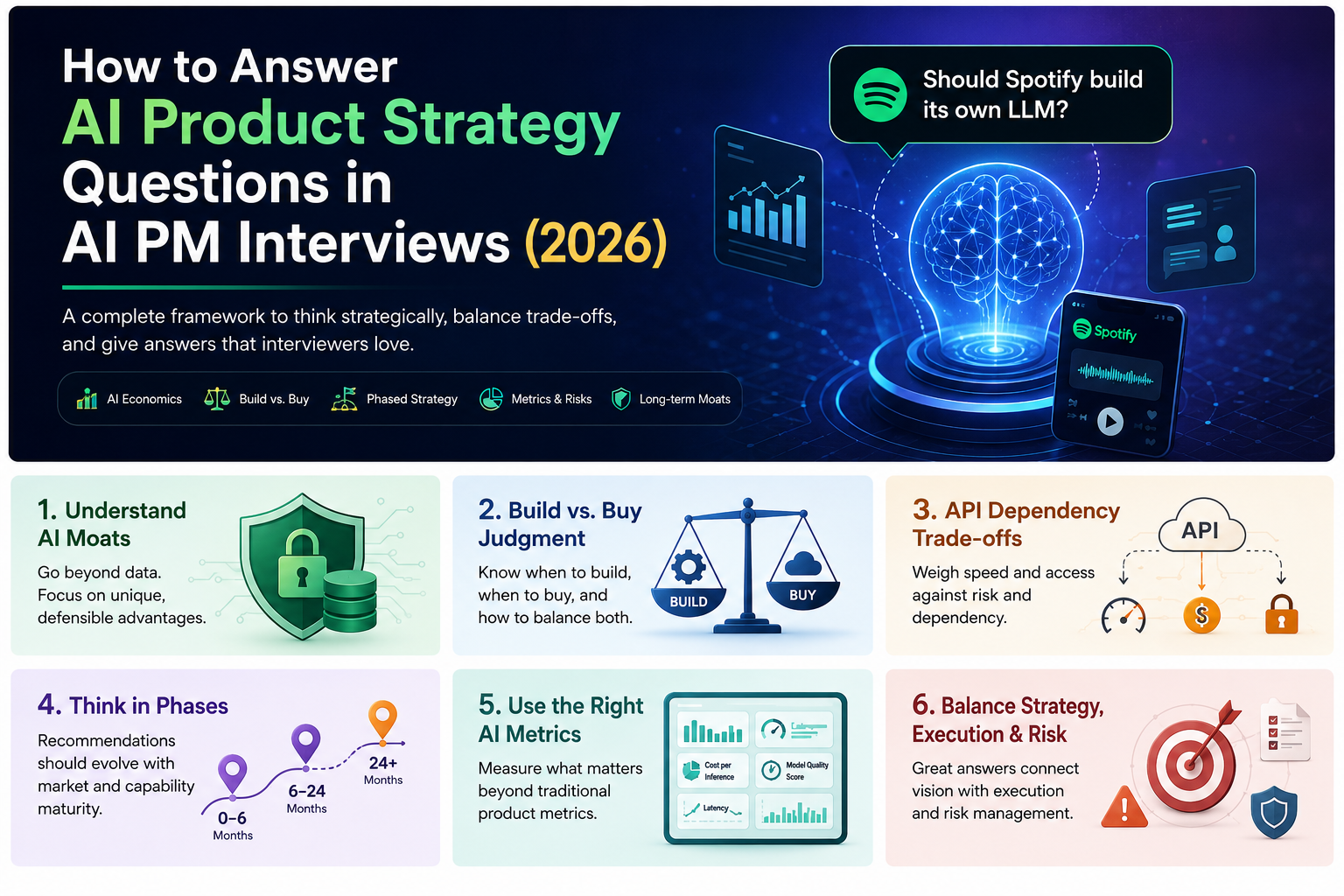
"Should Spotify build its own Large Language Model (LLM)?"
Many candidates immediately jump to familiar answers like:
"Spotify has a lot of user data, so it should build its own model to create a competitive moat."
While this sounds reasonable, it often misses what interviewers are actually evaluating.
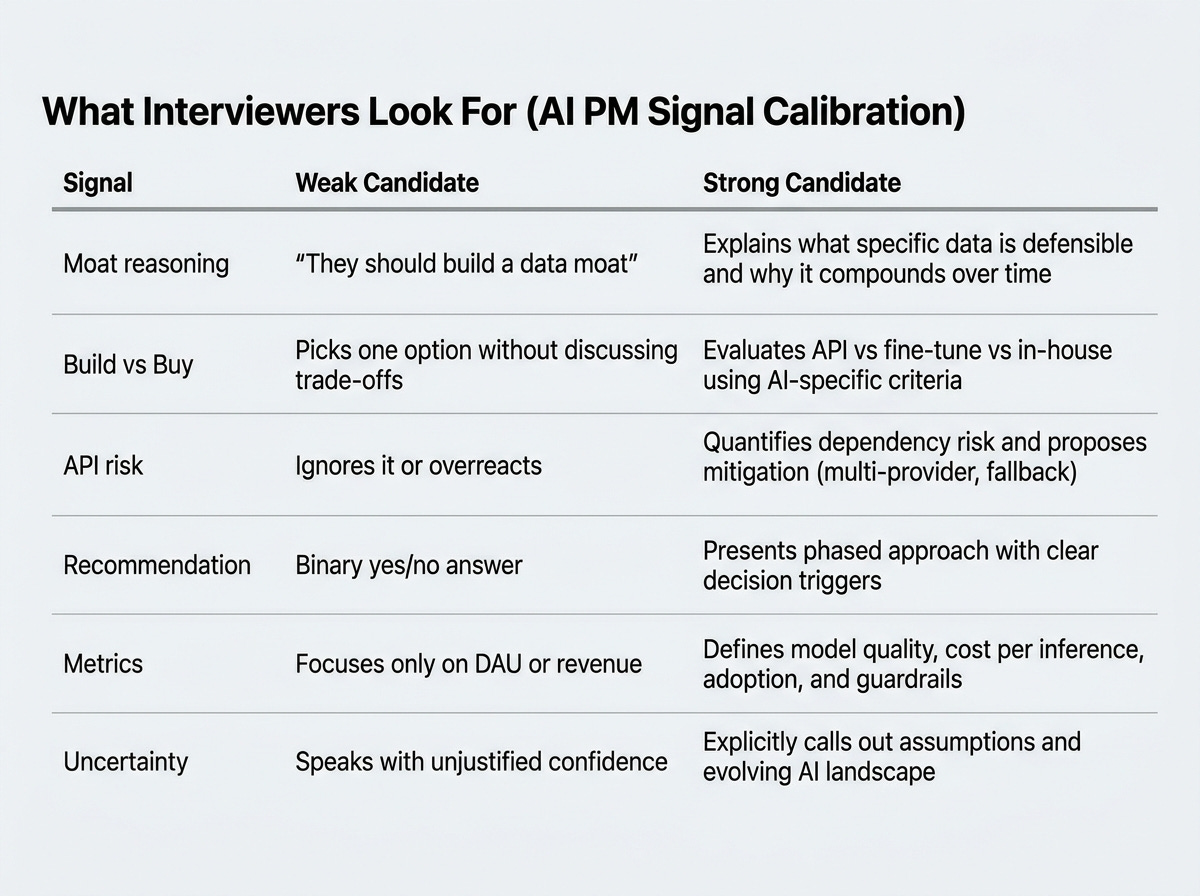
AI product strategy questions are different from traditional product strategy questions. Interviewers are not looking for buzzwords like data moat or AI advantage. They want to see whether you can:
- Evaluate the economics of AI systems.
- Understand model development versus API adoption trade-offs.
- Assess infrastructure and operational requirements.
- Think in phased strategies rather than binary decisions.
- Balance speed, cost, differentiation, and long-term defensibility.
What Makes AI Product Strategy Questions Unique?
AI strategy questions sit at the intersection of business strategy, product thinking, and AI economics.
Common categories include:
Build vs. Buy vs. Partner
Should a company build its own model, use third-party APIs, or partner with an AI provider?
Examples:
- Spotify and LLMs
- GitHub and AI coding assistants
- Salesforce and AI copilots
Moats and Defensibility
What prevents competitors from replicating an AI product?
Examples:
- OpenAI's competitive advantage
- Perplexity's differentiation against Google
Competitive Response
How should incumbents react to AI-native challengers?
Examples:
- Adobe vs. Midjourney
- Duolingo vs. AI tutors
- Bloomberg vs. AI search platforms
Platform vs. Product
Should a company remain an AI-powered application or evolve into a platform?
Open vs. Closed Source
What are the strategic implications of open-sourcing AI models?
What Interviewers Are Really Assessing
1. Your Understanding of AI Moats
Simply saying a company has "lots of data" isn't enough.
Strong candidates explain:
- Why the data is unique.
- Whether competitors can access similar information.
- How that data improves model performance.
For Spotify, unique behavioral signals such as listening habits, skips, replays, and playlist creation may create defensible advantages.
2. Your Build-vs-Buy Judgment
Most companies should not train foundation models.
Why?
- Massive training costs
- Scarce AI talent
- Rapid improvements in open-source alternatives
Interviewers expect you to recognize when building is justified—and when it isn't.
3. Your Understanding of API Dependency
Using external AI providers creates risks:
- Pricing changes
- Vendor lock-in
- Reliability concerns
However, APIs also provide:
- Faster launch timelines
- Lower upfront investment
- Access to state-of-the-art models
The best answers balance both perspectives.
4. Your Ability to Think in Phases
AI markets evolve quickly.
A recommendation that makes sense today may be obsolete in two years.
Strong candidates propose:
- Immediate actions
- Mid-term investments
- Long-term strategic options
5. Your Knowledge of AI Metrics
Traditional metrics like DAU and revenue are important, but AI products require additional measures such as:
- Cost per inference
- Model quality scores
- Response latency
- Fine-tuning ROI
- Dependence on external model providers
A Framework for Answering AI Product Strategy Questions
The classic BUS Framework (Business, User, Solution) can still be used, but it must be adapted for AI contexts.
Step 1: Business Objectives (AI Perspective)
Start by understanding the company's AI position.
Key Questions
AI Maturity
- AI-native
- AI-first
- AI-augmented
Data Assets
- What proprietary data exists?
- Is it structured and usable for training?
Technical Capabilities
- Does the company have ML infrastructure?
- Can it fine-tune and maintain models?
Competitive Pressure
- Is an AI-native competitor creating urgency?
Revenue Model
- Does AI directly generate revenue or primarily create costs?
Spotify Example
Spotify is an AI-augmented company, not an AI-native one.
- Massive user base
- Rich behavioral data
- Strong distribution
- Limited foundation-model expertise
- Margin pressure from music licensing costs
These realities significantly influence strategic choices.
Step 2: User Needs (AI Perspective)
AI strategy should always be grounded in user value.
Key Questions
Who Benefits?
- End users
- Developers
- Enterprise customers
- Internal teams
What Capabilities Are Needed?
Not every use case requires the most advanced model.
- Speed
- Reliability
- Consistency
Trust and Explainability
Particularly important in regulated industries.
Willingness to Pay
Will users pay more for a significantly better AI experience?
Spotify Example
Most Spotify users don't care whether recommendations come from an in-house model, OpenAI, Anthropic, or an open-source model.
They care about:
- Relevance
- Personalization
- Fast responses
This suggests Spotify should optimize for recommendation quality rather than invest heavily in building a frontier model.
Step 3: Solutions and Strategy (AI Perspective)
This is where the recommendation comes together.
Consider Four Strategic Options
1. Build
Train or develop a proprietary model.
2. Buy
Use third-party AI APIs.
3. Partner
Collaborate with an AI provider.
4. Hybrid
Launch using external models, then gradually develop proprietary capabilities.
Evaluate Each Option Against
- Time to market
- Cost
- Differentiation
- Data moat potential
- API dependency risk
- Regulatory requirements
- Internal capabilities
Make a Phased Recommendation
Avoid yes-or-no answers.
0–6 Months
- Fastest path to market
6–24 Months
- Capability development
- Fine-tuning efforts
24+ Months
- Long-term strategic investments
Define Success Metrics
- Cost per inference
- User satisfaction
- Model quality
- Latency
- Revenue impact
- AI feature adoption
Address Risks
- Key risks
- Likelihood
- Mitigation plans
Spotify Example Recommendation
Option 1: Build a Proprietary LLM
❌ High cost, long timelines, and limited internal expertise.
Option 2: API-Only Approach
🟡 Fast deployment but creates dependency and margin pressure.
Option 3: Fine-Tune Open-Source Models
✅ Strong balance between differentiation, cost, and control.
Option 4: Hybrid Strategy
✅ Recommended.
Short Term: Launch quickly using external APIs.
Medium Term: Fine-tune open-source models using Spotify's behavioral data.
Long Term: Reassess whether proprietary models create sufficient competitive advantage to justify further investment.
This phased approach balances speed, cost efficiency, and long-term defensibility while leveraging Spotify's strongest asset—its unique user behavior data.