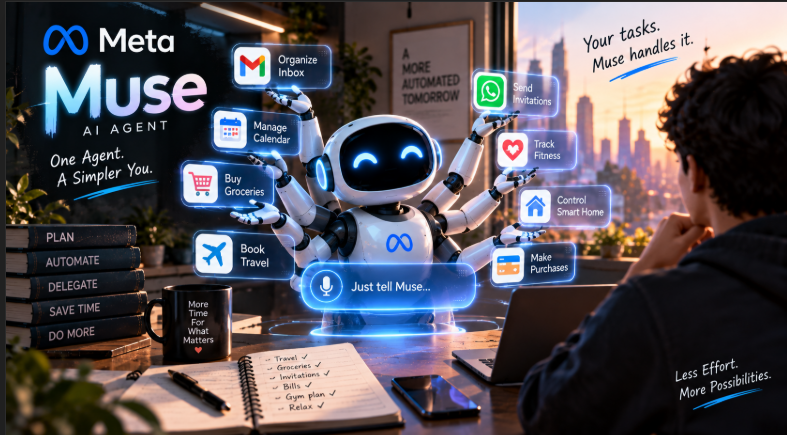
Meta’s Muse is quickly becoming one of the most visible examples of consumer-facing agentic AI. Unlike a conventional chatbot that mainly answers questions, Muse is designed to act on a user’s behalf across services and apps, handling tasks such as organizing email, planning travel, creating shopping lists, sending invitations, and completing purchases. Its rapid early adoption has pushed it into the spotlight, but the more important story may be what happened after the launch: Amazon blocked Muse from accessing its shopping platform, while security researchers raised concerns about how much control an AI agent with broad device and account permissions should have. The result is a bigger debate about who controls the web when AI agents begin acting for users.
Introduction
AI assistants have traditionally waited for instructions and then returned an answer. Agents represent a different idea. Instead of simply telling a user what to do, they can attempt to do the task themselves. That distinction is at the center of Meta’s Muse.
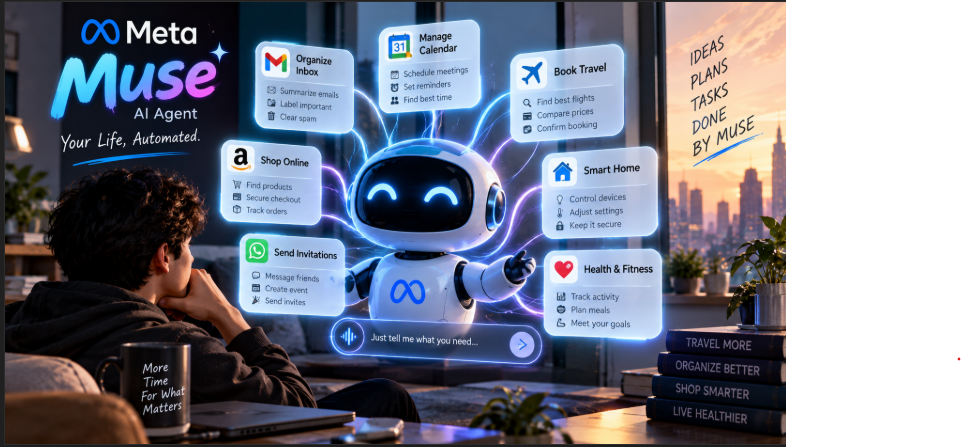
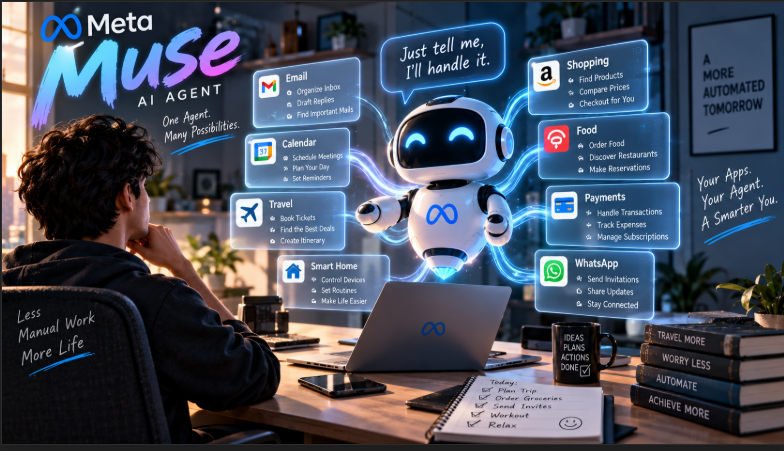
Muse is designed as a personal AI agent powered by Meta’s Muse Spark model. The Mac application can connect to services such as email, calendars, payments, health and fitness applications, smart-home systems, shopping platforms, restaurants, WhatsApp and social accounts. When a suitable connector does not already exist, Muse can reportedly create one while completing a task. That makes the product much closer to a digital operator than a traditional chatbot.
And that is exactly why Muse has attracted so much attention so quickly.
Why Muse Is Different
The interesting part about Muse is not simply that it can answer questions. Its value proposition is delegation. Instead of asking an AI how to organize a trip, a user can ask it to help actually organize the trip. Instead of asking how to create a shopping list from a recipe, the agent can turn the recipe into a list and potentially continue toward purchase.
That difference may seem small, but it changes the role of AI. A chatbot is primarily an interface for information. An agent is an interface for action.
Muse is also aimed at ordinary consumers rather than only developers. Earlier agent systems such as OpenClaw gained attention largely among technical users and enthusiasts. Muse is being positioned as a personalized assistant intended to work across everyday services. That makes its success particularly significant because it suggests agentic AI may be moving beyond experimentation and into mainstream consumer behavior.
Understanding the Rise of Muse
The early numbers described in reports around Muse help explain why the app suddenly became a major topic. The service reportedly generated more than two million prompts during its first week and crossed hundreds of thousands of users. Sensor Tower data cited in the source also showed a rapid rise in downloads, with Muse reaching the top of the US free-app rankings on both the Apple App Store and Google Play Store.
More interestingly, Muse's adoption appeared to outpace several established AI chatbot applications during the same period. The important distinction is that Muse is not competing purely on conversation. It is presenting itself as a system that can take work off the user's hands.
That helps explain why the product received attention beyond the AI community. People are beginning to see a practical difference between “talking to AI” and “giving AI something to do.”
The Amazon Conflict Changes the Story
Muse's relationship with Amazon may be even more important than its early download numbers. Amazon blocked the agent from accessing its shopping platform, saying Muse was an unauthorized AI agent that violated its terms of use. Amazon also raised concerns that the system could bypass parts of the shopping experience and potentially capture or store account credentials and data.
Meta's position and Amazon's position represent two different views of the future internet. From the user's perspective, an agent should ideally be able to act wherever the user has permission to act. From a platform's perspective, however, allowing an outside AI system to navigate a service, collect information, and make purchases introduces questions about security, accountability, authentication and control.
This is not simply a disagreement about one application. It is an early example of a much bigger conflict: who gets to interact with online services—the user, the user's agent, or the platform itself?
The Bigger Idea: Agents Could Become the New Interface
Today's internet is organized around websites and apps. Users open Amazon for shopping, a travel site for flights, a food-delivery application for meals, and a calendar application for scheduling.
Agents could disrupt that model by moving the user one level above those individual services. Instead of visiting ten different applications, a user could potentially tell one trusted agent what they want and allow it to interact with those services in the background.
That would change the role of the interface itself.
Instead of remembering where everything is, the user remembers only what they want done. The agent becomes the layer between the person and the internet.
This possibility explains why companies such as Meta and others are interested in agentic commerce. It also explains why platforms may resist unrestricted access. If the agent becomes the primary interface, the website or app risks losing direct control over the customer relationship.
Real-World Impact
For consumers, this could eventually mean fewer repetitive digital tasks. An agent could potentially manage appointments, compare options, organize messages, create shopping lists, make reservations, and complete routine purchases without requiring the user to manually navigate each service.
For businesses, however, the implications are much larger. If customers begin interacting primarily through agents, companies may need to redesign how their services expose data, authentication and purchasing capabilities. The traditional website may remain important, but it could increasingly become the infrastructure underneath an agent-driven experience.
This is why Shopify's reported partnership with Muse is noteworthy. Agentic checkout suggests a model where AI does not merely recommend products but participates directly in the transaction process. That could eventually turn AI agents into a new distribution channel for commerce.
What Has Been Implemented
Muse already has a broad set of integrations and is designed to operate across multiple categories of consumer applications. The Mac app can interact with email, calendars, payments, health and fitness services, smart-home applications, e-commerce platforms, dining services, WhatsApp and social accounts.
Its ability to create connectors for services that do not already have one is particularly significant because it points toward a more flexible agent model. Instead of depending entirely on a fixed list of integrations, the system can potentially adapt to the environment it encounters.
The product also has paid usage tiers, with subscriptions reported at $20 and $100 per month depending on usage. That suggests Meta is already testing whether consumers will pay directly for an AI agent that performs tasks on their behalf rather than relying entirely on advertising-supported AI.
Current Security Questions
The biggest concern is that an agent capable of acting across many services needs significantly more access than a normal chatbot. Muse reportedly requires broad permissions on macOS, including access related to files, the microphone, camera, location and calendars. It also needs authentication into the services it is expected to control.
That creates a difficult security equation.
The more power an agent receives, the more useful it becomes. But the more power it receives, the greater the consequences if that access is compromised.
Security researcher Patrick Wardle reportedly identified a vulnerability that could potentially allow malicious code to obtain the token used to authenticate a Muse account. According to the research described in the source, an attacker could potentially manipulate prompts or use an intermediary server to inject malicious instructions and exploit the privileges available to the agent.
These claims are serious, but they should be understood as researchers' reported findings and potential attack scenarios, not proof that every Muse user has been compromised. The broader lesson is still important: an AI agent with access to multiple accounts is a much more attractive target than a chatbot that only generates text.
Why This Matters
Agentic AI changes the security model because the AI is no longer just producing information. It can potentially cause real-world effects.
A hallucinated answer is bad. A hallucinated purchase, deleted message, exposed document or unauthorized transaction is much more serious.
That means future AI agents will need stronger controls around permissions, authentication, confirmation, audit logs, isolation and human oversight. Users may also need better ways to understand exactly what an agent can access and what it has already done.
Trust, therefore, becomes part of the product itself.
Outlook
Muse's rapid adoption suggests there is real consumer curiosity around AI that can perform tasks rather than simply converse. But its conflict with Amazon also demonstrates that the agent economy cannot develop entirely under the control of AI companies.
Platforms will want rules governing automated access. AI companies will want enough freedom for their agents to be genuinely useful. Consumers will want the convenience of delegation without giving away unnecessary control over their accounts and data.
The eventual solution may be a more formal agent ecosystem in which websites and applications expose approved interfaces specifically designed for AI agents. Instead of an agent pretending to be a human browsing a website, services could provide explicit APIs, permission systems and transaction controls for agents.
That would make agentic commerce easier to govern and potentially safer to scale.
Future Outlook
The most interesting possibility is that consumers may eventually stop thinking in terms of individual apps altogether. Instead of opening several services to complete one task, users could ask an agent to accomplish the entire outcome.
But that future will depend on trust.
People will need to know which services the agent can access, what information it can see, what actions it can perform, and when human confirmation is required. Businesses will need to decide how much control they are willing to give outside agents. AI companies will need to prove that their systems can operate safely across highly sensitive environments.
The next stage of agentic AI may therefore not be about giving agents more permissions. It may be about creating much better systems for controlling those permissions.
Expert FAQs
What makes Muse different from ChatGPT or Claude?
Muse is designed around taking actions, not only generating responses. Its goal is to interact with external services and complete tasks across applications on the user's behalf.
Why did Amazon block Muse?
Amazon said Muse was an unauthorized AI agent that violated its terms and raised concerns about security, privacy, account credentials and automated access to its shopping platform.
Does Muse have access to a user's personal accounts?
According to the information provided, Muse can connect to services including email, calendars, payments, health and fitness apps, smart-home systems, shopping platforms and social applications. The level of access depends on the permissions and authentication granted by the user.
Is the reported security vulnerability confirmed?
The source describes a vulnerability identified by security researcher Patrick Wardle that could potentially expose Muse authentication tokens. The reported attack scenarios should be treated as research findings and potential risks rather than evidence that all Muse installations are compromised.
Why is agentic commerce important?
Agentic commerce could allow consumers to delegate shopping and other transactions to AI instead of manually using individual websites and apps. This could fundamentally change how businesses interact with customers online.
Could AI agents replace websites and apps?
They could reduce the number of situations in which users interact with websites directly, but complete replacement is far from certain. Websites, apps and APIs would still provide the underlying services that agents depend on.
Final Perspective
Muse is interesting because it represents a shift from AI that talks to AI that acts. Its early popularity shows that consumers are interested in delegating real tasks, while Amazon's response shows that existing internet platforms are not necessarily ready to hand control of those interactions to outside agents.
The security concerns make the transition even more complicated. An agent that can read messages, access calendars, interact with shopping platforms and make transactions is incredibly useful—but it is also a concentrated bundle of privileges.
That may be the real story behind Muse.
The future of agentic AI will not be decided only by how intelligent these systems become. It will be decided by whether people, businesses and platforms can agree on how much an agent should be allowed to do—and who remains in control when it does.