Google has launched Gemini 4 Argon, its flagship AI model designed for complex reasoning, software development and enterprise problem-solving. Announced on October 13, 2026, the model targets demanding tasks across coding, finance, legal research, cybersecurity and scientific research.
Unlike basic AI assistants focused on answering questions, Gemini 4 Argon is designed to support multi-step workflows, process large amounts of information and work with external tools. Google is making it available through its developer ecosystem and selected AI products, alongside introductory API pricing and dedicated programmes for cybersecurity professionals and scientists.
Here is a closer look at Gemini 4 Argon's features, pricing, benchmarks, applications and potential limitations.
What Is Google Gemini 4 Argon?
Gemini 4 Argon is Google's advanced reasoning model for complex, multi-step tasks. It is designed to help developers and businesses analyse information, solve technical problems and build AI-powered applications.
Its intended use cases include debugging software, reviewing lengthy documents, analysing financial information and supporting scientific research. The model also supports multimodal inputs, including text, images, audio, video and PDFs.
However, advanced capabilities do not guarantee error-free results. Developers and organisations still need to validate outputs, test generated code and apply suitable security controls.
Gemini 4 Argon: Key Features at a Glance
Key features of Google's Gemini 4 Argon include:
- Advanced reasoning: Designed for complex coding, analytical and scientific tasks.
- Large context window: Supports up to 1,048,576 tokens across input, reasoning and output.
- Multimodal input: Processes supported text, image, audio, video and PDF inputs.
- AI agent capabilities: Supports tool-assisted workflows and function calling.
- Developer access: Available through Google AI Studio and the Gemini API.
- Enterprise applications: Targets software engineering, finance, legal research and cybersecurity.
- Configurable thinking: Offers different reasoning-effort settings for supported workflows.
Together, these features position Argon as a model for more demanding AI applications rather than simple conversational assistance.
1. Advanced Reasoning for Complex Problems
Gemini 4 Argon is designed to handle tasks requiring multiple connected steps. For example, it can assist a developer in investigating a bug, examining relevant code, suggesting a fix and preparing tests.
Businesses may also use it to review documents, organise research and analyse complicated datasets. Its usefulness depends on task complexity, available tools and the accuracy of the supplied information.
2. A One-Million-Token Context Window
Gemini 4 Argon supports a context window of up to 1,048,576 tokens. This allows developers to work with substantial amounts of information, including large codebases, lengthy reports and multiple research documents.
A large context window can reduce the need to split information into numerous smaller requests. However, it does not guarantee that every detail will be interpreted correctly.
The window is shared across input, reasoning and output, so developers must account for context usage when designing applications.
3. Gemini 4 Argon for AI Coding and Software Engineering
Software development is a major target for Gemini 4 Argon. Google is positioning it for tasks that extend beyond generating individual code snippets.
How developers could use Gemini 4 Argon
- Debugging: Investigate errors and identify possible causes.
- Codebase analysis: Understand relationships between files and software components.
- Code generation: Implement features and assist with refactoring.
- Automated testing: Suggest test cases and investigate failures.
- Documentation: Generate technical explanations, setup instructions and API documentation.
- AI coding agents: Connect the model to development tools to support multi-step coding workflows.

Reported productivity improvements inside Google
Google reports that its engineers using Argon in Antigravity increased agentic code submissions by more than 35% and reduced code rollbacks by nearly one-third. The company also describes using Argon for a large Chromium architectural refactor.
These are Google's reported internal results, not guaranteed productivity improvements for every engineering team. Developers should test the model against their own codebases and measure quality, reliability and time saved.
4. Gemini 4 Argon API Pricing: How Much Does It Cost?
Google has announced introductory pricing for the Gemini 4 Argon API.

The introductory rates are scheduled through November 30, 2026. Google has also announced discounted cached-input pricing, subject to the applicable terms.
What does the pricing mean for developers?
API costs depend on input size, output length and request frequency. Applications processing large documents or performing extended reasoning may consume more tokens than simple chatbots.
Developers should estimate usage, monitor spending and calculate costs using the standard rates before committing to long-term deployments.

5. Gemini 4 Argon Benchmark Performance: Does It Outperform Other AI Models?
Google's published model-card results compare Gemini 4 Argon with competing models across several evaluations. The company reports strong performance in areas such as knowledge work, coding and cybersecurity.
Selected results from Google's model card
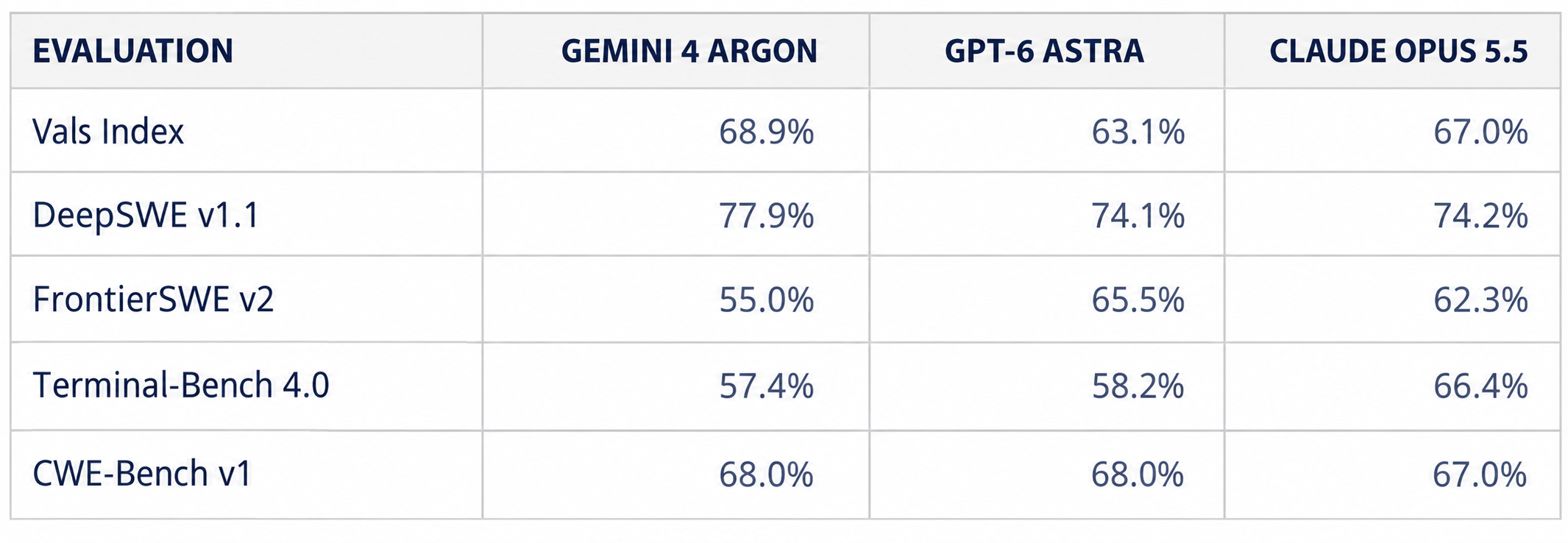
Source: Gemini 4 Argon model card.
These figures show why AI model comparisons should consider individual tasks rather than relying on a single ranking. Argon performs strongly on some listed evaluations but trails competitors on others.
For developers, real-world testing remains essential. Accuracy, cost, speed and reliability may matter more than a model's position on one benchmark.
6. Multimodal AI: Working With Documents, Images, Audio and Video
- Gemini 4 Argon supports multiple input types, allowing developers to build applications around more than text alone.
- Potential applications include reviewing PDF reports, analysing screenshots during debugging, processing supported audio and video inputs, and combining visual information with written instructions.
- This capability is useful in document-heavy business workflows and technical research. However, complex tables, unclear images and ambiguous information can still be misinterpreted.
- Google's model documentation should be consulted for the exact supported input formats and output capabilities.
7. AI Agents and Google Antigravity: Moving Beyond the Chatbot
- AI agents use models and external tools to complete multi-step tasks. Instead of simply explaining how to fix a software bug, an appropriately configured agent may inspect files, propose changes and run tests.
- Gemini 4 Argon's tool-use capabilities can support such applications, while Google Antigravity provides an environment for AI-assisted software development.
- However, agents require appropriate safeguards. Developers should restrict permissions, monitor actions and require human approval for sensitive or irreversible operations.
8. Gemini 4 Argon in Finance, Legal Research and Enterprise Work
Google is targeting knowledge-intensive tasks where large amounts of information must be analysed.
Finance and accounting
Argon can help organise financial data, analyse variations and prepare preliminary reports. Financial calculations and conclusions should be verified before decisions are made.
Legal research and compliance
The model can assist with reviewing documents, finding relevant clauses and preparing summaries. Legal professionals must confirm citations, wording and interpretations.
Healthcare and scientific research
Researchers may use AI to organise literature, analyse data and support technical workflows. Scientific results require validation, while healthcare applications need appropriate privacy and safety controls.
Business operations
Enterprises can explore AI-assisted document processing, internal support and selected workflow automation. Clearly defined tasks with measurable outcomes are usually the best starting point.
9. Cybersecurity: Powerful Defence Capabilities With Additional Controls
Gemini 4 Argon is also positioned for defensive cybersecurity work. AI models can help security teams analyse code, investigate possible vulnerabilities and suggest remediation.
Google says Argon includes safeguards intended to restrict certain harmful cyber activities. It has also announced the Fairwind Program, which provides selected, vetted defenders with access to a version without its typical cyber guardrails.
Potential defensive applications
- Vulnerability discovery: Help investigate weaknesses in software.
- Code remediation: Suggest fixes for insecure implementations.
- Security research: Support authorised vulnerability analysis.
- Secure software development: Assist teams with identifying problems earlier in development.

These capabilities must be used responsibly. Security findings should be independently verified, and testing should take place only in authorised environments.
10. Google's Scientific Research Initiative: Free Antigravity Access for 10,000 Scientists
Google has announced an initiative offering 10,000 scientists six months of free access to the highest usage tier in Google Antigravity, subject to eligibility and selection.
The programme aims to help researchers use AI-assisted development in areas involving data analysis, computational research and scientific software.

Such access could reduce some development bottlenecks, but scientific findings still need appropriate testing, reproducibility and expert review.
11. How to Access Gemini 4 Argon
Access depends on your role and the Google product you use.
For developers
Use Google AI Studio and the Gemini API. The documented model identifier is:
gemini-4-argon
Official documentation: Gemini 4 Argon API.
For general users
Google has announced access through the Gemini app and Search AI Mode for eligible Google AI subscribers. Availability may vary by region and account.
For enterprises
Businesses can explore Google's cloud and enterprise offerings while reviewing data-protection requirements, access controls and pricing.
For coding teams
Eligible subscribers can access Argon through Google Antigravity for AI-assisted development. Developers should evaluate its performance before making it part of their standard workflow.
12. Should Developers and Businesses Switch to Gemini 4 Argon?
Gemini 4 Argon is worth evaluating if your work involves complex coding, large documents, advanced analysis or AI agents.
Before switching, consider five factors:
- Performance: Test the model on real tasks.
- Accuracy: Measure mistakes and human correction requirements.
- Cost: Estimate token usage and future API expenses.
- Security: Limit access to confidential data and critical systems.
- Reliability: Evaluate response quality, speed and consistency.
The best AI model is not necessarily the one with the highest benchmark score. It is the one that meets your workload's requirements at an acceptable cost and risk.
13. Limitations and Risks to Consider
Despite its capabilities, Gemini 4 Argon has limitations:
- Hallucinations: It may generate incorrect information or unsupported conclusions.
- Coding errors: AI-generated software still needs testing and review.
- Agent security: Excessive permissions can expose systems to unnecessary risk.
- Context limitations: A large context window does not guarantee perfect recall or understanding.
- API costs: Long inputs and outputs can increase spending.
- Benchmark differences: Performance varies across tasks and evaluation methods.
- Data governance: Organisations must consider privacy, confidentiality and compliance.
The safest approach is to treat Argon as a powerful assistant that operates within a controlled, verifiable workflow.
14. Gemini 4 Argon and the Future of AI Agents
Gemini 4 Argon reflects a wider shift towards AI systems that can assist with connected tasks rather than simply generate individual responses.
For software teams, this could mean more assistance with debugging, testing and maintaining code. For enterprises, it could support document-heavy processes and selected internal workflows.
However, successful automation depends on more than model capability. Tool permissions, testing, monitoring and human accountability remain essential.
Frequently Asked Questions About Gemini 4 Argon
What is Google Gemini 4 Argon?
Gemini 4 Argon is Google's flagship reasoning model designed for complex coding, analytical tasks, enterprise workflows and AI agent applications.
Is Gemini 4 Argon available to developers?
Yes. Developers can access it through Google AI Studio and the Gemini API, subject to Google's current availability and usage terms.
How much does Gemini 4 Argon cost?
The announced introductory rates are $2 per million input tokens and $10 per million output tokens through November 30, 2026. The published standard rates are $4 and $20, respectively, after that date.
What is the context window of Gemini 4 Argon?
It supports a unified context window of up to 1,048,576 tokens, shared across input, reasoning and output.
Can Gemini 4 Argon write and debug code?
Yes. It is designed to support code generation, debugging, refactoring and multi-step development. Generated code should be tested before production use.
Does Gemini 4 Argon support images, audio and video?
Google documents support for text, images, audio, video and PDFs as inputs. Check the model documentation for specific format and output limitations.
Is Gemini 4 Argon better than competing AI models?
Google's benchmarks show strong results on some evaluations, but performance varies by task. Test competing models against your own requirements before choosing one.
Can Gemini 4 Argon be used for cybersecurity?
It is designed to support defensive security work. Google has also announced controlled access to a version without typical cyber guardrails for selected defenders.
Is Gemini 4 Argon free to use?
API usage is priced per token. Access through Google products depends on subscription eligibility, while the scientific initiative offers selected researchers six months of Antigravity access.
What is Google Antigravity?
Google Antigravity is an AI-assisted development environment designed to support coding agents and more extensive software workflows.
Final Verdict: Is Gemini 4 Argon a Major Step Forward?
Google Gemini 4 Argon is built for complex reasoning, software development and enterprise AI applications. Its large context window, multimodal inputs and tool-use capabilities make it relevant to developers, businesses and research teams.
Its real value will depend on accuracy, security, cost and reliability in everyday use. Developers should test it against existing tools, while businesses should introduce it with clear safeguards and measurable objectives.
The key opportunity is turning advanced AI capabilities into practical, reliable and secure results—not simply adopting the newest model.
Sources and Further Reading
Google: Introducing Gemini 4 Argon
Google AI for Developers: Model documentation